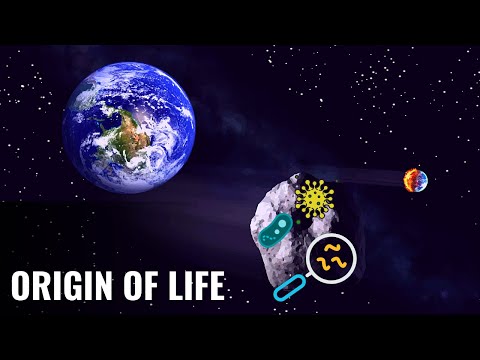
The Panspermia Hypothesis, Explained

The Panspermia Hypothesis, Explained

¿Cómo comenzó la vida en la Tierra?

La diversidad de la vida en la Tierra

  • La vida ha conquistado todos los rincones del planeta, desde las profundidades del océano hasta la atmósfera terrestre.
  • Los dinosaurios son los seres extintos más conocidos, pero la vida apareció mucho antes, hace aproximadamente 250 millones de años.
  • Un cristal de 4 mil millones de años encontrado en Australia ofrece pistas sobre el origen de la vida.

Preguntas fundamentales sobre el origen de la vida

  • La pregunta clave no es "cuándo" comenzó la vida, sino "cómo" se originó y su posible conexión con el universo.
  • Para entender esto, debemos retroceder 4.5 mil millones de años cuando la Tierra era un planeta hostil sin condiciones para albergar vida.

Proceso de abiogénesis

  • Con el tiempo, al enfriarse, se permitió que existiera agua líquida en su superficie, lo que llevó a un proceso llamado abiogénesis.
  • Este proceso describe cómo surgió la vida a partir de materia no viva como compuestos orgánicos simples.

Hipótesis de panspermia

  • Se discute una hipótesis llamada panspermia que sugiere que microorganismos pudieron haber sido transportados a nuestro planeta desde otros lugares del universo.
  • Panspermia implica que hay "semillas" (vida microbiana) distribuidas por todo el universo a través de asteroides o naves espaciales.

Tipos y mecanismos de panspermia

Panspermia interplanetaria e interestelar

  • La panspermia puede ser interplanetaria (vida entre planetas cercanos) o interestelar (vida entre sistemas estelares).

Mecanismos propuestos para panspermia

  1. Radiopanspermia:
  • Propone que organismos fueron impulsados por presión radiativa desde estrellas hasta aterrizar en cuerpos celestes favorables.
  • Sin embargo, este mecanismo ignora el daño potencial al ADN debido a radiación durante viajes prolongados.
  1. Litopanspermia:
  • Sugiere que microorganismos estaban presentes dentro o sobre asteroides y cometas resistentes a las condiciones adversas del espacio.
  1. Panspermia intencional:
  • Propone que una civilización extraterrestre avanzada pudo haber sembrado accidentalmente vida en la Tierra al deshacerse de desechos orgánicos.

Desafíos y consideraciones sobre panspermia

  • Aunque interesante, esta hipótesis enfrenta desafíos; por ejemplo, ¿cómo podría evolucionar rápidamente una forma simple de vida?
  • Hasta los años 70 no se conocían organismos capaces de sobrevivir en el espacio; sin embargo, se descubrieron extremófilos capaces de resistir condiciones extremas.

Reflexiones finales sobre el origen cósmico de la vida

  • Aunque panspermia ofrece respuestas sobre cómo llegó la vida a nuestro planeta, no aborda completamente cómo surgió originalmente en el universo.
Video description

The panspermia hypothesis is one of the several hypotheses in astrobiology that tries to explain the origin of life. Panspermia means "seeds everywhere." According to this hypothesis, life exists elsewhere in the universe and got transported to the Earth via asteroids, planetoids, or even spacecraft. Now Panspermia could be interstellar or interplanetary. As the name suggests, interstellar Panspermia points at the transportation of life between different star systems. In contrast, interplanetary Panspermia refers to the transport of life from the neighboring planets and stars. But, to achieve both these types of Panspermia, three mechanisms have been proposed, each having its own limitation. Let us begin with radio panspermia. It says that radiation pressure from stars propelled microorganisms through space until they reached an object to land upon. After the organisms landed on a site favorable to their existence, they developed into more extensive forms of life. But radiopanspermia ignores one critical fact. Due to the long exposure of bacteria to radiation during interplanetary travel, DNA or RNA would get extensively denatured and reduce any chances of successful Radiopanspermia to almost zero. This limitation brings us to the second mode of Panspermia, which is Lithopanspermia. To save the microorganisms from getting damaged by harmful cosmic radiations, lithospanspermia assumes that microorganisms were present on or in asteroids, comets, and other planetoids. These celestial bodies were large and sturdy enough to withstand planetary ejections, lengthy travels along with powerful atmospheric reentry, thereby carrying out safe transportation of life. The third and perhaps the most exciting mode of Panspermia is intentional Panspermia. As per this hypothesis, life was intentionally implanted on Earth by an advanced extraterrestrial civilization, or maybe it was merely an accident! It is possible that the advanced civilization was not intending to populate Earth with living organisms. Instead, it was only disposing of its organic waste that accidentally landed on planet Earth, thereby leading to life on Earth. In the 1970s, researchers discovered an exotic set of microorganisms that existed in the depths of the Galapagos Rift. They required only water and energy synthesized from the oxidation of reactive chemicals found in Earth's soil to exist. Also known as extremophiles, these microorganisms developed cysts and spores to protect and shield themselves when exposed to high stress like gamma radiations and extreme temperatures. This has again hinted at the credibility of the Panspermia hypothesis! Although Panspermia provides a satisfactory answer to the possible origin of life on Earth, it doesn't address the fundamental question of the origin of life in this universe. It only explains how life knocked on the doors of our planet. From a cosmic point of view, the origin of life is still a mystery.

The Panspermia Hypothesis, Explained | YouTube Video Summary | Video Highlight