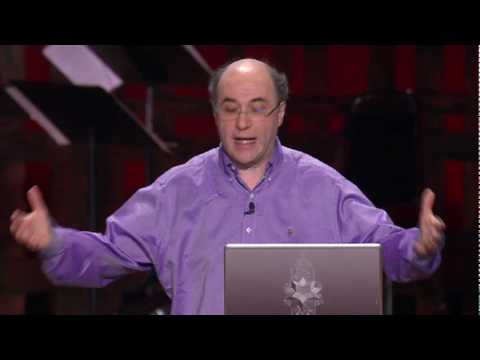
Computing a theory of everything | Stephen Wolfram
The Idea of Computation
In this section, the speaker introduces the idea of computation and its significance in the past century. They explain that computation is a deep and powerful concept with far-reaching effects beyond computer technology.
The Significance of Computation
- The idea of computation is considered to be one of the biggest ideas that has emerged in the past century.
- Computation has led to advancements in computer technology, but its scope goes beyond that.
- It is a fundamental and powerful concept whose full potential is yet to be realized.
Three Projects on Computation
The speaker discusses their personal journey working on three large projects related to computation. They highlight their exploration of computations, building Mathematica, and pouring ideas into it over the years.
Personal Journey with Computation
- The speaker started as a physicist using computers as tools and then delved deeper into understanding computations.
- They aimed to automate computations by identifying primitive elements and creating a structure based on symbolic programming.
- This led to the development of Mathematica, which has been continuously enhanced for 23 years.
- Mathematica has had positive impacts in research and development (R&D), education, and various other fields.
Exploring the Computational Universe
The speaker shares their motivation behind building Mathematica - exploring the computational universe. They introduce programs as typically being built for specific purposes but raise questions about the space of all possible programs.
Programs and Their Possibilities
- Programs are usually seen as complex entities designed for specific tasks.
- However, there exists a vast space of all possible programs that can be explored.
- By running simple programs with different rules repeatedly, intricate patterns with regular structures can emerge.
- This raises questions about what else can happen in the computational universe.
Cellular Automata and Rule 30
The speaker conducts a mathematical experiment using cellular automata to explore different program behaviors. They focus on rule number 30, which exhibits interesting and unexpected patterns.
Cellular Automata Experiment
- The speaker runs all possible programs of a specific type called cellular automata.
- While most programs exhibit simple behavior, rule number 30 stands out with intriguing patterns.
- Rule number 30 produces complex outcomes that challenge intuition and require a new kind of science for understanding.
A New Kind of Science
The speaker introduces their concept of a new kind of science that goes beyond traditional mathematics-based science. They discuss how this new science helps explain the complexity observed in nature and raises questions about predictability and controllability.
A Paradigm Shift in Science
- Traditional mathematics-based science has been limited in explaining the complexity observed in nature.
- The speaker's new kind of science provides a more general framework for understanding complex phenomena.
- It reveals that nature samples from the computational universe, leading to intricate patterns like Rule 30.
- This paradigm shift has implications for the limits of science, predictability, intelligence, free will, and technology.
Systematizing Knowledge with Computation
The speaker discusses their interest in systematizing knowledge using computation. They share their initial assumption that replicating an entire brain would be necessary but then realize that their scientific paradigm offers a different approach.
Systematizing Knowledge
- The speaker had always wanted to systematize knowledge and make it computable.
- Initially, they believed replicating an entire brain would be required for progress.
- However, their scientific paradigm suggests an alternative approach using computation capabilities like Mathematica.
- They aim to explore and utilize the systematic knowledge available in the world.
Conclusion
The speaker introduces the idea of computation as a significant concept with vast potential. They discuss their personal journey, the exploration of the computational universe, and the emergence of a new kind of science. The implications of this paradigm shift are far-reaching, impacting various fields and raising profound questions about predictability, intelligence, and technology.
Introduction and Easy Start
The speaker introduces the topic and explains that they will start with something easy.
- The speaker suggests starting with an easy task.
- They express hope for a successful outcome.
Asking Questions about Real World Data
The speaker discusses asking questions about real-world data using Wolfram Alpha.
- The speaker proposes asking a question about the GDP of Spain.
- They mention computing the ratio of Spain's GDP to Microsoft's revenue as an example.
- Wolfram Alpha is capable of using available public health data to answer health-related questions.
- The speaker gives an example of asking about the International Space Station, which Wolfram Alpha can compute in real-time.
Expanding Knowledge Coverage and Goals
The speaker explains that Wolfram Alpha aims to be an authoritative source in all areas by democratizing knowledge.
- Wolfram Alpha has extensive coverage of various subjects found in standard reference libraries.
- The goal is to go beyond current coverage and become a comprehensive knowledge resource.
- Wolfram Alpha aims to provide fresh answers based on built-in knowledge rather than relying on pre-existing information from others.
- Developing Wolfram Alpha involves curating vast amounts of facts and data from different sources.
Challenges and Computing Methods
The speaker discusses the challenges faced in developing Wolfram Alpha, including implementing computational methods and models.
- Curating facts and data is just the beginning; answering specific questions requires implementing various methods, models, algorithms, etc.
- Mathematica code plays a significant role in building Wolfram Alpha, with approximately 8 million lines of code written by experts from different fields.
Understanding Human Language Input
The speaker talks about understanding human language input as a crucial aspect of Wolfram Alpha.
- Wolfram Alpha allows users to ask questions using ordinary human language.
- Initially, the speaker believed understanding such input would be impossible.
- New ideas from studying the computational universe and having computable knowledge have revolutionized language understanding.
Coevolution with Users and Future Expansion
The speaker discusses the coevolution between Wolfram Alpha and its users, as well as future plans for expansion.
- The usage of Wolfram Alpha has led to learning and improvement in its capabilities.
- Currently, more than 80% of web queries are successfully handled on the first attempt.
- Wolfram Alpha's technology will be integrated into more platforms, including private knowledge for individuals and companies.
Knowledge-Based Computing vs. Raw Computation
The speaker introduces knowledge-based computing as a new paradigm enabled by Wolfram Alpha.
- Wolfram Alpha provides a new kind of computing called knowledge-based computing.
- Knowledge-based computing leverages vast built-in knowledge to change the economics of delivering computational solutions.
Contrasting Mathematica and Wolfram Alpha
The speaker compares Mathematica's precise formal language with Wolfram Alpha's natural language processing capabilities.
- Mathematica offers precise programming capabilities with a formal language for specific tasks.
- In contrast, Wolfram Alpha understands natural language input and provides broader computational functionality.
Due to the length of this section, it is split into two subtopics.
Trivial Piece of Mathematica Programming
- A simple example demonstrates basic Mathematica programming.
Integrating Different Capabilities in Mathematica
- A more complex program showcases various algorithmic operations and user interface creation using Mathematica.
The Power of Wolfram Alpha
In this section, Stephen Wolfram discusses the potential of Wolfram Alpha to democratize programming and enable users to express their queries in plain language. He explains how Wolfram Alpha can understand vague input and generate precise code examples to help users build complex programs.
Democratizing Programming with Wolfram Alpha
- Users can give vague input and let Wolfram Alpha figure out what they mean.
- Wolfram Alpha can determine the specific pieces of code needed to fulfill user requests.
- Examples are provided to help users build up bigger and more precise programs.
- Sometimes, Wolfram Alpha can immediately provide a complete program for computation.
Harnessing the Computational Universe
- The computational universe offers an infinite supply of programs.
- The challenge is to utilize these programs for human purposes.
- Simple programs like Rule 30 can serve as randomness generators.
- Other simple programs model natural or social processes.
- Algorithms discovered through searching the computational universe are integrated into tools like Wolfram Alpha and Mathematica.
Mass Customized Creativity
- The computational universe enables mass customized creativity.
- Applications like Wolfram Alpha could perform invention and discovery on the fly, generating unique and innovative solutions that traditional engineering or incremental evolution may not produce.
Exploring the Computational Universe
Stephen Wolfram explores the possibility of finding our physical universe within the computational universe. He discusses how simple rules in the computational universe can lead to complex behavior, raising questions about whether our own universe operates based on similarly simple rules.
Simple Rules in a Complex Universe?
- In the computational universe, incredibly simple rules can produce rich and complex behavior.
- Could our physical universe be governed by similarly simple rules?
- Physics history suggests that the rule for our universe is likely complicated, but computational exploration challenges this assumption.
Candidate Universes and Computational Irreducibility
- The computational universe contains candidate universes with simple rules that reproduce special relativity, general relativity, gravitation, and hints of quantum mechanics.
- Discovering the rule for our universe is a challenging task due to computational irreducibility.
- Serious candidates for our universe are difficult to analyze and determine if they match our physical universe.
The Quest for the Rule of Our Universe
- Despite the challenges, efforts are being made to find the rule for our universe within the computational universe.
- Building technology and organizing a comprehensive structure are necessary steps in this endeavor.
- Collaboration, open participation, and offering incentives like prizes may be part of the approach.
The Ultimate Goal: Theory of the Universe
Stephen Wolfram expresses his commitment to finding the theory of the universe within this decade. He discusses the potential impact of achieving this goal and envisions a future where we can input "the theory of the universe" into tools like Wolfram Alpha.
A Decade to Discover
- The ultimate goal is to hold in our hands the rule for our universe within this decade.
- Finding the theory of the universe is an ambitious project requiring significant technological advancements.
- Organizational strategies such as building teams, fostering collaboration, and offering prizes may be employed.
Unveiling Our Universe's Rule
- Discovering the rule for our universe would provide insights into its position among all possible universes.
- Tools like Wolfram Alpha could potentially incorporate this knowledge, allowing users to explore "the theory of the universe."
This summary provides an overview of key points discussed by Stephen Wolfram in his talk. It is important to refer back to the original transcript or video for complete context and understanding.
The Power of Computation
In this section, Stephen Wolfram discusses his experience working on the idea of computation for over 30 years and emphasizes the increasing power and potential of computation in various fields.
The Significance of Computation
- Wolfram has been involved in building tools and methods for computation for more than 30 years.
- Computation has proven to be a powerful concept that has led to significant advancements.
- Wolfram believes that computation will continue to play a crucial role in shaping the future, from scientific foundations to technological limits and even defining the human condition.
Integration with Fundamental Explanations
In this section, Chris Anderson asks Stephen Wolfram about how computational thinking can integrate with fundamental explanations of the universe, such as string theory or other theories in physics.
Relationship with String Theory
- Wolfram mentions that attempts have been made to connect computational thinking with string theory, which aims to explain the standard model of physics.
- While there may be some similarities between his work and string theory, it is still uncertain how they will ultimately align mathematically.
Complexity and Benoit Mandelbrot's Work
In this section, Chris Anderson asks Stephen Wolfram about the relationship between his work on complexity and Benoit Mandelbrot's contributions.
Connection with Benoit Mandelbrot's Work
- Wolfram acknowledges Benoit Mandelbrot's work as foundational in understanding complexity.
- Mandelbrot's focus on nested patterns and fractals aligns with Wolfram's exploration of complexity through cellular automata like Rule 30.
- Both approaches contribute to understanding different levels of complexity.
Capabilities of Complexity
In this section, Stephen Wolfram discusses the capabilities and limits of complexity.
Exploring Complexity
- Wolfram suggests that certain systems, like the Rule 30 cellular automaton, can exhibit complexity at its highest level.
- These systems have the potential to reach a level of complexity that cannot be surpassed.
The transcript provided does not contain any further sections or timestamps.
Turn any video into a summary like this
YouTube links, meetings, lectures. With transcripts, search, and chat.