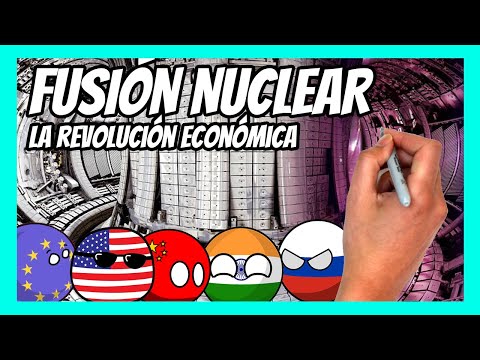
✅ ¿Qué es la FUSIÓN NUCLEAR y por qué es tan importante? | Todo lo que hay que saber en 10 minutos
What is Nuclear Fusion and Its Potential?
Understanding Nuclear Fusion
- Nuclear fusion is a process where multiple atomic nuclei combine to form a larger nucleus, releasing an enormous amount of energy under specific conditions.
- The energy released in fusion reactions is significant, but achieving the necessary high temperatures and pressures on Earth has proven challenging.
- For decades, humans have been working to replicate these extreme conditions in small-scale fusion reactors, yet previous attempts required more energy input than output.
The Importance of Continued Research
- Despite past failures to achieve net positive energy from fusion, ongoing research remains crucial due to its potential for providing nearly limitless clean energy without greenhouse gas emissions or nuclear waste.
- If successful, nuclear fusion could drastically reduce reliance on fossil fuels and traditional nuclear power sources, accelerating decarbonization efforts globally.
Implications of Successful Fusion Energy
- A breakthrough in commercial nuclear fusion would lead to a significant shift in global energy dynamics, potentially rendering fossil fuel and conventional nuclear sources obsolete.
- Countries that successfully implement fusion technology could gain substantial economic advantages while reducing geopolitical tensions related to energy dependence.
Challenges Ahead
- While advancements are being made in fusion research by major powers, the path to practical implementation remains uncertain; many hurdles still need addressing before widespread use can occur.
- Enhanced capabilities in nuclear technology may also lead to improvements in military deterrence among nations rather than increased conflict.
Recent Developments at Lawrence Livermore National Laboratory
- The recent experiment at Lawrence Livermore achieved a milestone where the energy produced (2.5 megajoules) exceeded the input (2.1 megajoules), marking progress toward viable fusion.
- However, this achievement requires caution as it involved feeding 300 megajoules into lasers for the reaction; thus, true net gain remains elusive.
Future Prospects of Fusion Technology
- Although there’s excitement surrounding these developments, experts caution against overestimating timelines for commercial reactors; practical applications may take longer than anticipated.
Fusion Energy: A Global Endeavor
Overview of Inertial Fusion and Magnetic Confinement
- The experiment utilizes inertial fusion, a protocol employing high-power lasers to implode nuclei, contrasting with other active experiments using magnetic confinement reactors.
- The ITER project (International Thermonuclear Experimental Reactor) is highlighted as a collaborative effort among multiple countries, including the EU, China, India, the USA, Japan, South Korea, and Russia.
ITER Project Details
- The construction of ITER in France is projected to cost €24 billion, aiming to demonstrate the scientific and technical viability of nuclear fusion. However, conclusive results are not expected until at least 2050.
Private Sector Initiatives in Fusion Research
- Notable private companies like Helion Energy and General Fusion are pursuing fusion energy solutions where governmental efforts have stalled.
- Other startups funded by prominent figures such as Jeff Bezos include CFS, Tokamak Energy, and Offer Slide, although none are publicly traded yet.
China's Advancements in Nuclear Technology
- A leading Chinese scientist predicts that China will operate a fusion power plant by 2035, indicating significant progress in this field.
Nuclear Fission's Role in Energy Transition
- The transition towards renewable energy increasingly relies on nuclear energy; fossil fuels are being phased out while fission becomes crucial for future energy strategies.
- Both the USA and China lead globally with 96 and 50 nuclear reactors respectively; ambitious plans exist for expanding their nuclear capabilities significantly by mid-century.
Interconnection Between Fission and Fusion Research
- France generates about 70% of its electricity from fission reactors. Ongoing research in both fission and fusion could yield advancements beneficial to each technology.
Future Outlook on Nuclear Energy
- Nuclear energy is poised to play a vital role moving forward; whoever successfully commercializes fusion may dominate global energy markets.
Challenges Ahead for Fusion Energy Implementation
- While there’s optimism surrounding fusion as a solution to climate crises, reliance solely on it would be naive. Current renewable technologies like wind and solar are more likely to provide immediate emission reductions before practical fusion solutions emerge.