Media, mediana y moda | Datos agrupados en intervalos Ejemplo 1
New Section
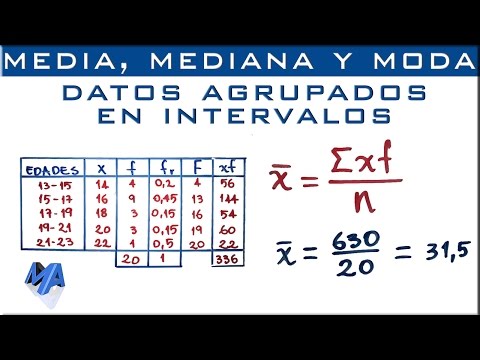
In this section, the instructor introduces the concepts of mean, median, and mode for grouped data intervals using a table with age intervals, class marks, absolute frequencies, and cumulative absolute frequencies.
Finding the Mean for Grouped Data
- The mean is calculated using the formula Σ(x*y)/Σf.
- Understanding statistical equations like Σx*y and Σf is crucial in calculations.
- Explaining how to find Σ(x*y) by multiplying class marks with absolute frequencies.
- Creating a new column for xyf when it's not present in the table.
- Demonstrating multiplication of class marks by absolute frequencies to fill the new column.
New Section
This part focuses on calculating the mean for grouped data by summing up xyf and dividing by total frequency or number of data points.
Calculating the Mean
- Continuing multiplication of class marks with absolute frequencies to complete calculations.
- Substituting values into the mean formula: (Σ(xy))/n or (Σ(xy))/(Σf).
- Discussing how to interpret results as an average age based on calculations.
New Section
Exploring further into understanding mean, median, and mode for grouped data intervals through practical examples and formulas.
Understanding Median Calculation
- Encouraging viewers to watch previous videos explaining mean, median, and mode for ungrouped data before proceeding.
- Defining median calculation methods for both odd and even numbers of data points.
- Demonstrating locating the middle value in a dataset with even numbers of observations.
New Section
Delving into finding the median for grouped data intervals through cumulative frequency distributions and interpolation techniques.
Median Calculation Continued
- Locating the position of the middle value within cumulative frequency distributions.
New Section
In this section, the speaker explains the concept of lower limit and division of data for further calculations.
Understanding Lower Limit and Data Division
- The lower limit is identified as the number present in the given context, which in this case is 15.
- Data division involves dividing the number of data points by 2, where the total number of data points is represented by 20.
- Calculations involve subtracting the cumulative absolute frequency from half of the total data points (20) to determine a specific value.
New Section
This part delves into calculating cumulative absolute frequency and its implications on subsequent computations.
Calculating Cumulative Absolute Frequency
- Cumulative absolute frequency is computed by subtracting one from the sum of absolute frequencies.
- The previous cumulative absolute frequency (4) plays a crucial role in determining subsequent values.
- Understanding distinctions between uppercase and lowercase representations in formulas aids accurate calculation processes.
New Section
Exploring the significance of amplitude in statistical calculations and its relationship with upper and lower limits.
Significance of Amplitude
- Amplitude signifies the difference between upper and lower limits within a dataset.
- Accurate computation involves subtracting the lower limit from the upper limit to derive amplitude values.
- Emphasizing clarity on uppercase versus lowercase notation ensures precision in statistical calculations.
New Section
Demonstrating step-by-step calculations involving amplitudes, divisions, and subsequent operations for statistical analysis.
Step-by-step Calculation Process
- Detailed computations include dividing 20 by 2 to obtain 10, followed by subtracting previous frequencies to derive new values.
- Multiplication steps are illustrated with clear explanations to facilitate understanding.
- Final results are obtained through systematic arithmetic operations for each stage of calculation.
New Section
Determining median value through calculated steps while emphasizing accuracy in mathematical procedures.
Calculating Median Value
- Sequential operations involve adding, dividing, multiplying, and summing up values to ascertain the median figure accurately.
- Ensuring precision at each computational stage leads to obtaining an accurate median value (16.33 years).