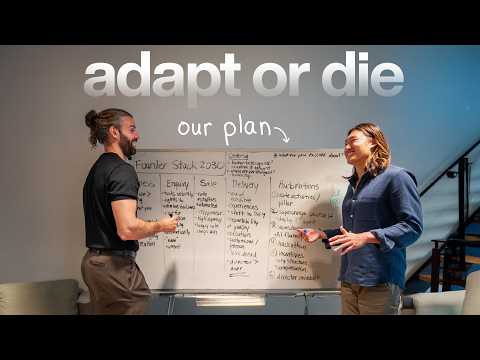
what makes you irreplaceable when AI kills most businesses?
The Future of Business in the Age of AI
The Impact of AI on Businesses
- Businesses are facing existential threats due to rapid advancements in AI technology, with many founders expressing concern about their viability as one-person operations can disrupt established models.
- Founders generating over $30 million annually are particularly anxious about competition from small teams leveraging AI agents to innovate and transform business practices.
Mapping the Founder Stack for 2030
- A discussion is initiated on five core areas: awareness, inquiry, sales, delivery, and automation that will define the founder stack by 2030.
- Emphasis is placed on identifying where human creativity and taste are essential while delegating other tasks to AI systems.
Understanding Taste in Entrepreneurship
- Successful founders must leverage their unique insights and creative instincts—termed "taste"—to differentiate themselves in a crowded market.
- The concept of taste is explored through a dual lens: the creative (right brain) aspect representing personal expression and the analytical (left brain) side focusing on market insights.
The Role of Awareness in Building Brands
- Awareness is highlighted as crucial for building a profitable founder-led brand; distribution has become a key competitive advantage that cannot be replicated easily.
- Founders should focus on their unique strengths while utilizing AI tools to handle less critical tasks like editing or analytics to enhance content quality.
Inquiry Stage: Owning Distribution
- Owning distribution channels such as email lists mitigates platform risks associated with reliance on social media giants for audience engagement.
- Future inquiry processes may involve automated agents optimizing landing pages and conversion rates through continuous testing and learning from user interactions.
Sales Evolution by 2030
- There’s speculation about the future role of salespeople; while bad salespeople may disappear, effective ones will need to adopt an entrepreneurial mindset to thrive amidst automation changes.
- High-ticket sales will still require human interaction due to trust factors, but routine tasks within sales processes will increasingly be automated by AI technologies.
Enhancing Delivery Through Automation
- Delivery remains a challenging area for many founders; however, integrating AI into customer success roles can streamline onboarding and improve service quality significantly.
- As delivery processes become more efficient through automation, entrepreneurs can focus more on enhancing customer experiences rather than operational details like coding or project management tasks.
The Challenges of Scaling and Customization
Understanding the Complexity of Scaling
- As systems scale, they encounter numerous edge cases that complicate operations, making it difficult to address every issue due to limited resources.
- AI enables customization at a granular level, allowing individual founders to create solutions that can cater to millions while maintaining personalization.
Shifting Mindsets: From Doers to Directors
- Success in the new paradigm requires a shift from being a doer to becoming a director and decision-maker, focusing on strategic oversight rather than execution.
- Time and energy are finite resources; effective leaders must prioritize high-value tasks over routine work.
Navigating the Future as Founders
Adapting Business Strategies
- Founders need to understand how customer journeys will evolve and recognize distribution as a competitive advantage.
- With automation on the rise, it's crucial for founders to rethink their roles and take actionable steps today.
Core Steps for Immediate Action
- Acknowledging both excitement and fear about future opportunities is essential; focus should remain on current actions that can be controlled.
- Founders should map out their business processes across four key quadrants (awareness, inquiry, sale, delivery).
Automating Processes for Innovation
Identifying Low-Value Tasks
- To foster innovation, founders must first eliminate undesirable tasks by mapping workflows and identifying areas for automation.
- Deploying automations can free up time for more strategic activities that drive growth.
Supercharging Teams with AI
- Once mundane tasks are automated, teams can leverage AI tools to enhance productivity and creativity in content creation.
Cultivating an AI-Fluent Culture
Building Team Competence in AI
- It's vital for organizations to embrace AI fluency culturally; this involves training teams on new technologies through initiatives like hackathons.
- Encouraging team members to share innovative projects fosters collaboration and inspires others within the organization.
Incentivizing Innovation Within Organizations
Structuring Incentives Effectively
- To harness entrepreneurial spirit within teams, companies must create structures that allow employees time and autonomy for innovative projects.
Balancing Organizational Needs with Individual Aspirations
- Leaders face decisions about resource allocation when promising ideas emerge; empowering individuals is crucial for fostering innovation.
Embracing Change in an Exciting Era
The Dual Nature of Current Times
- The present moment is characterized by complexity but also offers unprecedented opportunities for innovation in business practices.