What Makes Trade Setups Low Odds? Trapped Order Flow
Introduction and Non-Farm Payroll
The speaker discusses the non-farm payroll release and its impact on trading. They mention that they usually refrain from engaging in trades on this day due to increased uncertainty.
Euro Dollar Price Action Analysis
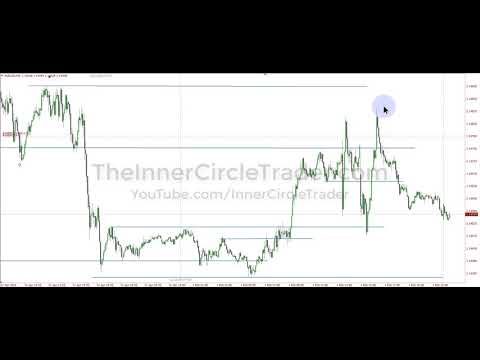
- The speaker highlights a segment of price action that demonstrates trapped order flow, where the market fails to move significantly higher or lower.
- Trapped order flow is caused by specific price points that create difficulties for price movement.
- Understanding when the market is less likely to move can help identify areas of low resistance and potential profitability.
High Resistance Liquidity Runs
- Liquidity runs with high resistance are characterized by a lot of adversity in bullish conditions and a lot of support in bearish conditions.
- The trapped order flow on Friday was framed by two reference points with smaller fractal patterns within larger patterns, creating additional trapping mechanisms.
Breakers and Order Flow
- The larger bullish ICT breaker acts as a reference point for sell-side liquidity below it, while the bearish ICT breaker represents buy-side liquidity above it.
- Price movements between these breakers indicate a back-and-forth tug-of-war for order flow.
Non-Farm Payroll Impact
- The non-farm payroll release on Friday led to meandering price action until the release came out, causing an aggressive drop followed by a rally and subsequent sell-off.
- This indecisive price action coupled with economic calendar events like FOMC-related events or high-impact speakers can create challenges in finding trade opportunities.
Seek and Destroy Type Event
- The speaker explains that the price pattern observed during this period is characteristic of a seek and destroy type event, where every high and low gets taken out subsequently.
- This back-and-forth movement can be frustrating for traders trying to enter long or short positions without taking partial profits.
Entry Framing and Short Position
- The speaker shares their assumption of finding an entry point within the price pattern but ultimately decides to go short based on a breach of the midpoint of an up close candle.
- They highlight the importance of timing and specific candle patterns for making trading decisions.
Conclusion
The speaker concludes by emphasizing the challenges presented by seek and destroy type events, where price movements can be unpredictable and frustrating. They also mention their intention to provide more insights in future discussions.
This summary is based on the provided transcript and has been formatted using markdown language.
New Section
The speaker discusses their trading strategy and the importance of adjusting stop levels. They mention the frustration of being caught in a volatile market and emphasize the need to be on the lookout for certain scenarios. They also explain their reasoning behind entering trades at specific price points.
Adjusting Stop Levels
- Moving stop levels to lower levels is important, even if it results in getting stopped out.
- If the speaker believes that a high point has been reached and the market will roll lower, they are willing to take a 100-pip drop.
- The timing of this drop may not occur immediately but could happen later in the week.
Frustration in Volatile Markets
- Being caught in an environment with frequent ups and downs can be frustrating.
- Buying when the market runs up and then selling short when it takes a short-term high can lead to continuous back-and-forth movements.
- Recognizing this situation early on allows for better decision-making.
Entering Trades at Optimal Points
- Ideally, one should be a seller above old highs and a buyer below old lows.
- Entering trades closer to the middle can result in painful experiences as it may not move in one's favor immediately.
- The speaker entered a trade close to the midpoint of an up-close candle, anticipating that even if they get stopped out, there is unlikely to be a return to that midpoint due to clearing previous highs.
Assumptions and Trade Management
- The speaker acknowledges that their assumptions are based on statistical edges but are still just assumptions until proven right after-the-fact.
- Despite having paper profit, they do not consider themselves right about the trade until it is closed or partially closed with profits taken.
- Their goal is for the Eurodollar trade to move below a certain low point, indicating trapped order flow and potentially leading to further downward movement.
Holding onto Positions
- The speaker wants to hold onto their position, even though they feel uncomfortable about the trade.
- Past experiences have shown that trades that felt uncomfortable often turned out to be profitable.
- They view the current market as still being within a range until it breaks below a specific low point.
Trade Management and Potential Profit
- The speaker plans to take a portion of the trade off below a certain low point and adjust their stop level accordingly.
- If the trade continues to move lower, they will consider taking more profits at subsequent low points.
- Their goal is to achieve a 100-pip move if their assumptions about the market prove correct.
Market Analysis and Participant Behavior
- The speaker believes that by breaking above previous highs, participants who were short or selling were knocked out of the market.
- They anticipate that those participants will not be able to participate in any upcoming upward moves.
- This further strengthens their conviction in holding onto their position.
New Section
The speaker discusses their feelings about the trade and shares insights into how past trades that felt uncomfortable turned out to be profitable. They also analyze the current market situation and express their desire for price action to break below a certain low point.
Uncomfortable Trades
- The speaker admits feeling uncomfortable about the trade both at the time of entry and currently while discussing it.
- Based on past experiences, trades that felt uncomfortable often resulted in missed opportunities for larger profits due to early exits.
Market Analysis and Range Bound Conditions
- The market is still considered range-bound until it breaks below a specific low point.
- There is uncertainty whether price action will continue lower or potentially reverse back towards the top of the range.
Role-Based Idea for Trade Management
- The speaker has a role-based idea where they plan to take some profits off below a certain low point in the market.
- They acknowledge that taking profits at the current moment would only result in a small gain, but they have a larger position size to potentially benefit from.
Technical Analysis and Non-Farm Payroll Price Action
- The recent price action has moved out of the high end of the range defined by non-farm payroll data.
- However, until there is a break below a specific low point, the speaker remains cautious about the likelihood of further downward movement.
New Section
The speaker continues to analyze the current market situation and expresses their thoughts on potential price movements. They discuss their position size and leverage, as well as their technical analysis based on recent price action.
Market Analysis and Potential Price Movements
- The speaker acknowledges that price action is currently stammering around and could potentially move back up towards the top of the range.
- They express uncertainty about whether price will break below a certain low point or reverse higher.
Position Size and Leverage
- The speaker mentions having a relatively small position size with leverage on a demo account.
- They are not overly concerned about being stopped out or making significant gains due to these factors.
Technical Analysis Based on Recent Price Action
- Recent price action has moved out of the high end of the range defined by non-farm payroll data.
- Until there is a break below a specific low point, the speaker remains cautious about potential further downward movement.
Understanding Resistance and Support Levels
The speaker discusses the concept of resistance and support levels in trading.
Importance of Highs and Lows
- When there is a high, followed by a low, and then a higher high, the lower point between the two highs becomes a potential resistance level.
- Resistance levels act as barriers for price movement.
- Classical support levels can also act as resistance when broken.
Range Bound Markets
- In range-bound markets, where there is significant accumulation on one side (buy or sell), the market eventually rebalances.
- Accumulation near a breaker level indicates potential for a breakout.
- Multiple attempts to break above a certain level without success may indicate strong resistance.
Demo Trading vs Live Trading
The speaker explains why they use demo trading for teaching purposes instead of live trading.
Conceptual Teaching Approach
- The speaker teaches concepts rather than focusing on real money trades.
- Building a foundation with live funds can lead to bad habits and poor decision-making due to excessive focus on money.
- Reading price action is emphasized as an important skill to develop.
No 100% Strike Rate
- The speaker acknowledges that losses are part of trading and even they make mistakes at times.
- The goal is not to guarantee profits but to help traders avoid unfavorable market conditions.
- Opposing ideas within trapped ranges indicate uncertainty in the market.
Exiting Range Bound Markets
The speaker discusses the potential outcomes when exiting range-bound markets.
Displacement after Range Breakout
- Once a range-bound market exits its consolidation phase, there is likely to be a significant displacement in price movement.
- This could result in sustained moves of several hundred pips either upwards or downwards.
- It is uncertain whether institutional buying or selling is the driving force behind the breakout.
Analyzing Euro Dollar
- The euro dollar has been in a consolidation phase for months.
- Observing how price action develops after non-farm payroll data can provide insights into potential market direction.
- Resistance levels and equal lows are important factors to monitor for potential breakouts.
Layered Opposing Ideas
The speaker explains the concept of layered opposing ideas in trading.
Bearish Breakers
- The speaker identifies two bearish breakers in the euro dollar chart.
- Breakers occur when price breaks through a short-term high or low, indicating a shift in momentum.
- Layered opposing ideas create uncertainty and require careful analysis.
Timestamps have been associated with relevant bullet points.
New Section
The speaker discusses the emotional and psychological impact of a failing market, emphasizing that traders can no longer tolerate the situation. They mention that the overall market environment appears to be in consolidation.
Market Environment
- The markets are currently trading in trading ranges.
- Price is being held between two breakers.
- One of these breakers will have to give away, leading to easier trading conditions.
- The current market state is characterized by high resistance liquidity runs.
New Section
The speaker continues discussing the market environment and its implications for trading.
Trading Ranges and Liquidity Runs
- Markets are in consolidation, similar to previous instances.
- Traders can observe price being held between two breakers.
- Eventually, one of these breakers will give way, providing an opportunity for easier trading.
- The current market state is marked by high resistance liquidity runs.
Timestamps provided are approximate and may not align exactly with the transcript.
Turn any video into a summary like this
YouTube links, meetings, lectures. With transcripts, search, and chat.