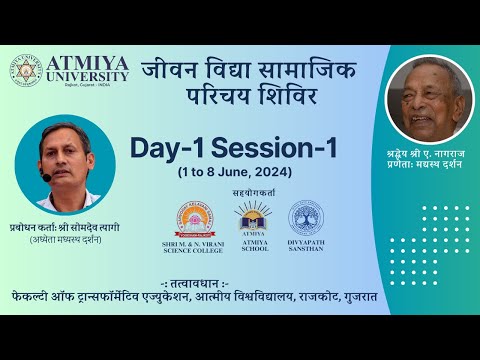
Day - 1 National Level FDP on Humanization of Education and Harmonious Living
Introduction to the Seminar on Happiness and Wellness
Personal Reflections from Participants
- Druti Paneri, a second-year Biochemistry student at Rani Science College, shares her insights gained from a seminar conducted by Shri Som Tyagi on happiness and wellness.
- She reflects on her previous lack of clarity regarding living versus merely existing, realizing that she was pursuing superficial aspects of life instead of true happiness.
- The seminar helped her understand that the key to happiness is simpler than she thought; it’s often complicated by our own actions and mindset.
- Druti emphasizes the significant impact of mindset on life outcomes, noting that education alone does not determine success; a positive mindset is crucial for progress.
- She highly recommends attending this seminar for anyone seeking clarity in their thoughts about wellness and relationships.
Additional Participant Insights
- Katesh Pankaj expresses gratitude for the seminar, highlighting its focus on self-control and personal responsibility in relationships.
- He mentions the importance of love and connection with others as essential elements discussed during the event.
Inauguration Ceremony Highlights
Acknowledgments and Rituals
- Saloni Kundaliya begins by paying homage to revered figures like Shri E. Nagaraj Ji during the inauguration ceremony.
- The ceremony includes floral tributes to spiritual leaders such as Hari Prasad Swami Maharaj, emphasizing respect for tradition.
Significance of Knowledge
- The speaker discusses how knowledge acts as a guiding light against ignorance, akin to a lamp dispelling darkness.
Understanding Life Vidya (Knowledge)
Purpose of Life Vidya
- The concept of Life Vidya aims to foster peace within individuals, families, and society while promoting qualitative changes in life experiences.
- It emphasizes establishing balance with nature through understanding coexistence principles among self, society, and nature.
Core Concepts Introduced
Life Vidya Camp Overview
Introduction to Life Vidya and Transformative Education
- The concept of Life Vidya has been introduced to children since 20146, with opportunities for PhD studies in Mediated Philosophy being offered by the university.
- The establishment of the School of Consciousness Development under the Faculty of Transformative Education aims to implement value education across various educational institutions in India.
Significance of the Eight-Day Camp
- The eight-day Life Vidya Social Introduction Camp is a significant initiative by Atmiya University, marking its first effort to reach out to society.
- A diverse group of 185 participants from various societies and states have joined this camp, indicating strong community engagement and interest.
Contributions and Background of Key Figures
- Som Bhaiya has played a crucial role in promoting Life Vidya over the past 30 years without any financial expectations, contributing significantly to its outreach across India.
- He has conducted over 200 workshops on topics like Happy Marriage and Parenting across multiple states including Delhi, Uttarakhand, Uttar Pradesh, Chhattisgarh, Gujarat, Maharashtra, etc.
Personal Journey and Philosophy
- Som Bhaiya's background includes engineering studies at Y.C.C. College Nagpur and experience working at multinational companies like Tata Nelco; he has dedicated his life to practicing and teaching Life Vidya principles.
- His commitment reflects a deep understanding of life's universal goals while striving to improve society as if it were his own home.
Workshop Structure and Expectations
- The camp will feature sessions in both Hindi and Gujarati led by knowledgeable facilitators such as Jay Bhaiya from Atmiya University.
- Participants are encouraged to engage actively during sessions; volunteers are available for assistance throughout the workshop.
Addressing Societal Challenges
- The workshop aims to provide new perspectives on common societal issues faced today, such as relationship dynamics that weaken over time despite increased material comforts.
- Participants will explore solutions for personal dilemmas related to career choices versus life satisfaction through guidance from facilitators Somdev Tyagi Ji and Jay Bhaiya.
Registration and Attendance Process
Overview of Registration
- Attendees are instructed to use the main entrance for registration and refreshments, which will be arranged at that location.
- The attendance sheet for the FDP (Faculty Development Program) is available at the front desk on the right side.
Instructions for Attendance
- Participants are encouraged to sign in and mark their attendance upon arrival.
- Acknowledgment of attendees who have taken time off from their schedules for this eight-day program.
Expectations from the Program
Aspirations of Participants
- The speaker acknowledges that participants may have specific expectations or hopes for personal growth during these eight days.
- Emphasis on the importance of listening attentively to facilitate meaningful change in one's life.
The Importance of Listening
Learning from Experience
- A story about a past experience with a Tibetan Prime Minister highlights the significance of sincere listening during sessions.
- The Prime Minister's commitment to not wasting any time during discussions showcases dedication to learning.
Cultural Insights
- The speaker reflects on how traditional teachings emphasize unconditional listening, allowing participants to grasp concepts without preconceived notions.
Engagement During Sessions
Interactive Learning Approach
- Encouragement for participants to listen fully before questioning, promoting a more profound understanding of content discussed.
- Acknowledgment that modern education often encourages constant questioning, suggesting a balanced approach is necessary.
Questioning and Reflection
Addressing Queries
- Participants are advised to jot down questions throughout the program, ensuring they can track unanswered queries over the eight days.
Success Measurement
- The ultimate goal is for each participant to feel they gained more than what they initially expected from the program.
Connecting Concepts Over Time
Holistic Understanding
- Discussion on how intensive programs help connect various ideas and insights into a cohesive understanding applicable in daily life.
Challenges in Communication
Barriers to Effective Listening
- Recognition that religious backgrounds can sometimes hinder open communication; thus, clarity in discussions is essential.
A Unique Educational Model
Exemplifying Collaboration
Understanding the Nature of Truth and Existence
The Distance Among People
- The speaker reflects on the apparent distances among people, even when they are physically together, questioning how humanity can work collectively for the greater good.
Models of Understanding Atoms
- Various models of atoms (e.g., Thomson model, Rutherford model) illustrate attempts to understand a singular truth. Each model represents an effort to uncover aspects of a single reality.
- The discussion raises questions about the continuity of models: once a complete understanding is achieved, will new models continue to emerge?
Recognition and Continuity in Knowledge
- Once we fully recognize something (like water's role in quenching thirst), it becomes stable knowledge that does not change frequently.
- Ongoing efforts are made to understand things that remain unclear or contextually relevant; this includes our understanding of homes, clothing, roads, and vehicles.
Universal Laws and Their Implications
- The speaker asserts that existence operates under universal laws accepted by all educated individuals. These laws apply universally across different contexts.
- Regardless of location (e.g., Earth vs. Mars), fundamental atomic structures remain consistent; thus, universal truths exist beyond specific circumstances.
Religion and Philosophy as Models
- Despite diverse religions and philosophies, there exists a singular truth that manifests differently across cultures—similarities in human anatomy highlight this commonality.
- All humans desire respect and fulfillment regardless of their religious or cultural backgrounds; this shared aspiration transcends differences.
Seeking Freedom from Lack and Fear
- Humans universally seek liberation from scarcity and fear while striving for happiness—a natural inclination present across all societies.
Nature’s Consistency in Rules
- Natural laws govern both physical entities (like animals' dietary habits) and human desires; these rules are consistent throughout existence.
Acknowledging Existence Beyond Humanity
- The speaker emphasizes that existence predates humanity; nature operates under its own set of rules independent of human presence.
Clarity Amidst Contradictions
Understanding the Nature of Truth and Human Progress
The Concept of Truth Across Cultures
- The speaker discusses how truth can be perceived through the lens of religion, suggesting that it varies across different cultures, religions, and times.
- It is emphasized that there has been a continuous effort to unveil a singular truth throughout history, leading humanity from primitive times to modern discussions on equality between genders and among humans.
Acknowledging Historical Figures
- The journey from primitive existence to contemporary society is credited to great individuals who recognized deeper truths about human existence beyond mere physicality.
- The speaker reflects on ancient wisdom that suggested humans are not just bodies but possess an essence that transcends physical life, which remains relevant today.
Respecting Tradition and Knowledge
- There is a call for respect towards ancient traditions and knowledge systems that have identified essential truths about human nature long before modern challenges arose.
- Gratitude is expressed towards those who dedicated their lives to uncovering truths about humanity and the universe, allowing current generations to engage in meaningful discussions.
Universal Laws and Their Constancy
- The discussion highlights that if universal laws exist, they are unchanging across time and space; this constancy forms the basis of various philosophies and religions.
- Different cultural expressions may vary (language, customs), but the core truths remain unchanged despite these differences.
Practical Applications in Education
- Personal experiences with educational practices reveal a desire for practical results in societal change through education based on traditional values.
- Emphasis is placed on preparing young individuals with both skills for employment and mental well-being as part of their education.
Addressing Modern Challenges Through Education
- There’s a recognition of the need for holistic education that nurtures both intellectual capabilities and emotional health in students.
- Successful experiments in educational reform across various governments demonstrate positive outcomes when integrating these principles into schooling systems.
Bridging Divides Among Humanity
- As societies evolve, there’s an acknowledgment of divisions based on religion or ethnicity; however, understanding universal truths can help bridge these gaps.
- The speaker stresses the importance of listening deeply to one another's perspectives to foster unity amidst diversity.
Evolving Understanding of Spirituality
- Historical attempts by great figures to reveal deeper truths continue today as society seeks qualitative changes within humanity beyond religious or spiritual frameworks.
- There's an argument made for initiating education early in life—starting even before birth—to instill positive values from conception onward.
Understanding the Essence of Philosophy and Existence
The Universal Truth in Philosophies
- The speaker emphasizes that all philosophies, regardless of their origin or religious context, aim to unveil a singular truth about existence. This middle path philosophy is another attempt to reveal this core truth.
The Pursuit of Peace and Understanding
- The discussion revolves around how individuals seek peace and liberation from fear and scarcity through understanding various philosophies and religions. This quest for tranquility drives people to engage in discussions and workshops.
Continuation of Philosophical Exploration
- As long as humanity has not achieved its goal of peace, the exploration of different philosophies will persist. If current philosophical approaches fail to provide answers, new ones will emerge.
Practical Application in Daily Life
- The speaker suggests that true understanding manifests through actions within families, societies, education systems, and governance. A peaceful life leads to trust in the pursuit of knowledge.
Overcoming Internal Conflicts
- Viewing different religions and philosophies as either 'us' or 'them' creates internal contradictions that hinder personal growth. Negative thoughts can obstruct qualitative changes in life.
Collective Human Progress
- All religions and philosophies are seen as efforts to elevate humanity from primitive states to higher consciousness. Middle path philosophy is highlighted as a significant step towards this evolution.
Education's Role in Cultivating Conduct
- There’s an emphasis on integrating ethical conduct into educational frameworks so that professionals like engineers or doctors can embody these values effectively.
Gratitude Towards Spiritual Leaders
- A heartfelt acknowledgment is given to spiritual leaders for transcending boundaries to honor universal truths related to humanity's essence.
Nature of Universal Truth
- The speaker asserts that existence operates under complete laws which are universal; thus, they should be logical, understandable, and applicable across contexts.
Mechanisms for Understanding Truth
- Three powerful mechanisms for understanding proposed truths include self-reflection (स्व निरीक्षण), testing (परीक्षण), and surveying (सर्वेक्षण). These methods help verify if philosophical propositions align with personal experiences.
Communication Strategies
- Effective communication during discussions is crucial; it involves clarity about what each term represents—like defining roles associated with objects such as pens or microphones used during sessions.
Holistic Understanding
- Emphasizing a holistic approach: understanding concepts requires seeing the whole before breaking it down into parts. This principle will be reiterated throughout the upcoming sessions.
Understanding the Role of Parts in a Whole
The Importance of Context
- The speaker discusses the significance of context, using the example of a pen that has dried out after six months without use. This illustrates that if something is not utilized regularly, it may lose its relevance.
Understanding Parts and Wholes
- A metaphor is introduced comparing understanding parts to recognizing components within a machine. Only someone familiar with the entire machine can identify individual parts accurately.
Family and Society Dynamics
- The relationship between family and society is explored, emphasizing that understanding one requires comprehension of the other. Families are seen as foundational units within society.
Self-Understanding Through Relationships
- The speaker emphasizes self-awareness through familial relationships, suggesting that our understanding of ourselves is often reflected in our interactions with family members.
Fundamental Questions of Existence
- Three essential questions are posed: What is the world? Who am I? What should I do? These questions will be explored throughout an eight-day discussion series.
The Fragmentation of Identity
Cultural and Personal Identity
- The speaker reflects on how personal identities (e.g., nationality, gender) can fragment one's sense of wholeness. This fragmentation leads to misunderstandings both at home and in broader societal contexts.
Clarity in Understanding Existence
- Emphasizing clarity about one's role within the larger system (the world), the speaker suggests that recognizing oneself as part of a greater whole can lead to better answers regarding existence.
Challenges in Life Decisions
Navigating Life Choices
- The speaker shares insights on life choices, highlighting instances where individuals pursue paths only to realize they were not aligned with their true desires or interests.
Generational Perspectives on Freedom
- Discussing generational differences, there’s an acknowledgment that children often seek independence from parental expectations while parents desire freedom for themselves too.
The Quest for Truth
Seeking Clarity Over Confusion
- It’s noted that without clarity about one’s nature and purpose, individuals may struggle with decision-making throughout life.
Transition from Student to Teacher
- The workshop aims not just at creating students but fostering teachers who understand truth deeply enough to guide others effectively.
Confronting Internal Conflicts
Addressing Inner Turmoil
Understanding the Nature of Thought and Identity
The Intrusiveness of Thoughts
- Despite not wanting them, intrusive thoughts and desires frequently arise, leading to a sense of relief when realizing they are just dreams rather than reality.
The Concept of Individual Thinking Machines
- Each person has a unique "thinking machine," akin to a computer, which influences how they perceive and process information. This raises questions about whether the body itself thinks or if it is merely a vessel for thought.
Distinction Between Body and Mind
- The speaker emphasizes that while the body operates as a physical entity, the true essence of thinking lies within an abstract concept often referred to as the soul or spirit. This distinction highlights the complexity of human identity.
Decision-Making Responsibility
- Individuals must take responsibility for their own thoughts and decisions; no one else can dictate what one should think or feel. This autonomy is crucial in understanding personal identity.
Clarity on Identity and Existence
- There is an ongoing quest for clarity regarding one's identity beyond physical attributes. The speaker reflects on how societal roles (like being an engineer or doctor) do not fully encapsulate who someone is at their core.
The Relativity of Self-Identity
Material vs. Spiritual Identity
- Questions arise about the material nature of the soul: where it comes from, its essence, and its impact on personal identity. Without clear answers, individuals struggle with self-identification.
Perception Based on External Factors
- People's identities are often perceived through external appearances; however, deeper understanding requires interaction beyond mere observation. Titles like 'judge' or 'professor' only reveal part of one's identity.
Comparison as a Basis for Self-Worth
- Many individuals gauge their worth based on comparisons with others—this relativity creates dissatisfaction when faced with someone else's success or status.
Challenges in Relationships and Fulfillment
Lack of Absolute Identity Foundation
- The absence of an absolute foundation for self-identification leads to persistent issues in relationships; people often find themselves comparing their lives against others'.
Desire for Harmonious Relationships
- There exists a universal desire among families to maintain harmonious relationships without grievances—a challenge given human nature's tendency toward conflict.
Education vs. Emotional Intelligence
Addressing Neighborhood Issues and Societal Development
Concerns About Neighbor's Behavior
- A resident expresses frustration about their neighbor throwing garbage, leading to discomfort in the community. They discuss the challenge of addressing this behavior without escalating tensions.
Reflections on Child Safety and Urban Development
- The speaker reflects on urban development in Delhi, noting that mothers can now leave their young children to play outside without worry, contrasting it with conditions in Rajkot which may not yet be as developed.
Economic Influences on Family Dynamics
- Despite having multiple PhDs in economics, families struggle to identify their physical needs independently, often influenced by societal pressures and comparisons with others.
Impact of Materialism on Family Relationships
- Families face challenges when members feel inadequate due to material possessions. This perception can lead to dissatisfaction within relationships and increase the likelihood of poor decision-making.
Societal Implications of Family Dynamics
- The discussion highlights how a family's inability to meet its own needs without external influence can create societal fear. Such dynamics contribute to selecting leaders who may perpetuate these issues.
Understanding Societal Fear and Leadership
Consequences of Fearful Societies
- Families that operate from a place of fear will likely produce leaders who reflect those fears, resulting in a political system driven by anxiety rather than constructive governance.
Global Warming and Personal Responsibility
- The speaker connects personal family dynamics with broader issues like global warming, suggesting that understanding one's role is crucial for addressing larger societal problems.
Philosophical Questions About Existence
Science vs. Spirituality: The Purpose of Creation
- There is an ongoing debate about the purpose behind creation from both scientific and spiritual perspectives. The lack of clarity regarding existence raises questions about life's meaning.
Health Motivation and Life Purpose
- Medical science fails to address why one should strive for health, leading individuals to question their life’s purpose if no clear motivation exists beyond basic survival.
Religion's Role in Modern Society
Challenges Facing Religious Institutions
- Observations are made about declining interest in religious practices among youth globally, indicating a shift towards material concerns over spiritual engagement.
Seeking Clarity Through Faith
- Individuals are encouraged to seek clarity through faith so they can better understand themselves and live fulfilling lives based on deeper connections rather than superficial desires.
Building a Harmonious Society
Importance of Fulfillment Within Families
- A fulfilled family unit contributes positively to society by multiplying happiness rather than fear. This fulfillment is essential for creating effective political systems that represent true societal interests.
Preparing for Future Discussions
- As discussions progress over eight days, participants are invited to share thoughts or confusion regarding previous points made about personal growth and understanding one's role within society.
Understanding Human Quality and Universal Standards
The Nature of Existence
- The speaker questions the origin of creation, emphasizing the need for a creator or mechanism behind existence. This sets the stage for discussing human behavior as an important aspect of understanding our reality.
Education and Standardization
- The speaker draws parallels between educational exams (like JEE and NEET) across different boards, highlighting that quality standards exist in education but not in assessing human qualities.
- There is a concern about whether issues arise from machine quality or human quality, suggesting that we have established standards for physical objects (like ISI and ISO), but not for humans.
Qualitative vs Quantitative Assessment
- When evaluating potential partners, qualitative traits are prioritized over quantitative measures like salary or appearance. This reflects a deeper societal issue regarding how we assess human value.
- The lack of standardized methods to measure human qualities leads to disillusionment with marriage among both genders, indicating a broader crisis in societal values.
Universal Human Standards
- The concept of "Universal Human Standards" is introduced as a potential solution to assess humanity beyond religious or cultural differences. It suggests creating a universal basis for measuring humanity.
- Disputes often arise from differing perceptions of right and wrong due to the absence of agreed-upon standards for superiority or correctness among individuals.
Towards Universal Human Conduct
- Discussion shifts towards identifying universal human conduct that transcends natural entities. Recognizing this could lead to establishing universal education systems based on these principles.
- A vision emerges for creating an educational framework that promotes universal human conduct, potentially leading to a new constitution based on these ideals.
Implications for Society
- The speaker mentions aspirations for establishing an institution focused on delivering teachings related to humane conduct, hinting at future developments in education.
- Emphasizes that while physical attributes may vary across planets, fundamental desires such as freedom from fear and living harmoniously remain constant among all humans.
Conclusion: A Call for Change
- Concludes with reflections on political systems needing alignment with humane conduct principles. Acknowledges the necessity of revisiting constitutional frameworks to support this vision.
Welcome to the Camp
Introduction and Activities
- The speaker welcomes participants back to the camp, emphasizing comfort for children during activities.
- A significant point is made about self-assessment as a measure of human quality, introducing an impact form that will be explained by another speaker, Darshana Madam.
Importance of Self-Evaluation
- Participants are reminded to keep their shoes in designated areas and are informed about the distribution of materials needed for note-taking.
- An impact study will be conducted through pre-and post-surveys to evaluate changes in participants' perspectives over the course of the camp.
Survey Process
- Participants can fill out surveys via QR codes or hard copies; this is crucial for personal evaluation and certification purposes.
- Emphasis on completing surveys, especially for those involved in Faculty Development Programs (FDP), as it is mandatory for certification.
Group Discussions Setup
- Three types of group discussions will occur: one for registered faculty members, another for Hindi speakers from society, and a third group for Gujarati speakers.
- Specific room numbers are assigned for each discussion group based on language proficiency.
Logistics and Materials
- Instructions regarding seating arrangements after lunch are provided; participants should check their names against lists posted in PDF format.
- Participants are encouraged to bring personal diaries instead of small pads due to the content's significance.
Discussion Highlights
Key Themes Discussed
- The essence of life’s foundation was discussed, focusing on bridging gaps between genders and improving overall living standards through insights gained at the camp.
Participant Engagement
- Attendees share their understanding of fundamental principles related to existence and societal norms.
- A participant emphasizes that understanding established rules can help resolve confusions prevalent across various religions.
Understanding the Role of Senior Citizen Groups
Introduction to the Group Activities
- The speaker reflects on their experiences and observations regarding senior citizen groups, emphasizing the importance of community engagement.
- Mention of "Bola Bala Trust," an NGO involved in various social activities, highlighting its role in bringing people together for communal purposes.
Activities for Senior Citizens
- The group focuses on members aged 55 and above, organizing events that help them spend their time meaningfully post-retirement.
- Engaging activities include competitions like eating contests (e.g., pani puri and laddoo), which foster camaraderie among participants.
Cultural and Religious Programs
- Regular programs are held that encompass religious, social, and cultural themes, providing entertainment and spiritual nourishment to members.
- The speaker expresses gratitude for the opportunities these programs provide to connect with others through shared interests.
Personal Reflections on Life's Purpose
- A discussion about self-reflection is introduced; individuals are encouraged to consider their identity beyond physical existence as souls.
- Emphasis on understanding one's true self leads into a broader conversation about life’s purpose and fulfillment.
Exploring Human Desires and Aspirations
Need for Workshops
- The necessity of workshops is questioned; they serve as platforms for individuals seeking deeper satisfaction in life despite previous achievements.
Discrepancy Between Dreams and Reality
- Participants are prompted to reflect on whether their dreams have translated into reality as fulfilling experiences or if there remains a gap between expectation and outcome.
Understanding Human Happiness
- Discussion centers around human nature's tendency to desire more happiness than currently experienced, leading to continuous longing for greater joy.
Identifying Gaps in Fulfillment
Analyzing Actions vs. Desires
- A critical examination of what individuals truly want versus what they are doing reveals inconsistencies that need addressing.
Common Aspirations Among Humans
- It is noted that all humans share a fundamental desire for happiness, which drives many actions taken daily.
Sensory Experiences as Sources of Happiness
Four Basic Needs Identified
- Four primary areas contributing to human satisfaction are identified: food (आहार), sleep (निद्रा), fear management (भय), and reproduction (प्रजनन).
Connection Between Humans and Animals
Discussion on Human and Animal Behavior
Comparison of Senses and Intellect
- The speaker discusses the need for a distinguishing mark for older individuals to help newcomers identify them, facilitating communication.
- Participants are encouraged to express their thoughts in either Hindi or Gujarati, emphasizing comfort in communication.
- A distinction is made between humans and animals regarding the use of senses; while both possess five senses, humans have an additional cognitive ability (mind and intellect).
Eating Habits and Control
- The speaker notes that animals have instinctual eating habits without overeating, contrasting this with human behavior which shows a decline in control over desires as they evolve.
- There’s a humorous mention of how even after 55 years, certain cravings persist among humans.
Evolution of Consciousness
- The discussion shifts to the role of individual responsibility and societal roles, particularly focusing on women's roles within families.
- The speaker reiterates that both animals and humans utilize their senses but highlights that their priorities differ: survival for animals versus happiness for humans.
Priorities: Survival vs. Happiness
- Animals prioritize survival by using their senses to find food, while humans prioritize happiness through sensory experiences.
- This reversal indicates fundamental differences in motivations between species; survival is instinctual for animals whereas happiness is a conscious pursuit for humans.
Reflection on Life's Purpose
- Humans rarely think about survival unless faced with life-threatening situations; instead, they focus on comfort and pleasure in daily life.
- The absence of responsibility or fear in animals leads to different existential considerations compared to humans who often engage in comparisons with others.
Conclusion: Human Complexity
- The complexity of human thought processes allows for deeper reflections on existence compared to animal instincts.
Understanding Human Freedom and Limitations
The Nature of Human Freedom
- Humans possess the gift of free will, which can be a blessing or a curse depending on its usage. Misunderstanding this freedom leads to life's challenges.
- The essence of human existence revolves around understanding what to do with our ability to think and our physical bodies.
The Power of Thought
- Our lives begin with the realization that we must decide how to utilize our thinking power and physical capabilities.
- Ultimately, it is our thoughts that dictate our actions; thus, understanding what to think becomes crucial for meaningful living.
Pursuit of Happiness and Identity
- Every individual seeks happiness through their senses while simultaneously striving for identity and respect based on appearance, wealth, and status.
- People often measure their self-worth by external factors such as looks, possessions, and social standing.
Limitations in Seeking Happiness
- Continuous pursuit of sensory pleasure can lead to limitations; once a certain level of satisfaction is reached, individuals crave more without achieving lasting happiness.
- Sensory pleasures are temporary; after reaching a peak experience (like tasting delicious food), the desire for greater experiences increases but may not be attainable.
Understanding Suffering vs. Pleasure
- The quest for pleasure through senses can lead to suffering because the intensity of pain often outweighs moments of joy.
- It’s essential to regulate sensory desires since they provide fleeting happiness rather than enduring fulfillment.
Insights on Sensory Experiences
- While enjoying material comforts isn't discouraged, it's important to recognize that these pleasures cannot provide continuous happiness due to their transient nature.
- Each person's experience with sensory pleasure varies greatly; however, fundamental desires like peace and love remain universal across humanity.
Conclusion: Transience of Sensory Joy
Understanding Emotional Dependency and the Mind-Body Connection
The Nature of Dependency
- Discussion on how emotional dependency manifests in various forms, including reliance on one's body, others, and external circumstances. The speaker emphasizes that such dependencies are often beyond personal control.
Personal Experiences and Emotions
- Introduction of the speaker, Prful from Rajkot, who shares insights about the dual nature of pleasure and pain in life. He highlights how emotions play a significant role in shaping experiences for oneself and others.
Differentiation of Emotions
- The speaker elaborates on how differing emotional states can lead to contrasting experiences during shared events like festivals. This differentiation underscores the subjective nature of happiness and sadness.
Importance of Mindfulness
- Acknowledgment that understanding one’s mental state is crucial for managing emotions effectively. The speaker suggests practicing mindfulness to gain better control over fluctuating thoughts and feelings.
Components of Self
- Introduction to key components that make up an individual: mind (man), will (vritti), consciousness (chitta), intellect (buddhi), and soul (atma). Each component plays a distinct role in human experience but is interconnected.
Reality vs. Perception
- Discussion on how reality is perceived through these components. The speaker notes that while traditional views may not recognize this complexity, understanding it can lead to deeper self-awareness.
Natural Channels of Existence
- Explanation of the natural flow between components: the soul guides intellect, which influences consciousness, leading to willpower that drives actions through the body. This channeling is essential for harmonious living.
Seeking Happiness
- Insight into how the mind's primary pursuit is happiness, regardless of its source—right or wrong. This relentless search shapes our desires and decisions throughout life.
Categories of Happiness
- Exploration into different categories of happiness as determined by comparative analysis within one’s experiences. The mind evaluates what brings more joy based on past memories stored in consciousness.
Developmental Hierarchy
- Analysis of developmental stages among various components: mind develops from body; will evolves from mind; consciousness emerges from will; intellect arises from consciousness; ultimately leading back to soul awareness.
Understanding the Mind-Body Connection
The Relationship Between Mind and Body
- The discussion begins with the question of whether the body should follow the mind or vice versa, highlighting a reversal where the mind is influenced by the body instead.
- This reversal leads to feelings of hope and despair, creating a state of unfulfilled desires and dissatisfaction when the mind operates under external influences rather than its own power.
- The concepts of temporary pleasure (momentary happiness) versus deeper emotional states like dissatisfaction are introduced, emphasizing how fleeting pleasures can lead to a sense of emptiness.
- If this imbalance persists, it can result in a metaphorical 'hell' on earth, indicating that an over-reliance on bodily desires can lead to suffering.
Control Over Sensory Desires
- A critical point is made about how control over sensory experiences affects personal confidence; if one perceives a lack of control over their senses, it diminishes trust in oneself and others.
- When individuals recognize their inability to manage sensory impulses (like overeating), it further erodes self-confidence and belief in personal agency.
Seeking Happiness Through Sensory Experiences
- The speaker clarifies that while enjoying material possessions is not inherently wrong, recognizing limits is crucial; exceeding one's means leads to distress.
- There’s an emphasis on understanding energy management—how mental clarity impacts physical strength—and how failing to channel this energy effectively results in confusion about life’s purpose.
Life's Purpose and Material Pursuits
- A critique is presented regarding societal norms where individuals work tirelessly for material gains (like housing), often losing sight of deeper fulfillment beyond mere survival needs.
- The distinction between superficial attraction (temporary pleasure from appearances or possessions) versus genuine goodness (character and values) is explored. True worth lies beyond physical attributes.
Identity Beyond Materialism
Understanding the Limitations of Identity through External Attributes
The Nature of Recognition and Identity
- The speaker discusses the problems associated with seeking recognition and respect based on external attributes such as appearance, strength, wealth, and status. These attributes are temporary and subject to change.
- Emphasizes that while individuals desire permanent recognition, the reality is that these external factors are inherently transient. This creates a conflict between our desires for stability and the nature of these attributes.
- Reflects on how many people strive for identity through mutable aspects like looks or wealth, leading to an unfulfilled pursuit of permanence in a changing world.
The Illusion of Permanence
- Shares personal experiences from conducting workshops over 20 years, noting that physical changes (like aging) are inevitable but do not define one's true self.
- Questions whether efforts to achieve stability through transient things will ever be successful. Most people fail to recognize this futility in their pursuits.
Competition and Comparison
- Discusses how reliance on external validation leads to unhealthy competition among individuals. When everyone seeks superiority over others based on changeable traits, it results in dissatisfaction.
- Highlights that if everyone possesses similar statuses (e.g., all being top achievers), individual identities become blurred, leading to feelings of inadequacy or depression when comparing oneself with peers.
The Search for Absolute Identity
- Explores the idea that without a solid foundation for identity beyond superficial measures (like wealth or position), individuals default to comparing themselves against others.
- Argues that without an absolute basis for identity, one inevitably relies on fluctuating standards which can lead to constant comparison and insecurity about self-worth.
Universal Standards vs. Individual Value
- Points out there is no universal standard for beauty or success; different cultures have varying definitions which complicates comparisons across contexts.
Understanding Life's Struggles and the Quest for Happiness
The Gifts of Life's Challenges
- Life presents us with three significant gifts: the pain of the past, opposition from the present, and anxiety about the future.
Ongoing Conflicts in Society
- Continuous struggles exist both internally and externally; nations vie for world power while individuals compete for status within their communities.
- This competition leads to a lack of stability, resulting in a constant cycle of conflict where people attempt to elevate themselves by diminishing others.
The Nature of Existence
- The essence of living is questioned as we grapple with feelings of inadequacy and negativity. True living should not be synonymous with suffering or insecurity.
- As life progresses, concerns about past pains, present conflicts, and future anxieties become more pronounced.
Identity and Existence
- A distinction is made between physical existence ("the body") and true self-awareness ("I"). Many struggle to understand whether they are truly alive or merely existing.
- There is confusion regarding identity; some believe they live through their bodies rather than recognizing their deeper selves.
Understanding Suffering
- Personal suffering often arises from external comparisons—feeling inadequate when observing others' possessions or achievements.
- Clarity emerges that one must differentiate between bodily existence and true self-awareness.
Seeking Truth
- It’s emphasized that accepting beliefs without understanding holds little value; similarly, opposing ideas without knowledge lacks merit.
- Universal truths exist beyond individual perspectives. Achieving clarity on these truths can alleviate life's complexities.
The Desire to Live Fully
- A desire to live authentically transcends mere physical survival; understanding one's internal state is crucial for genuine happiness.
Emotional Awareness
- Emotions (feelings and thoughts) play a pivotal role in determining happiness or sadness. Recognizing this connection is essential for personal growth.
Observing Inner States
- Self-reflection reveals that positive emotions lead to happiness while negative emotions result in suffering. This observation does not require external validation but comes from within oneself.
Events Impacting Emotions
Understanding the Nature of Suffering and Opportunity
The Relationship Between Events and Emotions
- The speaker discusses how personal perception influences happiness and sadness, emphasizing that events themselves are not the root cause of these emotions.
- A reference to childhood experiences in school illustrates how individuals react differently when faced with challenges, highlighting the subjective nature of problem-solving.
- The teacher's questioning is framed as both a problem and an opportunity, depending on one's preparedness to respond.
Events as Continuous Phenomena
- Life is described as a continuous series of events; understanding and handling these events determines whether they become opportunities or sources of suffering.
- The capacity to manage events effectively leads to opportunities, while a lack of understanding results in suffering.
Understanding Suffering
- Personal inadequacies are identified as the root causes of suffering; recognizing this can lead to greater self-awareness.
- Anger is defined as a manifestation of one’s inability to understand existence's rules, suggesting that true happiness comes from aligning with natural laws.
Energy Management and Spiritual Insights
- The speaker emphasizes the importance of channeling energy towards understanding rather than seeking transient pleasures, which often lead to bondage.
- Acknowledging life's struggles reveals deeper truths about existence; many people remain unaware due to their limited understanding.
Perception Shaping Reality
- It is asserted that personal thoughts and feelings directly influence happiness or sadness; external circumstances do not dictate emotional states.
- Lack of comprehension regarding life’s principles leads to suffering; thus, gaining knowledge equates to achieving happiness.
Self-Belief and Interpersonal Dynamics
- Confidence in oneself stems from understanding; this belief allows individuals not to be affected by others' shortcomings.
- Transforming another's failures into strengths reflects true mastery over interpersonal relationships, promoting collective well-being.
Understanding Emotions and Control
The Nature of Responses to Questions
- When the speaker has an answer, they eagerly raise their hand and call out, indicating confidence in their knowledge. This reflects a proactive approach to sharing information.
- The speaker discusses how emotions can be channeled; anger may arise from frustration or inability to handle situations effectively.
External Influences on Happiness and Sadness
- The speaker emphasizes that both happiness and sadness are often attributed to external factors, such as relationships or jobs, suggesting a lack of personal control over one's emotional state.
- They illustrate the idea that individuals often relinquish control over their lives by attributing their feelings solely to others or external circumstances.
Understanding Personal Responsibility
- A metaphor is used comparing life management to driving a car; if one allows others to take control, they risk accidents in life.
- The discussion shifts towards the need for a solid foundation (like a runway for landing planes), emphasizing that clarity in understanding oneself is crucial for accepting broader concepts.
Clarity in Relationships and Self-Awareness
- The speaker notes that misunderstandings about who causes our happiness or sadness lead to conflict; both parties must recognize their roles in these dynamics.
- They highlight the importance of human connection and understanding amidst societal changes, questioning whether true human comprehension has been achieved.
Shifting Perspectives on Suffering
- There’s an exploration of two traditions: one focusing on spiritual understanding and another on physical pleasures. Both reveal limitations in human understanding.
- The speaker argues that logical reasoning has diminished faith-based practices, leading to confusion about sources of happiness and suffering.
Recognizing Emotional Signals
- An analogy involving a fuel gauge illustrates how emotional distress serves as an indicator rather than just a problem; it signals areas needing attention.
- If one ignores these signals (like running low on fuel), they risk facing greater issues later. Awareness is key for proactive emotional management.
Interpreting Life's Challenges
- The speaker encourages reframing perceived suffering as informative rather than purely negative experiences; this perspective fosters growth.
- They assert that recognizing when we feel 'empty' emotionally should prompt us to seek solutions rather than succumb to despair.
Conclusion: Seeking Solutions Through Understanding
- Ultimately, when faced with difficulties, it's essential to interpret them correctly—viewing them as opportunities for learning rather than mere obstacles.
Understanding Pain and Suffering
The Nature of Suffering
- The speaker discusses the concept of suffering, comparing it to a car breakdown. When taking a car to a mechanic, the mechanic is not sad; instead, he has the solution. Similarly, suffering can be seen as information about our understanding rather than an inherent problem.
- Suffering serves as an indicator that there is a lack of understanding. The speaker emphasizes that when feeling sad, it signals an empty tank of comprehension.
- Gratitude for suffering is encouraged because it reveals gaps in our understanding. Without such experiences, we may remain unaware of our limitations.
Human Desire for Peace
- The desire for peace and happiness is universal among humans. This desire stems from an internal mechanism that seeks tranquility amidst chaos.
- If all humans wish to be happy and peaceful, this indicates a potential within humanity that aligns with these desires.
Completeness vs. Incompleteness
- Humans live in a state of incompleteness while nature itself is complete. This paradox suggests that human existence reflects both potential and imperfection.
- The speaker argues that every human possesses the potential for completeness but often fails to channel it effectively due to various attachments and reactions.
Control Over Behavior
- True peace comes from being free from attachments and reactions. A person who achieves this state can control their behavior rather than being controlled by external circumstances.
- Currently, many people are influenced by their behaviors instead of controlling them; this dynamic creates a sense of bondage rather than freedom.
Understanding External Influences
- Freedom involves liberating oneself from environmental pressures. However, the environment is not just physical; it's also mental—our mindset shapes how we perceive external factors.
- Pain does not inherently cause suffering; rather, it's our interpretation and understanding (or lack thereof) that leads to distress.
Distinguishing Between Pain and Suffering
- There’s a distinction between pain (physical sensation) and suffering (mental anguish). Mental stability allows one to experience pain without succumbing to emotional distress associated with it.
Understanding Life, Death, and Environment
The Nature of Existence
- Discussion begins on the quality of resources like water and nutrients affecting growth. The speaker emphasizes the importance of environmental conditions for development.
- The speaker reflects on the cyclical nature of life and death, stating that both are governed by natural laws. They question their understanding of these rules.
- Personal grief is examined; the speaker suggests that sorrow stems from attachment to personal happiness rather than loss itself.
Emotional Stability and Perception
- Achieving a stable state of mind can lead to freedom from emotional reactions. The speaker advocates for maintaining joy regardless of external circumstances.
- Understanding the inevitability of change allows one to accept loss without suffering. Emotions may remain but do not dictate one's happiness.
Environmental Influence on Growth
- The speaker reflects on societal changes over decades, noting improvements in infrastructure as a metaphor for personal growth opportunities.
- Acknowledges that both positive and negative experiences are part of life’s journey, emphasizing shared human experience across time.
Interconnectedness with Surroundings
- Discusses how individual circumstances are shaped by broader environmental factors, suggesting that personal development is intertwined with collective progress.
- Highlights that current knowledge is built upon centuries of effort, indicating a continuous evolution influenced by our surroundings.
Future Perspectives
- Anticipates future societal changes driven by technological advancements, hinting at potential shifts in interpersonal relationships over time.
Break Announcement
- Transition into a break where logistical details about lunch arrangements and upcoming sessions are provided for attendees.
Exploring the Concept of Universal Laws in Existence
Introduction to the Discussion
- The session begins with a focus on clarifying questions and ensuring content understanding, emphasizing the importance of attention for effective communication.
- A new proposal is introduced regarding humanity's efforts to understand both the physical and spiritual realms, highlighting significant contributions from various religions and philosophies.
The Framework of Universal Laws
- The discussion transitions into a framework called "Madhyasth Darshan," which aims to explore universal laws governing existence without personal beliefs interfering.
- Emphasis is placed on discussing these universal laws as fundamental principles that govern human happiness and existence, suggesting that they are logical and universally applicable.
Understanding Universal Principles
- It is argued that these universal laws have existed prior to human recognition, using gravity as an example discovered by Newton but always present.
- The conversation highlights how individuals identify rules based on their needs or experiences, reinforcing the idea that understanding these laws can lead to greater happiness.
Logical Reasoning in Understanding Existence
- Participants are encouraged to apply logic when questioning whether certain concepts can be universally accepted across different contexts.
- An analogy is drawn between learning to drive a vehicle and understanding universal principles; practice leads to mastery through verification of information.
Verification Process for Understanding
- The importance of verifying knowledge through personal experience and discussions with others is emphasized as crucial for deeper understanding.
- A three-step process for verification includes self-checking, consulting family or friends, and engaging in broader discussions about learned concepts.
Clarity in Existence Questions
- Clarity around existential questions is deemed essential for living harmoniously within society; it involves recognizing one's role as a human being.
- Discussions highlight how individual preferences may vary (e.g., food choices), indicating that not all beliefs are universal but rather subjective.
Conclusion: Seeking Common Ground
- The session concludes with reflections on finding commonality among diverse perspectives while acknowledging individual differences in belief systems.
Understanding Happiness and Suffering
The Concept of Body and Mind
- Discussion begins on the relationship between happiness, suffering, and the physical body. It emphasizes that feelings are tied to bodily sensations.
- Differentiation is made between physical pain and mental suffering; understanding this distinction is crucial for emotional well-being.
- The mind's role in interpreting bodily sensations is highlighted, suggesting that awareness can influence one's state of being.
The Nature of Suffering
- Acknowledges that if one allows their mind to control their feelings, they may experience unrest or dissatisfaction.
- Discusses how human beings strive for happiness through various means but often face challenges due to misunderstanding their desires.
Human vs. Animal Experience
- Explores the differences between humans and animals regarding the pursuit of happiness; humans have a unique capacity for imagination and choice.
- Highlights that while animals seek survival, humans seek fulfillment beyond mere existence.
Temporary vs. Permanent Happiness
- Examines how temporary pleasures can lead to boredom over time; true happiness requires deeper engagement with life.
- Introduces frameworks for understanding happiness: it’s not just about immediate gratification but also about long-term satisfaction.
Freedom and Choice in Happiness
- Discusses the concept of freedom as a distinguishing factor in human experience; it allows individuals to pursue their own paths toward happiness.
- Emphasizes self-respect and recognition as essential components of lasting joy; societal status can impact personal contentment.
Sources of Happiness
- Identifies four main sources of happiness: form, strength, wealth, and position. These elements contribute significantly to an individual's sense of worth.
- Stresses that reliance on external validation (like social status or material wealth) can lead to temporary rather than permanent satisfaction.
Reality Check on Happiness
- Questions whether perceived realities align with actual experiences; encourages reflection on what constitutes genuine fulfillment.
- Suggestion that self-awareness plays a critical role in determining one's emotional state—whether happy or sad depends largely on internal perceptions rather than external events.
Conclusion & Reflection
Understanding Emotions and Solutions in Life
Joining the Group for Support
- Participants are encouraged to join a group for ongoing support and problem-solving, emphasizing the importance of community in addressing issues.
Reflection on Previous Discussions
- A call for sharing insights from previous discussions during breaks, highlighting the value of collective reflection on conversations held.
The Nature of Happiness and Suffering
- Chandrika Mehta discusses how continuous thoughts and feelings influence happiness; completeness in emotions leads to joy, while incompleteness results in suffering.
Internal vs. External Influences
- The speaker asserts that external circumstances do not dictate happiness or sadness; rather, it is our understanding and emotional responses that shape our experiences.
Managing Anger and Frustration
- Acknowledges that anger arises from perceived incapacity to address problems; maintaining composure can lead to positive changes in others' emotions as well.
The Role of Mindset in Personal Growth
Understanding Our Actions
- Discussion begins with self-awareness regarding desires versus actions; recognizing this discrepancy is crucial for personal development.
Family Dynamics and Emotional Responses
- If one understands their role in family conflicts, they can find solutions instead of succumbing to frustration or anger during disputes.
Finding Solutions Amidst Challenges
- Emphasizes the importance of identifying solutions rather than dwelling on problems; knowing where to seek help transforms challenges into opportunities for growth.
Developing Self-Awareness and Control
Acceptance of Limitations
- Recognizing one's limitations is essential; understanding that personal inadequacies contribute to emotional turmoil helps foster acceptance and growth.
Trusting Oneself
- Dr. Mona Chauhan highlights the significance of self-trust as a foundation for navigating life's complexities effectively.
Training Our Emotional Responses
- Compares driving skills with emotional management, suggesting that just as one learns to drive amidst chaos, we must also learn to navigate our emotions through training and understanding.
Understanding Relationships and Self-Awareness
The Importance of Awareness in Relationships
- The speaker emphasizes that while power may be equal among individuals, understanding is not. This lack of understanding can lead to deteriorating relationships.
- Often, indicators of relationship issues go unnoticed due to busy lifestyles, leading to misunderstandings and conflicts.
- Just as a mechanic diagnoses a car's problems by listening to its sounds, individuals must learn to recognize the signs of distress in their relationships.
Clarity and Confidence in Skills
- The speaker draws parallels between cooking skills and confidence; familiarity with a task leads to assurance regardless of the environment.
- When one has clarity about a subject, they maintain confidence even when circumstances change. This highlights the importance of understanding one's capabilities.
Understanding Existence and Energy
- The discussion shifts towards the concept that human beings possess an infinite capacity for understanding existence. Proper channeling of this energy leads to wisdom.
- It is noted that while spiritual knowledge was previously emphasized, there remains a need for deeper clarity regarding the soul and its connection with existence.
Action as Proof of Understanding
- Clarity in understanding will manifest through actions; if there are issues in behavior or thoughts, it indicates a lack of comprehension.
- The speaker stresses that both individual and collective behaviors reflect our level of understanding about existence and relationships.
Duality in Existence
- Two constants are identified: the unchanging nature of existential laws and humanity's limitless capacity for comprehension.
- Human effort (purushartha) is defined as striving to understand these existential rules through personal experiences and insights into life’s purpose.
Reflection on Suffering
- A significant realization is made: personal happiness or suffering stems from internal emotions rather than external circumstances.
- Understanding one’s feelings—whether they stem from intellect or spirit—is crucial for navigating life's challenges effectively.
Misconceptions About Identity
- When individuals identify solely with their physical bodies, they miss out on deeper truths about existence, leading them toward transient pleasures instead of lasting fulfillment.
Understanding the Mind-Body Connection
The Influence of Body on Mind
- The speaker discusses the struggle to understand rules governing life, emphasizing that while the body is comprehensible, the mind lacks clear directives. This leads to a dependency of the mind on bodily experiences for happiness.
- It is noted that the mind is influenced by bodily conditions, which in turn affects thoughts and desires. This creates a downward circuit where dissatisfaction arises from this misalignment.
Conflict Between Desires and Reality
- A personal anecdote illustrates how conflicting thoughts arise when considering purchasing a new mobile phone versus financial constraints, leading to dissatisfaction.
- The speaker humorously reflects on contemplating quitting their job due to these conflicts but recognizes it as an impractical solution.
Sharing Experiences for Growth
- An introduction occurs with Dr. Aparna Kulkarni from KJ Institute of Ayurveda, who encourages sharing personal experiences related to discussions for collective learning.
- A participant shares their experience of managing work-life balance after facing challenges with domestic help, highlighting resilience and adaptability.
Overcoming Challenges Through Self-Reliance
- The participant recounts initial frustration when their maid left unexpectedly but decided to adapt by waking up earlier and managing household tasks independently.
- They express gratitude towards their former maid for inadvertently teaching them self-sufficiency during challenging times.
Perspective Shift: From Problem-Centric to Solution-Centric Thinking
- The discussion shifts towards recognizing that understanding one's own limitations can lead to better handling of difficult situations without succumbing to negativity.
- Emphasis is placed on expanding one’s perspective; acknowledging that many struggles stem from misunderstanding existence's rules can facilitate better coping mechanisms.
Defining Humanity Through Expression
- The speaker articulates that being human involves expressing oneself fully and understanding universal truths about existence.
- They highlight that true fulfillment comes from expressing oneself in alignment with deeper understanding rather than merely reacting based on immediate circumstances.
Conclusion: Embracing Understanding for Personal Growth
- By accepting that happiness or suffering stems from one’s comprehension or lack thereof, individuals can shift focus towards solutions rather than problems.
Reflection on Self-Perception and Growth
The Mirror of Life
- The speaker compares self-reflection to looking in a mirror, emphasizing the importance of recognizing one's own appearance and state before stepping out into the world.
- People’s eyes and experiences serve as mirrors for self-perception, revealing both strengths and weaknesses based on performance in various situations.
- Challenging life events are highlighted as crucial for personal growth, suggesting that adversity often leads to greater advancement than favorable circumstances.
Understanding Happiness and Success
- The speaker critiques the common desire for physical enjoyment in life, questioning whether individuals truly seek progress or merely comfort in routine.
- Achievements such as jobs or promotions are discussed as less significant determinants of happiness; rather, mental states dictate one’s perception of joy or sorrow.
- Acknowledgment is made that understanding happiness requires deeper analysis beyond physical conditions; this workshop aims to shift perspectives over seven days.
Workshop Dynamics
- Participants are encouraged to focus on understanding rather than just note-taking during the workshop sessions.
- The concept of revisiting content multiple times is introduced, likening it to exploring a mall where one cannot buy everything at once but can prioritize later visits based on need.
Practical Application Post-Workshop
- After each session, participants should reflect on their learnings by taking notes and discussing insights with others to deepen understanding.
- Emphasis is placed on maintaining a relaxed mindset while learning; stress can hinder comprehension.
Listening with Intent
- Attendees are advised to listen selfishly—focusing solely on their own understanding without distraction from those around them.
- Comparisons with past teachings or figures should be avoided; each philosophy has its unique terminology that may not translate directly across contexts.
Understanding Self-Reflection Through Events
The Role of Painful Experiences
- Painful experiences serve as a constant reminder, and it's suggested to write down troubling thoughts on the back of a paper to process them.
- Listening to discussions can enhance understanding, leading to solutions for specific events rather than avoiding them.
Events as Mirrors
- Events act as mirrors reflecting our understanding and self-awareness; they help us identify areas where we lack comprehension.
- Each event presents a different perspective, but confusion arises when one believes they are always right, neglecting their own flaws.
Importance of Absolute Reference
- Without an absolute reference point, reaching conclusions becomes challenging; understanding human nature is essential for clarity in self-reflection.
- Recognizing established rules about happiness and suffering aids in better self-perception.
Building Trust in Oneself
- Gaining trust in oneself comes from understanding one's own nature; this discussion will evolve further into what 'self' truly means.
- Self-trust manifests as trust in relationships; it leads to complaint-free interactions with others.
Connection Between Self and Relationships
- Understanding oneself enhances trust in relationships; when we recognize our own emotions, we can better navigate connections with others.
- Acknowledging that suffering stems from misunderstanding helps cultivate a more positive outlook on relationships.
Harmony Through Shared Understanding
- When one understands their happiness and stability, it fosters harmony between individuals; mutual support leads to growth.
- Just like learning to drive from someone experienced builds confidence, shared knowledge strengthens bonds between people.
The Essence of Relationships
- True connection requires first establishing a relationship with oneself before attempting to connect with others effectively.
- If one struggles with personal communication, it indicates a lack of self-understanding or confidence.
Understanding the Distinction Between Ego and Trust
The Nature of Trust and Ego
- Trust is defined as the ability to connect with others, support their growth, and build relationships. It contrasts sharply with ego, which represents a sense of isolation and superiority over others.
- Ego is characterized by a need to feel superior or more capable than others, while trust fosters collaboration and mutual advancement.
- The speaker emphasizes that feeling superior due to skills (like driving) can lead to ego, whereas helping others improve reflects trust.
Learning from Mistakes
- Acknowledging human fallibility, the speaker notes that people often make mistakes but also learn from them. This duality is essential for personal growth.
- The discussion shifts towards how learning occurs not just through mistakes but also through positive experiences and guidance from those who have come before us.
- The speaker illustrates this point by sharing personal anecdotes about learning various skills (like speaking or working in engineering), highlighting the importance of mentorship.
Progress in Material vs. Relational Worlds
- Despite significant advancements in material aspects over the last century, there seems to be stagnation in relational understanding and development.
- A contemporary example is given regarding young women earning their own income questioning traditional marriage norms; this reflects changing societal values around relationships.
Changing Perspectives on Marriage
- Historically, marriages were often arranged based on financial stability; now individuals are questioning these traditions as they gain independence.
- The speaker prompts reflection on how societal expectations around marriage have evolved compared to previous generations where such questions were rarely asked.
Understanding Relationships Today
- There’s an acknowledgment that while technological advancements have improved many areas of life, understanding interpersonal relationships remains challenging.
- The speaker suggests that historically ingrained beliefs about family dynamics may hinder progress in developing fulfilling relationships today.
Spirituality vs. Materialism
- A shift is noted where spirituality was once seen as exclusive to a few; now it becomes relevant for everyone as material needs are increasingly met within families.
Understanding Relationships and Learning from Mistakes
The Need for Fulfillment in Relationships
- The speaker reflects on the feeling of emptiness in life, emphasizing the importance of fulfilling relationships within families.
- It is suggested that the need for fulfillment is universal, not limited to a few individuals; everyone requires meaningful connections.
Self-Identity and Relationship Dynamics
- The speaker discusses self-awareness in recognizing who maintains relationships, highlighting that while the body acts as a medium, true recognition comes from the self.
- There is an exploration of understanding one's identity (the 'self') versus merely existing as a physical entity.
Learning Through Experience
- The concept of learning through mistakes is introduced; children observe conflicts and learn what to avoid based on familial interactions.
- A personal anecdote illustrates how societal observations can instill fear regarding marriage due to witnessing failures around them.
Confidence and Understanding Relationships
- The lack of confidence arises when there’s insufficient understanding of relationships; this leads to avoidance rather than engagement.
- Emphasizes that humans do not intentionally seek out mistakes but often learn through trial and error.
Reframing Mistakes as Steps Towards Success
- Mistakes should be viewed as steps towards achieving success rather than failures; this perspective shift can enhance learning experiences.
- Reflecting on whether one intends to make mistakes can lead to deeper insights about personal motivations and desires.
Self-reflection and Perception Shifts
- Encourages self-examination regarding perceptions of others; assumptions about people can shape interactions negatively or positively.
- Highlights the power of self-inspection in understanding human behavior beyond preconceived notions.
Historical Context of Learning
- Discusses how historical knowledge has been accumulated over generations, contrasting it with contemporary challenges in relationship dynamics.
- Suggestion that if society views mistakes positively, it could foster better understanding among individuals.
Artificial Intelligence vs. Human Experience
- Compares rapid advancements in artificial intelligence with human learning processes over centuries, questioning how many errors are necessary for mastering interpersonal skills.
Understanding Relationships and Learning from Mistakes
The Nature of Relationships
- The speaker emphasizes that understanding relationships is crucial for living within them, suggesting that humanity has struggled with this for over two hundred thousand years.
- There is a discussion about the disconnect between parents and children, where parents believe they are doing everything for their children, while children express a desire for independence.
- A specific example is given of a mother whose daughter wishes she would leave for ten days to allow her to live freely.
Learning Through Tradition and Experience
- The speaker notes that traditions are often learned easily, but new concepts require more effort to understand, indicating a long journey in human history regarding relationship comprehension.
- Participants are encouraged to reflect on discussions held throughout the day and identify points of confusion or clarity regarding relationships.
Reflection on Personal Experiences
- An individual shares an anecdote about spilling a glass of milk due to carelessness, illustrating how mistakes can lead to learning through trial and error.
- The importance of recognizing one's intentions when making mistakes is highlighted; individuals do not intend to fail but may lack the necessary skills at times.
Overcoming Guilt Associated with Mistakes
- The speaker argues against labeling oneself as inherently flawed due to mistakes, advocating instead for understanding that errors stem from skill deficits rather than moral failures.
- It’s suggested that society should shift its focus from being problem-centric (focusing on mistakes) to solution-centric (focusing on improvements).
Human Sensitivity and Societal Issues
- A participant raises concerns about societal tragedies (like those related to TRP ratings), questioning whether these fit into the discussed criteria of suffering or stand apart.
- The conversation shifts towards broader societal issues such as the COVID pandemic's impact on mortality rates without accountability or discussion surrounding it.
Understanding Suffering and Happiness
The Basis of Identity and Wealth
- The speaker discusses the lack of an absolute basis for identity, suggesting that wealth, power, and physical appearance are often mistaken as measures of one's worth.
- This mindset can lead to a pursuit of wealth at the expense of others' well-being, highlighting a misalignment between personal happiness and ethical considerations.
Misguided Pursuits Leading to Suffering
- The definition of suffering is presented as opposition to universal laws; misunderstanding these laws leads to repeated suffering.
- Individuals may prioritize profit over the welfare of others, resulting in negative consequences for society, as illustrated by past events like the COVID-19 pandemic.
Reflection on Personal Relationships
- The speaker emphasizes that many sufferings stem from interpersonal relationships rather than external factors, questioning whether we experience more pain from loved ones or strangers.
- A call for awareness is made regarding how our actions impact those around us, urging listeners to reflect on their behavior within familial contexts.
Understanding Universal Laws
- The discussion shifts towards understanding universal laws governing existence. Participants are encouraged to listen without preconceived notions to grasp these concepts fully.
- Three critical questions arise: What are the rules governing existence? What role do I play in this system? How can I fulfill my role effectively?
Seeking True Happiness
- The speaker notes that true happiness is not derived from transient pleasures but rather from understanding oneself and one’s desires deeply.
- Emphasis is placed on self-belief as a foundation for happiness; without it, individuals struggle with understanding their circumstances.
Learning Through Experience
- It is highlighted that humanity learns not through mistakes but through correct references; thus, figures of wisdom serve as guides in our learning journey.
Understanding Human Fulfillment and Relationships
The Nature of Clarity in Self-Understanding
- The speaker emphasizes the importance of clarity regarding one's identity, stating that greater understanding leads to a more peaceful and happy life.
- Examples are provided of individuals who, after achieving significant material success, chose a path of spiritual renunciation, indicating that true fulfillment may lie beyond material gains.
Learning from Mistakes
- It is noted that humans inherently do not wish to err; rather, they learn from traditions and experiences.
- Personal events should be viewed as opportunities for growth rather than sources of suffering.
Self-Satisfaction and Relationships
- A person who finds satisfaction within themselves will also find it in their relationships. This self-sufficiency is crucial for identifying with material possessions.
- The concept of "abundance-free families" is introduced, where fulfillment comes from emotional connections rather than physical possessions.
Defining Human Completeness
- Human completeness is defined as the continuous pursuit of happiness without the acceptance of suffering or humiliation.
- Families are described as complete when they are free from complaints and lack, emphasizing mutual understanding and prosperity.
Universal Desires Across Families
- The speaker argues that all families across the globe share a common desire for harmonious relationships devoid of grievances.
- A family characterized by abundance will naturally contribute positively to other families, fostering a society free from fear.
Education as a Pathway to Global Harmony
- The discussion transitions into how education can facilitate the realization of a world where humanity exists as one family (Vasudhaiva Kutumbakam).
- By addressing societal issues through education, it’s suggested that we can achieve peace on Earth.
Core Human Aspirations
- Humans universally seek happiness and freedom from problems; this desire is inherent by nature.
- Questions arise about why all humans strive for happiness—suggesting it’s an intrinsic part of human nature established by divine influence.
Divine Nature Within Humanity
- The speaker reflects on how divine qualities such as love and peace are innate in humans but often forgotten due to societal pressures.
Understanding Life: The Distinction Between Living and Existing
The Nature of Existence
- The speaker emphasizes that the creator of the universe is also our creator, suggesting a profound connection to existence.
- A discussion arises about how many people feel clarity in their lives, questioning the percentage of individuals who truly live versus merely exist.
- Reflecting on past discussions, the speaker highlights that issues arise from misunderstandings about what it means to live and what one desires from life.
Misconceptions About Living
- The speaker asserts that if one's life address (purpose or direction) is incorrect, no amount of effort will lead to true fulfillment.
- There is a clear distinction made between "living" and "existing," with living requiring different resources than mere survival.
- True living involves being free from past pain, present conflict, and future anxiety; it requires understanding and peace in all circumstances.
Illusions of Wealth and Status
- The idea that wealth or status can bring peace is challenged; financial success does not guarantee happiness or resolution of life's conflicts.
- Many desire a life free from complaints and scarcity but often mistakenly believe money will solve these issues.
Clarity on Self-Identity
- Individuals often identify themselves solely as bodies, leading them to act primarily for physical needs rather than for deeper existential purposes.
- This self-identification leads to efforts focused on material gain rather than genuine living experiences.
Understanding Needs vs. Desires
- The speaker questions whether family problems stem from lack of resources or relationships, emphasizing the need for deeper connections over material accumulation.
- Life's struggles are framed as an interplay between understanding basic needs (like food and water) versus superficial desires.
Knowledge vs. Wisdom
- A critical insight is presented: true understanding eliminates mistakes; when we know something deeply (like quenching thirst with water), we do not entertain false alternatives.
- Mistakes occur when there’s a lack of understanding regarding fundamental truths about life.
Education's Role in Living vs. Existing
- Questions are raised about whether current education systems prepare individuals for living meaningfully or just surviving economically.
- Engineering or other professional qualifications are scrutinized—do they ensure emotional well-being or resolve familial conflicts?
Conclusion: Seeking True Fulfillment
Understanding the Concept of Living vs. Existing
The Nature of Intelligence and Existence
- The speaker discusses the distinction between mere existence and a higher level of intelligence, emphasizing that intelligence involves memory and logic.
- A strong memory and logical reasoning are indicators of good intelligence, while weaker abilities in these areas suggest lesser intelligence.
- Engineering has contributed significantly to making life more comfortable, showcasing the practical applications of intelligence in creating technology like airplanes.
Challenges in Relationships
- The speaker reflects on how being engineers can complicate personal relationships due to heightened egos and financial independence.
- Despite advancements in medical science and engineering improving living conditions, challenges remain in maintaining harmonious relationships.
Clarity on Living vs. Existing
- There is a need for clarity regarding what it means to live versus merely exist; existing is necessary but not sufficient for true living.
- For animals, existing is both necessary and sufficient; however, humans require more than just existence—they need fulfillment through emotional well-being.
Emotional Well-being as a Measure of Life Quality
- The speaker emphasizes that human life should be characterized by peace within oneself, free from fear or anxiety.
- Reflecting on family dynamics, the discussion highlights that material comforts do not equate to emotional satisfaction or happiness.
Community Reflection on Living
- An interactive segment invites participants to share their feelings about truly living versus just existing, encouraging open dialogue about personal experiences.
- The importance of multiplying positive influences within families is discussed; professionals like doctors and engineers have roles in enhancing community well-being.
Family Dynamics Across Generations
- Observations are made about family structures in Gujarat, noting a trend towards joint families which may offer stability compared to nuclear families facing fragmentation.
Understanding Life and Death: A Personal Reflection
The Nature of Loss and Acceptance
- The speaker reflects on the loss of their son, emphasizing a lack of tears due to a deep understanding of life’s cycle—birth, death, and relationships being in God's hands.
- They compare life to banking, suggesting that just as one deposits money without emotional attachment, God takes back what is needed when it is time.
- The speaker shares how they encouraged their daughter-in-law to move on after their son's passing by finding happiness again through remarriage.
The Power of Faith
- Emphasizing the strength of faith, the speaker discusses how positive beliefs can provide immense support during difficult times.
- They question how effectively individuals can multiply this mindset among others, particularly within families and communities.
Education and Mentality Multiplication
- The speaker argues for the need to find methods to multiply healthy mentalities in educational settings similar to training engineers.
- They predict significant advancements in humanity over the next 25–50 years if such methodologies are developed.
Distinguishing Between Living and Truly Living
- A distinction is made between merely existing (survival needs) versus truly living (understanding life's essence).
- An example involving blood donation illustrates this point; donating blood represents an act of living through compassion rather than just fulfilling survival needs.
Confusion Around Existence
- The audience is engaged with questions about whether voting or blood donation exemplifies living or merely existing.
- Clarification arises that while receiving blood sustains life physically, true fulfillment comes from acts driven by genuine emotion and connection.
Conclusion: Reflecting on Life's Journey
- The speaker encourages participants to reflect daily on insights gained throughout discussions for personal growth.
Understanding Sensitivity and Insensitivity in Life
Current State of Mind and Desired Destination
- The speaker reflects on their current mental state, identifying where they stand and where they wish to go. They emphasize the importance of understanding both locations to discuss the path forward.
- Three states of existence are introduced: insensitivity, sensitivity, and a third state referred to as "cognitive awareness." The discussion aims to explore these states in relation to personal growth.
Defining Sensitivity vs. Insensitivity
- Insensitivity is described as prioritizing personal success or happiness at the expense of others, even if it means causing harm. This extreme form of insensitivity is highlighted as detrimental.
- In contrast, sensitivity involves empathizing with others' pain; feeling their suffering as one's own. This connection fosters a desire to alleviate others' distress.
Actions Reflecting Sensitivity
- Acts of kindness such as donating blood or establishing free hospitals for the underprivileged exemplify sensitivity. These actions contribute positively to others' lives and well-being.
- Education is presented as a pathway for individuals to improve their circumstances, leading to jobs and financial stability that ultimately support life.
Challenges in Understanding Sensitivity
- The speaker acknowledges that while financial resources can help alleviate some issues, they cannot solve deeper emotional or relational problems within families.
- Transitioning from insensitivity directly to cognitive awareness isn't feasible; one must first cultivate sensitivity before achieving higher levels of awareness.
Self-reflection on Sensitivity Levels
- Individuals are encouraged to self-assess when they feel sensitive versus insensitive towards different groups (e.g., family members vs. strangers).
- The impact of religion on societal sensitivity is questioned—whether it has increased or decreased empathy among people.
Societal Observations on Education's Role
- A discussion arises about how education may lead individuals toward individualism rather than community contribution, reflecting a potential decline in collective sensitivity.
Conclusions from Discussions
- Participants reflect on whether material wealth truly leads to happiness or fulfillment; many believe that external comforts do not equate with internal satisfaction.
Understanding Life Education
The Role of Hospitals and Blood Donation Camps
- The speaker discusses the establishment of hospitals and blood donation camps aimed at helping the poor, emphasizing that merely existing does not equate to truly living.
Critique of Traditional Education
- There is a critique of current education systems, which focus primarily on skill development without fostering a stable mindset or holistic understanding of life.
Integrating Life Skills into Education
- Influential figures like J. Krishnamurti and Osho advocate for incorporating life skills into education, suggesting that learning should extend beyond classrooms to encompass real-life experiences.
Insights from Dr. A.P.J. Abdul Kalam
- The speaker recounts discussions with Dr. Kalam regarding the extensive hours students spend in school (25,000 hours), highlighting the need for integrating life skills into this framework to enhance educational effectiveness.
Potential Reduction in Learning Hours
- It is suggested that if life skills are integrated into education, the required learning time could be reduced significantly—from 25,000 hours to potentially 15,000 hours—indicating a more efficient approach to learning.
Current Educational Practices vs. Real Learning
- The speaker argues that traditional education focuses on survival rather than true living; thus, it fails to prepare individuals for meaningful existence.
National Message by Dr. Kalam
- In a message delivered on August 14, 2006, Dr. Kalam emphasized that integrating life skills could reduce educational hours while increasing productivity and effectiveness in learning.
Limitations of Conventional Class Structures
- The conventional structure of classes (45-minute periods) is critiqued as inadequate for deep engagement with topics; longer discussions can lead to better understanding when focused on meaningful content.
Listening Capacity and Engagement
- The speaker notes that human listening capacity is often underestimated; sustained engagement over longer periods can yield better comprehension when discussing significant topics related to living fully.
Distinction Between Living and Surviving
- A clear distinction is made between merely surviving (physical existence) versus truly living (emotional and spiritual fulfillment), stressing that financial wealth alone cannot guarantee a fulfilling life experience.
Call for Change in Educational Approach
- Despite having access to education, many still struggle with finding meaning in their lives; there’s an urgent call for re-evaluating how education prepares individuals for genuine living rather than just survival tactics.
Future Aspirations for Rajkot Community
- The speaker expresses hope that within a year, community members in Rajkot will witness positive changes through this new approach to education focused on enhancing quality of life rather than just academic success.
Conclusion and Next Steps
Turn any video into a summary like this
YouTube links, meetings, lectures — with transcripts, search, and chat.