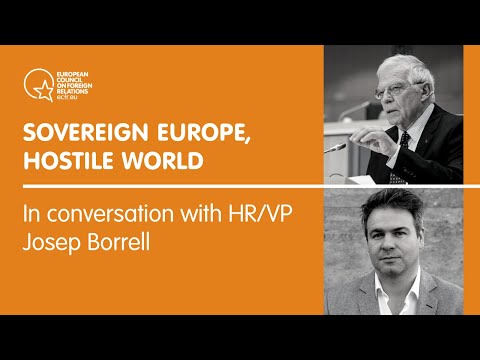
Sovereign Europe, hostile world: In conversation with HRVP Josep Borrell
Introduction
In this section, the speaker introduces the topic of discussion and welcomes Joseph Burrell, the EU's High Representative and Vice President European Commission to discuss the meaning of strategic autonomy and sovereignty.
Welcoming Remarks
- The speaker welcomes Joseph Burrell to discuss the meaning of strategic autonomy and sovereignty.
- The discussion is taking place on an auspicious day as the High Representative has been chairing a meeting with some of the remaining parties of the Iran nuclear deal.
- The work on strategic sovereignty started in 2018 when the US introduced secondary sanctions which threatened to blow up one of these big historic EU foreign policy achievements.
- In their first report, they made 56 concrete policy recommendations. Today they are launching three regional reports and an updated report which looks at the sovereignty agenda.
Five Dimensions of European Sovereignty
In this section, Mark Leonard presents his pentagon model for European Sovereignty that includes five dimensions: security, economic sovereignty, digital healthcare, climate change, and classical security and defense agenda.
Pentagon Model for European Sovereignty
- Mark Leonard presents his pentagon model for European Sovereignty that includes five dimensions: security, economic sovereignty, digital healthcare, climate change, and classical security and defense agenda.
- Under each headline there are a number of concrete actions which Europeans could take such as adding further parts of health sector to new investment screening procedure or developing a collective defense instrument against economic coercion.
- Other ideas include creating a security compact for Eastern Partnership states or backing up the European Green Deal with sustainable development offers.
Strategic Autonomy and Sovereignty
In this section, the speaker discusses how strategic autonomy and sovereignty can be translated into concrete actions to help protect European citizens, make its state stronger, and keep the economy on track.
Making Strategic Autonomy a Reality
- The idea of strategic autonomy or sovereignty needs to go from being an abstract concept into a concrete reality.
- This is something which allows the EU to help protect European citizens, make its state stronger, and keep our economy on track in these very difficult circumstances.
Discussion Format
In this section, the speaker outlines the format for the discussion.
Discussion Format
- The first half-hour of the discussion will be live-streamed.
- People can tweet under the hashtag ecfr events during this time.
- After 30 minutes there will be an offline discussion where people can ask direct questions to Joseph Burrell.
Strategic Autonomy: What Does It Mean for Europe?
In this section, the speaker discusses the concept of strategic autonomy and its importance in making Europe stronger and more able to act.
Understanding Strategic Autonomy
- The terms "strategic autonomy" and "political survival of the European Union" are often used interchangeably by ministers when discussing how to make Europe stronger.
- Strategic autonomy is not a goal in itself but rather a process that seeks to address vulnerabilities and seize new opportunities.
- The biggest risk facing the EU is becoming irrelevant if it does not act to defend its interests and values.
Responding to Interdependency
- Science, technology, and data are becoming sources and instruments of power in international politics, making it important for Europe to have what it takes to respond to those instrumentalizing interdependency.
- While the EU remains an opponent of protectionism, interdependency must be chosen rather than imposed upon them with genuine interest in cooperation towards achieving common objectives.
- The EU is increasingly seen as a partner of choice by countries around the world because they offer opportunities for progress without seeking to weaponize relations or bully partners.
Reinforcing Capacity
- To become a more credible global actor promoting multilateralism, Europe needs what it takes to reinforce capacity while also reinforcing transatlantic relations.
- A strong and united Europe is preferred by the US as a partner over a weak and divided one. Strategic autonomy does not imply strategic decoupling from NATO or weakening NATO.
- European initiatives such as PESCO (Permanent Structured Cooperation), strategic compass are proof that Europeans are ready to do their part and reinforce the European pillar of the alliance.
Addressing Sovereignty Challenges
- Europe needs to address key sovereignty challenges beyond defense issues, including health, economic, digital, and climate as well as traditional threats.
- The task ahead is huge and cuts across all sectors. It's not geographical approaches that are prevalent but rather transversal issues with blurred internal/external borders.
- Lessons can be learned from the current pandemic crisis in particular on the resilience and diversification of supply chains for mass or antibiotics.
Reassessing Economy, Trade, and Financial Tools
- There are also some lessons to learn about it from the current pandemic crisis in particular on the resilience and diversification of supply chains for mass or antibiotics one year ago nine months ago we were talking about the scarcity of such masks which is no way a strategic object until it became a strategic object due to the fact that they were not they were not supplies.
- The same thing can happen for vaccines. We have avoided ranks in nationalism but how do we make vaccines a global public good available to everybody everywhere independently of their economic capacity?
- Europe is reassessing its economy trade and financial tools.
The Importance of Diplomacy in Various Areas
In this section, the speaker emphasizes the importance of diplomacy in various areas such as economy, security, digital diplomacy, energy diplomacy, and climate diplomacy. He also highlights the need to develop all these areas with the support of the European Union delegations across the world.
The Role of Diplomacy
- Economy and security are intertwined with digital diplomacy, economic diplomacy, energy diplomacy and climate diplomacy.
- The network of European Union delegations across the world is an important tool that needs to be used more efficiently to protect norms and standards while creating a common European strategic culture.
- A minimum understanding of how the world works is necessary for a common foreign policy.
Making Better Use of Partnerships
This section discusses making better use of current and future partnerships in various regions such as southern neighborhood, eastern neighborhood, Africa and Asia.
Political Dialogues
- There are political dialogues at bilateral regional and multinational levels that need to be re-engaged.
- Partnerships should be used to let partners know what is expected from them while offering what can be provided.
Reflection on Recommendations
In this section, the speaker reflects on some recommendations made by Mark Leonard's report.
Implementation of Recommendations
- The speaker will ask his team to reflect further on some recommendations made by Mark Leonard's report.
- The recommendations will be used as raw material for debates and works of the external action service, the commission, and member states.
Building Strategic Autonomy and Sovereignty
This section discusses building strategic autonomy and sovereignty in a new political environment with Joe Biden going to the White House.
Reluctance Towards Strategic Autonomy
- There are two reluctances towards strategic autonomy.
- Autonomy doesn't mean protectionism but rather protecting oneself without being protectionist.
US Relationship
- Donald Trump treated the EU as a hostile actor while Joe Biden is more worried about a weak Europe than one which can stand on its own two feet.
- The debate about terminology was active because some member states were worried that it seemed like an anti-American agenda.
Sovereignty vs Autonomous
In this section, the speaker discusses the difference between sovereignty and autonomous. The speaker's friends from Germany and France tend to use sovereignty because they believe it doesn't include any reluctance with respect to transatlantic relations.
Sovereignty is Stronger than Autonomous
- Sovereignty is a stronger concept than being autonomous.
- Being sovereign means more than being autonomous.
- The word sovereignty is not an agreed language of the European Union.
- Some member states said that sovereignty is not an agreed language of the European Union.
Trump Awakening Strategic Laziness
In this section, the speaker talks about how Trump has been awakening us from strategic laziness. He has told us that he's not sure if he's going to be there for certain things, which means we can no longer rely on the US as a reliable partner.
Risk of Going Back to Sleep
- Trump has been awakening us from strategic laziness.
- We don't have to care because the US is there, but Trump has told us that he may not be there for certain things.
- The risk is that we go back to sleep again and think that now with Biden, this risk has disappeared and now the US remains a reliable partner.
- The US will no longer be engaged in large-scale military operations in Africa and in the Middle East.
EU Taking Care of Own Problems
In this section, the speaker talks about how there is a will from the US to let Europeans take care of their own problems. An exclusive reference to NATO is no longer sufficient to face these challenges.
EU Taking Care of Own Problems
- There is a will from the US to let Europeans take care of their own problems.
- An exclusive reference to NATO is no longer sufficient to face these challenges.
- The EU should have clearly in mind that the US will no longer be engaged in large-scale military operations in Africa and in the Middle East.
- It's not a matter of one president or another.
External Aspects of Internal Policies
In this section, the speaker talks about how foreign policy isn't just about diplomacy and defense but also about the external aspects of internal policies. The Lisbon agenda created his role, thinking about how we can make sure that there is more strategic focus on these internal areas.
Strategic Thinking for Domestic Discussions
- Foreign policy isn't just about diplomacy and defense but also about the external aspects of internal policies.
- The Lisbon agenda created his role, thinking about how we can make sure that there is more strategic focus on these internal areas.
- We need concrete ideas on how to inject more strategic thinking into domestic discussions.
- There are many areas where it's less clear what is the role for the EU and what member states can do.
Threats to European Interests and Values
In this section, the speaker discusses the various threats that pose a risk to European interests and values.
Increase in Dependency on Critical Products
- The speaker mentions that there is a symmetrical interdependency between digital energy space maritime climate, which threatens European interests and values.
- The dependency on critical products has been increasing, including growth and rare materials, batteries, masks, antibiotics, protection of data, protection of critical infrastructures, disinformation, cyber attacks.
Decreasing Autonomy in Various Fields
- The speaker questions whether autonomy is increasing or decreasing in fields such as rare materials, batteries, masks conjuncturally antibiotics protection of data protection of critical infrastructures disinformation cyber attacks.
- The classical role of a ministry foreign first has been changing rapidly because all ministers all commissioners have an external dimension on their job it's something that is going to be increasing every day due to the fact that there is no border for anything and all internal policy has an external dimension migration is maybe the most example the most critical example for us which is an internal policy one you have to take care of the migrants arriving but before they arrive is a matter of internal policy no it's a matter of external policy or relationship with countries of origin and transit.
Need for New Alliances
- There is no clear border between internal and external policies when facing issues such as climate change or terrorism.
- To address these challenges effectively requires new alliances with like-minded countries who share common interests and values.
- The speaker emphasizes the need for better use of current partnerships by relating and engaging with a lot of new things not the classical ones of being good neighbors.
Conclusion
In this section, the speaker concludes the talk and thanks the audience for listening.
- The speaker thanks the online audience for listening and encourages them to continue following ecfl's work on strategic sovereignty at www.ecfr.edu.