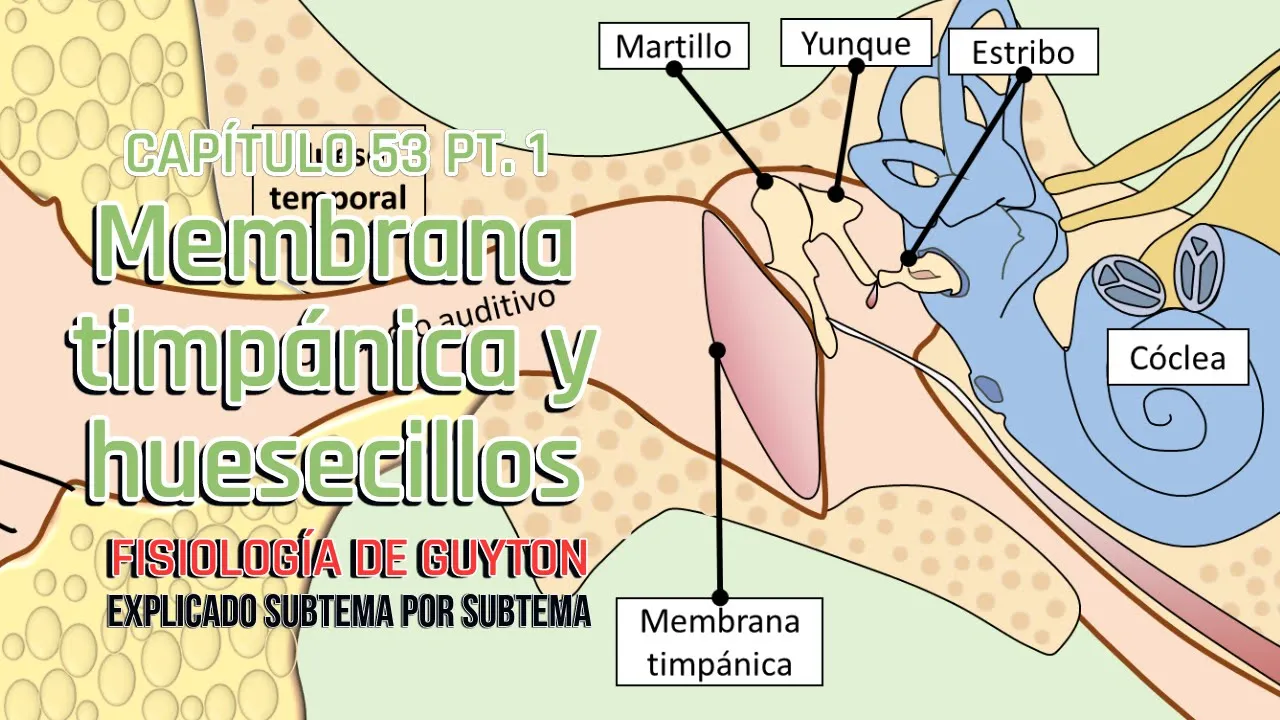
CAP 53 1/5: Membrana timpánica y huesecillos l Fisiología de Guyton
New Section
In this section, the speaker introduces the topic of audition and discusses the anatomy of the ear, focusing on the middle ear.
Anatomy of the Ear
- The ear is divided into three parts: outer ear, middle ear, and inner ear. The discussion will focus on the middle ear.
- The middle ear contains the tympanic membrane and ossicles (hammer, anvil, stirrup), responsible for transmitting sound vibrations.
- Vibrations start with the tympanic membrane connected to the hammer's handle, then to the anvil through ligaments, and finally to the stirrup resting on the oval window of the cochlea in the inner ear.
- The stirrup is crucial as it rests on the oval window of the cochlea in the inner ear. It is noted as being the smallest bone in humans.
- Sound conduction begins with vibrations transmitted from these structures; proper tension in the tympanic membrane is essential for sound transmission facilitated by tensor tympani muscle action.
New Section
This part delves into how sound vibrations are further processed within the cochlea.
Sound Transmission Process
- Vibrations continue from ossicles to stirrup hitting oval window causing movement in cochlear fluid containing hair cells that activate upon fluid motion.
- Cochlear fluid movement triggers hair cell activation which will be explored further in subsequent chapters or videos due to its complexity.
- The coordinated action of ossicles ensures effective sound transmission by pushing or pulling cochlear fluid based on movements like hammer displacement impacting force generation for fluid movement within cochlea.
New Section
This segment focuses on impedance matching facilitated by ossicles and its significance in sound conduction.
Impedance Matching
- Ossicles (hammer, anvil, stirrup) play a crucial role in adjusting impedance during sound conduction process translating air pressure variations into fluid movements within cochlea efficiently.
New Section
This section discusses the impact of sound waves on the oval window and how it affects force concentration.
Impact on Oval Window
- Sound waves impact the oval window, a smaller surface area, concentrating force due to the smaller area of impact.
- The force generated is 22 times greater than that on the tympanic membrane, enabling detection of sound frequencies ranging from 300 to 13,000 cycles.
New Section
This part explains how sound transmission occurs through different components in the ear.
Sound Transmission Process
- 50-75% of sound transmission reaches the oval window or cochlea through the hammer, anvil, and stirrup bones.
- Without these bones, only 20-30% of sound would be transmitted, reducing auditory sensitivity by 15-20 decibels.
New Section
Understanding decibels and their significance in measuring sound intensity.
Decibel Explanation
- Decibels measure sound intensity; high decibels indicate loud volume while low decibels signify quiet sounds.
- A decrease of 15-20 decibels in auditory sensitivity without ossicles can affect perception of alarms or loud sounds.
New Section
Exploring how ossicles and eardrum regulate impedance for optimal hearing sensitivity.
Impedance Adjustment
- Ossicles and eardrum adjust impedance to enhance hearing sensitivity by attenuating sounds through muscle contractions.
New Section
In this section, the discussion revolves around the function of the stapedial reflex in protecting the ear from loud sounds and its impact on sound transmission through the auditory system.
Ventana Oval and Stapedial Reflex
- The oval window and the tensor tympani muscle work together to tense or pull on the tympanic membrane, reducing the amplitude of vibrations.
- This action ensures that when vibrations occur, the stapes bone does not hit the oval window with excessive force, as it is held by the stapedius muscle.
New Section
This part delves into how the stapedial reflex reduces sound conduction through ossicular transmission in response to high-decibel sounds.
Stapedial Reflex Impact
- The stapedial reflex slows down and lessens aggressive movements towards the oval window by the stapes bone when triggered by loud sounds.
- It decreases sound conduction through ossicles (hammer, anvil, stirrup), particularly affecting low-frequency sounds below 1000 cycles per second.
New Section
Here, we explore how the stapedial reflex affects sound detection and communication in noisy environments.
Sound Detection Implications
- The stapedial reflex inhibits low-frequency sounds under 1000 cycles per second, allowing clearer perception of higher frequency sounds like speech.
- In a noisy setting like a party or festival, this reflex helps dampen low-frequency background noise, enabling better focus on higher frequency sounds such as speech.
New Section
This segment highlights three primary functions of the stapedial reflex in protecting hearing and enhancing auditory perception.
Functions of Stapedial Reflex
- The stapedial reflex protects the cochlea from damaging vibrations by retracting or pulling back on the stapes bone.
- It masks low-frequency sounds to prioritize higher frequency speech for improved communication in noisy environments.
New Section
This part discusses how the stapedial reflex influences self-perception of one's voice and modulates vocal intensity based on feedback mechanisms.
Self-Voice Perception
- The stapedial reflex reduces sensitivity to one's own voice by modulating feedback signals between cochlear nerve fibers and middle ear muscles.