The Most Disturbing Events in Space (Pt. 2)
The 2012 Near Miss: A Coronal Mass Ejection
Overview of the Event
- On July 23, 2012, a powerful coronal mass ejection (CME) occurred, one of the strongest in over 150 years.
- This CME was significant enough that if it had hit Earth, it could have caused catastrophic damage to satellites and power grids worldwide.
Consequences of Impact
- Scientists estimated that an impact could have fried satellites and collapsed power grids across continents. Recovery from such an event would likely take years.
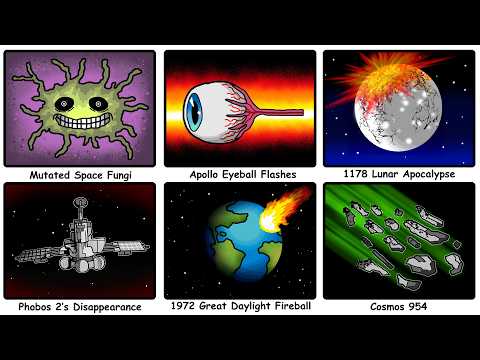
Cosmos 954: The Nuclear Satellite Incident
Background Information
- Launched by the Soviet Union in September 1977, Cosmos 954 was equipped with a nuclear reactor fueled by enriched uranium.
Incident Details
- In January 1978, Cosmos 954 lost control and reentered Earth's atmosphere, scattering debris over a vast area of Canadian wilderness (124,000 square kilometers).
Recovery Efforts
- Operation Morning Light was initiated to recover wreckage; only about 1% of the satellite's total debris was found. The rest either burned up or remains unaccounted for.
Mutated Space Fungi on Mir Space Station
Discovery and Adaptation
- In the late 1990s, researchers discovered fungal growth aboard the Russian Mir space station that adapted to harsh space conditions instead of dying off.
Health Concerns
- These fungi became more resilient and aggressive towards materials on the station, raising health concerns for cosmonauts living inside Mir.
The Vela Incident: Unexplained Flash Over Ocean
Detection and Analysis
- On September 22, 1979, an American satellite detected a double flash of light consistent with a nuclear explosion over a remote ocean area between South Africa and Antarctica.
Controversy Surrounding Findings
- While some analyses suggested it was caused by something hitting the satellite combined with sunlight reflection, underwater listening systems indicated an explosion may have occurred around that time.
The Great Daylight Fireball of 1972
Event Description
- On August 10th, 1972, witnesses observed a large object moving across the sky during daytime for nearly 100 seconds before skipping back into space without impacting Earth.
Potential Impact Consequences
- If it had entered at a steeper angle and impacted Earth, it could have released energy comparable to a nuclear explosion over populated areas below its path.
Supernova of 1054: Historical Observations
Global Sightings
- On July 4th, 1054, people worldwide witnessed what appeared as two suns due to a massive star's explosion located approximately 6,500 light-years away; this event is recorded in various historical accounts but not extensively in European records.
Lasting Effects
- The remnants are visible today as the Crab Nebula; this supernova remained bright enough to be seen at night for nearly two years after its occurrence.
Apollo Eyeball Flashes: Cosmic Ray Phenomenon
Astronaut Reports
- Apollo astronauts reported seeing flashes while in space due to cosmic rays passing through their eyes—an effect not experienced on Earth due to atmospheric protection against these high-energy particles.
Phobos II Disappearance Mystery
Mission Overview
- Launched in1988 toward Mars; Phobos II successfully transmitted data until contact ceased unexpectedly on March27th ,1989 after showing signs of rotation issues just before losing communication .
Speculation Around Final Images
- Among final images sent were anomalous shadows which led to speculation about possible causes including image processing artifacts or actual phenomena occurring near Mars .
Awakening of V404 Cygni Black Hole
Sudden Activity Resumption
- After being dormant for26 years ,the black hole V404 Cygni exhibited dramatic outbursts starting June15th ,2015 when X-ray surges were detected prompting global observatories’ attention .
Unique Jet Behavior Observed
- Unlike typical black holes emitting jets consistently ,V404 Cygni’s jets changed orientation rapidly indicating physical warping effects on surrounding spacetime .
Lunar Apocalypse Reported by Monks
Historical Account Analysis
- Five monks observed unusual activity involving what they described as fire bursting from moon’s surface leading scientists later analyzing reports suggesting potential meteor impacts based on crater formations matching descriptions given .
Ongoing Debate Regarding Validity
- Despite compelling evidence linking observations with lunar craters ,discrepancies remain regarding timing & lack thereof concerning subsequent meteor activity records postulated during medieval times .
GRB0606114: An Unexplained Gamma-Ray Burst
Unexpected Characteristics Detected
- NASA’s Swift satellite identified GRB0606114 lasting102 seconds yet failing produce expected supernova remnants challenging existing scientific frameworks surrounding gamma-ray bursts classification criteria .
ISS Sabotage Investigation
Leak Discovery & Initial Assumptions
- In August2018 crew members noticed air pressure drop traced back Russian Soyuz capsule revealing clean-edged hole suspected initially caused by micrometeorite impact but further investigation contradicted this theory suggesting possible sabotage instead .
Kessler Syndrome Threat Assessment
Explanation & Current Situation Overview
- Kessler syndrome describes cascading collisions among orbital debris creating self-sustaining chain reactions threatening operational satellites essential for GPS/weather forecasting/global communications amidst increasing risks posed by existing fragments already present within low-Earth orbit environments .