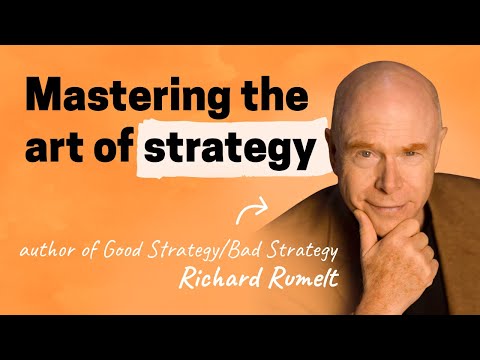
Good Strategy, Bad Strategy | Richard Rumelt
New Section
In this section, the speaker discusses the essence of strategy and challenges the traditional view of strategy as a complex concept requiring extensive preparation.
Understanding Strategy
- The speaker emphasizes that a strategy should be viewed as an action agenda rather than a complex plan.
- Contrary to common belief, one does not need to establish a mission, vision, or values before developing a strategy.
- The focus should be on identifying one or two key challenges that can be effectively addressed through coherent actions.
Richard Rummelt's Background and Expertise
This part introduces Richard Rummelt, highlighting his significant contributions to the field of strategy and his extensive experience working with various organizations.
Richard Rummelt's Profile
- Richard Rummelt is renowned in the world of strategy for his book "Good Strategy Bad Strategy," which offers valuable insights on strategic thinking.
- He has an impressive background as a professor at UCLA Anderson School of Management and Harvard Business School.
- Rummelt has provided strategic consultation to prominent companies like Microsoft, Apple, Intel, as well as government entities such as the US Army Special Ops Command.
Key Elements of Crafting a Winning Strategy
This segment delves into the essential components that constitute a successful strategy according to Richard Rummelt.
Components of a Good Strategy
- A good strategy commences with a clear diagnosis of the most significant challenge faced by an organization.
- It is crucial to outline concrete action steps within the strategy rather than focusing solely on abstract plans.
- Organizational dynamics often pose obstacles to effective strategies; understanding these dynamics is vital for success.
Understanding Strategy in Business
In this section, the speaker delves into the concept of strategy in business, highlighting the importance of understanding and defining strategy beyond mere analytical tools.
The Essence of Strategy
- Strategy is distinguished from analytical tools like the loran curve and five forces. It involves a narrative of strength and surprise, exemplified by stories like David and Goliath.
- A strategy story revolves around discovering strengths and unexpected successes, such as Steve Jobs changing the world against expectations.
- The realization that all strategy is a form of dealing with challenges led to a shift in perspective on defining strategy as a means to address complexities.
Diagnosing the Situation
- Strategy begins with diagnosing the situation, which entails understanding what aspects to focus on amidst the complexity of reality.
- Diagnosis involves deciding what elements to pay attention to and forming hypotheses about how things interconnect within the situation.
Guiding Policy and Coherent Action
- Following a rich diagnosis comes the formulation of a guiding policy that outlines how to address the identified challenges effectively.
Strategy Components and Examples
In this section, the speaker discusses the importance of changing strategies periodically, outlines three basic elements of a strategy, and provides an example using Microsoft's adaptation to AI.
Change in Strategy
- Changing strategy every five years is crucial for businesses, with tech companies having shorter time horizons.
- Three basic elements of a strategy: diagnosis, guiding policy, and coherent actions are essential for a successful strategy.
Example: Microsoft's Adaptation to AI
- Microsoft adapting to AI involves diagnosing the challenge, creating a guiding policy to invest in leaders, and incorporating changes into their search engine.
- Companies often fail at implementing strategies effectively despite understanding the components required.
Identifying Bad Strategy
This part delves into distinguishing between good and bad strategies by highlighting signs of bad strategies through examples like profit goals without coherence or ambition without action plans.
Signs of Bad Strategy
- Good strategy vs. bad strategy: Bad strategies often focus on profit goals or ambitions without clear action plans.
- Standard bad strategy includes setting abstract high-level goals that lack coherence or actionable steps.
Challenges in Strategic Planning
The speaker critiques ineffective strategic planning by citing examples where diagnoses are overlooked in favor of superficial solutions. He emphasizes the importance of thorough analysis before formulating strategies.
Lack of Diagnosis in Strategies
- Critique on strategic planning: Highlighting instances where surface-level solutions overshadow deep-rooted issues requiring proper diagnosis.
Diagnosis and Strategy in Housing
The discussion revolves around the importance of diagnosis in addressing issues, particularly in the context of housing affordability and strategy formulation.
Importance of Diagnosis
- Politicians have identified high housing costs as the main issue, leading to building expensive housing units.
- Lack of proper diagnosis hinders effective problem-solving, such as understanding why affordable housing construction is challenging.
Strategy Development
- Ineffective strategies often stem from a lack of clear diagnosis or mistaken goals equated with strategy.
- Missing a concrete action plan indicates an incomplete or ineffective strategy.
Elements of Effective Strategy
The conversation delves into the components that constitute a successful strategy, emphasizing coherence and focus.
Coherence and Focus in Strategy
- Strategies require coherence where actions are interconnected and focused on a few key objectives.
- Emphasizing concentration on a limited number of actions (e.g., rule of thirds) enhances effectiveness and power.
Power and Strategic Action
Exploring the concept of power within strategic decision-making processes and its significance in achieving desired outcomes.
Understanding Power in Strategy
- Power plays a crucial role in gaining advantages over competitors by exploiting asymmetries.
- Analogies like using a magnifying glass to focus sunlight illustrate the necessity of concentrated power for strategic success.
Implementing Power in Strategy
Discussing practical applications of power within strategic frameworks to achieve targeted objectives effectively.
Application of Power
- Effective strategic action requires focusing power on achievable targets for impactful outcomes.
Power and Competitive Advantage
The discussion delves into the concept of power as leverage in business, particularly focusing on how companies navigate the shift to cloud computing and the challenges faced by large corporations like IBM in adapting to new paradigms.
Power Dynamics and Business Strategy
- Large companies like IBM are hesitant to transition to cloud computing due to their substantial IT departments resistant to change.
- IBM's orientation towards big company structures becomes a disadvantage in evolving landscapes, leading to insecurity and potential layoffs.
- Sources of power can stem from inventions, customer bases, or unique advantages that provide competitive edges but may not be permanent.
Identifying Sources of Competitive Power
Exploring strategies for identifying sources of competitive advantage within a business context and offering advice on recognizing unique strengths.
Uncovering Competitive Advantages
- To identify sources of power, assess asymmetries within your company compared to others and recognize distinctive knowledge or assets.
- Differentiation is crucial for creating competitive power; redefining your niche can reveal unique strengths even for smaller companies.
Types of Power in Business
Examining various types of power in business strategy, including leverage, network effects, and growth advantages that shape competitive dynamics.
Diverse Forms of Business Power
- The spectrum of business powers includes leverage, design focus, growth advantages, inertia, entropy, among others.
- New business models exploit user base power through network effects where more users enhance product utility and value creation.
Network Effects and Market Dynamics
Discussing the significance of network effects in modern markets and how they influence user engagement and market dominance.
Impact of Network Effects
- Network effects drive user engagement; examples include Bill Gates leveraging network effects with MS-DOS through widespread adoption.
The Power of Strategy and Business Decisions
The discussion delves into the significance of data, innovation, network effects, power dynamics, and strategic decision-making in business contexts.
Bing's Challenge and Innovation
- Bing struggles to keep up with searches due to limited data compared to competitors like Google.
- Businesses can overcome this by specializing in unique approaches rather than competing directly with market leaders.
Network Effects and Venture Capital
- Network effects play a crucial role in building market positions rapidly.
- Twitter exemplifies the power of network effects despite significant changes in its operations.
Source of Power in Strategy
- Strategic decisions should be rooted in a source of power or advantage.
- Power can stem from reputation, institutional knowledge, asymmetry, or unique skills.
Strategic Decision-Making and Execution
The conversation shifts towards strategic decision-making, risk assessment, resource allocation, and the importance of focusing on achievable objectives.
Business Strategy and Risk Assessment
- Successful strategies leverage sources of power to tilt the odds in favor.
- Statistics highlight the challenges new restaurants face; success requires more than desire or mentorship.
Identifying Sources of Power
- Recognizing asymmetries or advantages is crucial for developing strategies with favorable odds.
- Effective strategy involves leveraging information, skills, and resources for competitive advantage.
Complexity of Nation-Building Strategies
The dialogue transitions to nation-building complexities by drawing parallels between historical warlord societies' transformations into structured governments.
Challenges in Nation-Building
- Nation-building demands a focus on achievable goals amidst diverse objectives.
How to Gain Insights from History
In this segment, the speaker discusses the importance of historical knowledge in gaining insights and power, emphasizing the value of studying various historical contexts.
Importance of Historical Knowledge
- Understanding history is crucial for strategic thinking as there is no set science of strategy like physics or engineering; it relies heavily on analogies from past human experiences.
- Exploring different historical periods, empires, and stories can provide valuable analogies and insights for understanding current situations.
- The further back in history one delves, the less biased the information may be, with firsthand accounts often offering richer perspectives than later interpretations.
Significance of Historical Analysis in Understanding Economic Cycles
This part delves into the importance of historical analysis in comprehending economic cycles and major events such as depressions.
Understanding Economic Cycles
- Examining historical events like economic depressions throughout different time periods can offer valuable insights into their causes and effects on societies.
- Reflecting on past economic crises like the Great Depression allows individuals to form their own opinions by analyzing historical data and diverse perspectives.
Critical Thinking Through Historical Context
The speaker emphasizes critical thinking through historical context to navigate complex situations effectively.
Critical Thinking Approach
- Analogizing a confusing situation to being adrift at sea, the speaker highlights the importance of seeking alternative perspectives to gain a clearer understanding.
- Encouraging individuals to challenge their initial diagnoses by considering other viewpoints and exploring different approaches to problem-solving.
Analyzing Complex Situations Through Historical Lens
This section focuses on analyzing complex scenarios using historical patterns for deeper comprehension.
Analyzing Complex Scenarios
- Drawing parallels between market saturation in industries like automobiles during economic downturns such as the Great Depression aids in understanding cyclical patterns.
Strategy Writing Advice for Product Managers
The speaker provides advice on how product managers can effectively write a strategy, emphasizing the importance of understanding challenges and framing strategies as action agendas.
Writing a Strategy
- The structure of a strategy should include sections like diagnosis, guiding principles, and actions.
- Emphasize understanding the challenge faced rather than just diagnosing the problem broadly.
- People struggle with creating strategies due to confusion from various sources; focus on stating the problem clearly.
Action Agenda vs. Strategy
- Reframe strategy as an action agenda focused on addressing specific problems rather than long-term visions.
- Instead of calling it a strategy, term it as an action agenda to emphasize problem-solving over abstract goals.
Balancing Ambitions and Challenges in Strategy Development
The speaker discusses the importance of aligning personal ambitions with practical challenges when developing strategies.
Setting Ambitions
- Acknowledge personal ambitions but differentiate them from strategic planning.
- Evaluate which ambitions are feasible currently and identify barriers hindering progress.
Choosing Challenges
- Select challenges aligned with ambitions that are both important and achievable.
Insight and Strategy in Business
In this section, the speaker discusses the concept of "Crux" in achieving ambitions, drawing parallels between climbing and business challenges. The importance of identifying and overcoming the hardest part of a problem is emphasized.
Understanding the Concept of Crux
- Identifies "Crux" as the hardest part of a climb or a problem in business.
- Mentions advice to climbers: if you can't handle the Crux, don't attempt the climb.
- Relates the concept to business challenges.
- States that in business, the Crux represents the most challenging aspect of a project or design.
Application in Design and Engineering
- Highlights how designers tackle challenges.
- Discusses how designers approach problems by focusing on difficult aspects.
- Provides an example from architecture.
- Shares a case where a designer solved a complex problem by building a transparent structure.
Innovation Through Insight
This segment delves into how insight drives innovation by focusing on challenging aspects and finding creative solutions. Examples from engineering and space exploration illustrate this process.
Insightful Problem-Solving
- Emphasizes focusing on difficult aspects for innovation.
- Gives an example of solving rocket landing challenges through insightful thinking.
- Showcases SpaceX's innovative approach.
- Discusses designing Voyager with creative solutions to technical hurdles.
Solving Complex Problems
- Addresses precision in space missions.
- Explains how taking pictures halfway through a journey helped locate Jupiter accurately during missions.
The Power of Insight in Strategy
The speaker underscores the significance of insight in strategy formulation, highlighting its role in problem-solving and decision-making processes for successful outcomes.
Strategic Decision-Making
- Defines strategy as deriving from insightful problem analysis.
- Stresses that strategy involves understanding complex problems deeply to find effective solutions.
Embracing Innovation
- Encourages embracing uncertainty for innovation.
- Acknowledges that insight may not be immediate but requires immersion in problem contexts for breakthrough moments.
Navigating Organizational Dynamics
Addressing organizational challenges, this part explores strategies to manage priorities, power dynamics, and conflicting interests within teams effectively.
Managing Priorities
- Advocates for hierarchical structures for decision-making clarity.
Strategy and Decision-Making in Organizations
The speaker discusses the challenges of forming a cohesive strategy within organizations due to diverse interests and agendas.
Challenges of Strategy Formation
- Organizations face difficulties in strategy formation when various stakeholders have conflicting priorities, leading to a lack of focus.
- Within organizations, individuals may not clearly communicate their interests, complicating decision-making processes.
- Expertise within organizations can be abundant, but differing agendas among experts hinder consensus on strategic decisions.
- Information within organizations is often accompanied by hidden agendas, making it challenging to align on a unified strategy.
- Academics acknowledge the complexity of forming strategies and suggest involving a small group of knowledgeable individuals for decision-making.
Leadership vs. Management in Organizational Strategy
The discussion contrasts leadership with management in organizational strategy development.
Leadership Dynamics
- Contemporary literature emphasizes self-improvement for leadership effectiveness rather than practical guidance on leading teams.
- The shift towards leadership over management has led to a focus on visionary leaders rather than action-oriented decision-makers.
- While transformational leadership theories have gained popularity, there is a reluctance to make concrete decisions in organizational settings.
Decision-Making and Authority in Organizations
Exploring the role of decisive leadership and authority in organizational decision-making processes.
Decisive Leadership
- Effective decision-making requires designated leaders who can make tough choices and allocate responsibilities clearly.
- Reference to George Bush's assertion as "the decider" highlights the importance of having authoritative figures for effective decision-making.
Strategic Errors and Startup Strategies
In this section, the speaker discusses strategic errors made by organizations like Nokia and provides insights into startup strategies for founders.
Strategic Errors at Nokia
- Nokia's downfall was attributed to replacing engineers with lawyers and accountants, leading to a loss of competitive edge in hardware and software.
- Implementing a diffused power structure through a matrix organization hindered decision-making, resulting in missed opportunities like developing touch screen smartphones.
Startup Strategy Insights
- For startup founders pre-product market fit, having a clear strategy is crucial amidst uncertainty; understanding the bet being made and adapting as information unfolds is key.
- Successful startups evolve by targeting specific customer needs, iterating their solutions based on feedback, and pivoting towards the right market over time.
Adapting to Uncertainty in Business
This section delves into the necessity for businesses to adapt to uncertainty and make informed bets in evolving industries.
Navigating Uncertainty
- Startups must continuously search for the right market fit by adapting their offerings based on customer feedback until they find success.
- Entrepreneurs need to balance certainty in their vision with flexibility to pivot when needed, especially in rapidly changing technological landscapes.
Historical Context of Industry Evolution
- Drawing parallels from history (e.g., automotive industry), predicting industry trajectories is challenging; businesses must be agile and responsive to unforeseen shifts for survival.
Discussion on Innovation and Problem-Solving
In this segment, the discussion revolves around innovation, problem-solving, and the concept of creating ideal solutions to everyday challenges.
Salesworth's Innovative Beginnings
- Salesworth's inception stemmed from questioning how things should be designed differently.
- The conversation delves into designing the perfect window as an example of innovative thinking.
- Attributes of a perfect window are discussed, such as letting in light but not excessive brightness or noise.
Opportunities for Innovation
This part focuses on identifying opportunities for innovation and overcoming obstacles that hinder progress in various industries.
Overcoming Regulatory Barriers
- Regulations like selling cars only through dealers in the US are highlighted as barriers to innovation.
- Challenges in plumbing and electrical innovations due to existing rules and restrictions are mentioned.
Strategic Problem-Solving Approach
The conversation shifts towards strategic problem-solving approaches and the importance of focusing on actionable solutions.
Strategy and Problem Resolution
- Emphasis is placed on strategy as a tool for solving critical problems effectively.
Strategy Books and Biographies
In this segment, the speaker discusses the importance of reading biographies and histories alongside strategy books. Recommendations for specific books are provided.
Importance of Reading Biographies
- The speaker suggests that in addition to strategy books, individuals should read biographies and histories.
- Specific recommendation includes the book about Steve Jobs as brilliant.
- Emphasis on learning from Business Leaders' biographies like Andy Grove's "Only the Paranoid Survive."
Insights from Historical Figures
- Highlight on Rockefeller's history and how he transformed industries by reducing costs significantly.
- Stress on understanding stories rather than just theories for a comprehensive perspective.
Favorite Movies, TV Shows, and Interview Questions
This part delves into the speaker's preferences regarding movies, TV shows, interview questions, and strategic thinking assessments.
Entertainment Preferences
- Mention of enjoying Yellowstone series.
- Absence of a TV at home leading to disconnection from recent movies.
Strategic Thinking Assessment
- Discussion on favorite interview questions focusing on evaluating candidates' strategic thinking abilities.
- Preference for asking about past challenges faced by individuals to gauge problem-solving skills.
Product Discoveries and Life Mottos
The conversation shifts towards product discoveries that intrigued the speaker and personal life mottos guiding his decisions.
Product Exploration
- Introduction to a new memory foam bed as an impressive innovation.
- Interest in smart telescopes for astronomical observations with advanced features.
Personal Life Mottos
- Reflection on marriage advice emphasizing communication of love unequivocally.
Writing Insights from Daughter
The speaker shares insights gained from his daughter who is a successful fiction writer, focusing on creating tension in writing narratives.
Writing Techniques
- Learning about creating tension in storytelling through contrasting elements like social backgrounds or characteristics.
Tension Between Decision-Making
In this segment, the speaker discusses the tension between decision-making processes and the emotional engagement required for effective choices.
Exploring Decision-Making Tension
- The speaker highlights the tension between determining the right or wrong path, emphasizing the importance of emotional engagement in decision-making.
- Acknowledgment of challenges faced by individuals and their need to confront them directly through action agendas.
- Contact information shared for further engagement with the speaker's work through a personal website and email address.
Strategies for Organizational Success
This part delves into strategies for organizational success and how individuals can contribute to creating effective strategies within their organizations.
Crafting Effective Strategies
- Invitation extended to share stories about experiences in developing strategies within organizations.
- Speaker expresses willingness to incorporate more stories into his repertoire.
Public Speaking and Foundry Approach
The discussion shifts towards the speaker's current focus on public speaking, teaching, and a problem-oriented approach known as Foundry.
Public Speaking and Foundry Methodology
- Speaker outlines his current activities involving public speaking on strategy and growth, along with engagements like teaching sessions.
- Introduction to Foundry approach where organizational leaders collaborate on problem-solving over several days to develop actionable plans.
Focus on Problem-Solving in Organizations
Emphasizing problem-solving within organizations using a focused approach to identify key challenges and devise actionable solutions.
Problem-Centric Approach
- Description of how focusing on problems initially leads to prioritization of critical issues for resolution.
- Discussion on narrowing down challenges to addressable ones through collaborative efforts within organizations.
Impact of Foundries on Organizational Development
Reflecting on the impact of Foundries in aiding companies in gathering resources effectively for strategic actions.
Influence of Foundries
Turn any video into a summary like this
YouTube links, meetings, lectures — with transcripts, search, and chat.