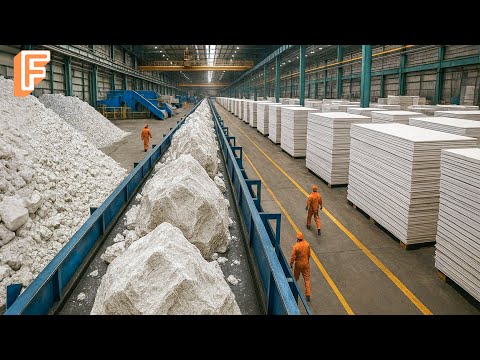
How Drywall Is Made From Gypsum In Massive Production Lines | 34 Billion Square Feet Every Year
How is Drywall Made?
The Importance of Drywall in Construction
- Drywall production exceeds 10 billion square meters annually, enough to cover millions of homes globally. This material is essential for modern construction.
- Over 95% of homes in the U.S. utilize drywall for walls and ceilings, making it the most prevalent material in residential building projects.
Composition and Cost of Drywall
- Each drywall sheet consists of a gypsum core sandwiched between two layers of industrial paper, resulting in lightweight, fire-resistant panels with superior sound insulation compared to traditional materials.
- A standard 4 by 8-foot sheet costs approximately $10 to $20; while more expensive than wood or plastic panels initially, its quick installation and low maintenance justify the investment over time.
Gypsum Extraction Process
- The initial step involves extracting gypsum from deep underground deposits using large open-pit mines where powerful drills create shafts for explosives. These blasts release layers of gypsum from mountainsides.
- After blasting, massive excavators collect tons of gypsum chunks and transport them via specialized trucks to staging areas before heading to processing plants.
Processing Gypsum into Drywall
- At the processing plant, truckloads of raw gypsum are received daily—over 100 trucks can deliver thousands of tons each day for crushing and further processing. Engineers manage distribution effectively at this stage.
- Excavators load large chunks into crushers that break down the rocks into smaller pieces, facilitating easier drying later on; this process generates significant dust which poses health risks if inhaled over time.
Grinding and Heating Gypsum
- Crushed gypsum is transported on conveyor belts to a rotary kiln where it undergoes heating; during this phase, calcium sulfate dehydrate loses water and transforms into calcined gypsum (calcium sulfate hemihydrate). Temperatures can reach up to 760 degrees Celsius during this process.
- Engineers closely monitor temperature control within different kiln zones to ensure high-quality output without compromising crystal structure integrity during heating processes lasting several hours.
Mixing Process Before Production
- Once heated, the powdered gypsum is mixed with water and additives like starch or setting time modifiers in a controlled environment; samples are tested for quality assurance before mass production begins. This ensures reliability across production lots as per required standards.
Drywall Production Process
The Initial Mixing and Preparation
- Water and additives are mixed with raw materials to create a thick slurry, which is essential for molding drywall.
- Massive rolls of paperboard are introduced into the production line, providing strength and preventing warping in the final product.
Paper Layering and Slurry Application
- Gypsum slurry is sprayed onto flattened paper using high-speed nozzles, ensuring an even layer that bonds tightly with the paper.
- A roller system levels the gypsum layer to a precise thickness (9 to 15 mm), ensuring consistent dimensions across all panels.
Surface Treatment and Shaping
- An automated spray system applies a thin solution over the surface to eliminate air bubbles that could weaken the panel.
- Edges of the drywall panel are shaped by specialized machines for clean outlines, facilitating easier installation at construction sites.
Cutting and Folding Process
- Sensors measure each panel's length as industrial blades cut them into standard sizes (e.g., 2.4m or 3m).
- Panels are folded so that paper wraps tightly around the gypsum core, enhancing strength and protecting against cracks during transport.
Drying and Final Finishing
- Panels enter a drying chamber where hot air removes excess moisture; this process lasts about 30 minutes at temperatures between 300°F to over 660°F.
- After drying, special paper strips are applied along edges for protection against chipping during transport while also reinforcing strength.
Storage and Distribution
- Finished drywall panels are stacked efficiently in storage areas, ready for large orders; organized storage enhances loading speed.
- Forklifts load batches onto trucks for delivery to construction sites; drywall's lightweight nature makes it easy to install.
Sustainability in Drywall Usage
- Over 90% of homes in the US use drywall due to its affordability and convenience; it has become indispensable in modern construction.
- In Europe, recycling drywall is common; recycled material costs significantly less than mined gypsum while maintaining quality through multiple recycling processes.
How is Drywall Made and Recycled?
The Process of Recycling Drywall
- Recycled drywall is processed by being lifted and loaded into industrial crushers, where it is ground down into a fine powder. This powder undergoes further processing to prepare it as a raw ingredient for new drywall panels.
- Unlike the US, Europe has advanced recycling technology that allows for the incorporation of recycled paper into drywall panels. This method enhances product strength while reducing the need for mined raw materials.
- The recycled paper, sourced from industrial and household waste, is carefully sorted to eliminate impurities. When combined with gypsum, it forms a durable and environmentally friendly building material.
Mixing and Forming New Panels
- The mixture of recycled gypsum and processed paper is fed into a modern mixing system along with water and additives to enhance bonding strength. This creates a uniform slurry ready for pressing into new drywall panels.
- Once mixed, the gypsum slurry is spread out in layers; rollers press down to remove excess air and smoothen the surface. Automatic blades ensure consistent thickness across the entire sheet as it moves along conveyors.
Finalizing Production
- Long strips of drywall are cut into standard-sized panels using an automatic cutting machine that operates continuously for uniformity. After cutting, panels are stacked in bundles, wrapped by automatic packing machines to protect them during transport.
- The entire process illustrates how drywall can be recycled multiple times, contributing positively to environmental sustainability while showcasing technological advancements in production methods.