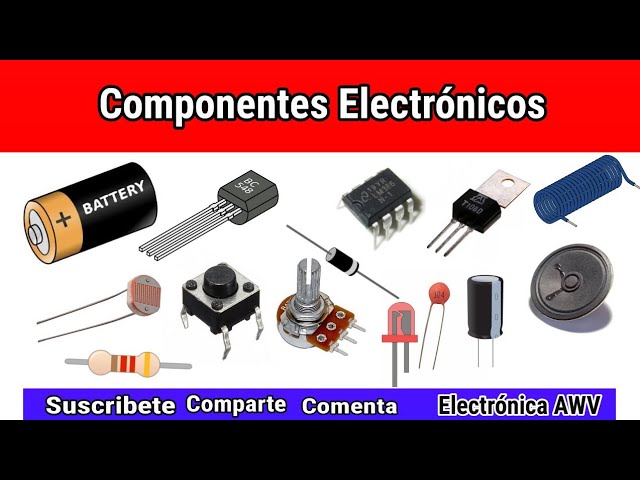
Componentes Electrónicos Esenciales y Sus Funciones: ¡Todo lo que Debes Saber!
New Section
In this video, the speaker discusses the most important components in electronics, how they work, and their symbols. They explain the concept of electronic components and circuits, as well as active and passive components.
Components in Electronics
- Electronic components are devices that are part of an electronic circuit.
- They are usually encapsulated in ceramic, metal, or plastic materials.
- Components can have two or more pins or terminals.
Active Components
- Active components control the flow of current in a circuit.
- Examples include batteries, diodes (rectifier and LED), transistors, and integrated circuits.
- Transistors are semiconductor devices used for amplification, oscillation, switching, and rectification.
- They have three pins: emitter, collector, and base.
Op Amp (Operational Amplifier)
- An op amp is a high-gain electronic amplifier with two inputs (inverting and non-inverting) and one output.
- It is commonly used for amplification, regulation, signal conversion, and switching.
Diode
- A diode is a two-terminal semiconductor component that allows current flow in one direction while blocking it in the opposite direction.
- It can be used for current circulation control and protection purposes.
- Diodes have two possible positions: forward bias (current flows) and reverse bias (blocks current).
- The symbol consists of an anode (+) and cathode (-).
Battery
- A battery provides electrical power to electronic circuits.
- It has two terminals: positive (+) and negative (-).
Passive Components
- Passive components do not produce amplification but help control electricity for better performance.
- Examples include resistors (rheostats/potentiometers), capacitors (ceramic/electrolytic), and inductors/coils.
- Resistors limit current or set voltage values, while capacitors store energy and sustain electric fields.
- Inductors store energy in the form of a magnetic field.
Light Emitting Diode (LED)
- An LED emits light when current flows through it.
- It has two terminals: anode (+) and cathode (-).
- The symbol is similar to a diode but with two arrows indicating light emission.
Switch
- A switch allows opening or closing a circuit.
- It can have multiple terminals.
New Section
This section concludes the discussion on electronic components, summarizing the liabilities used in electronics.
Passive Components Summary
- Passive components include resistors, capacitors, and inductors/coils.
- Resistors limit current or set voltage values.
- Capacitors store energy and sustain electric fields.
- Inductors store energy in the form of a magnetic field.
Conclusion
- These are the main components used in electronics for both active and passive functions.
New Section Understanding SCR and Triac Components
This section provides an overview of SCR (Silicon Controlled Rectifier) and Triac components, explaining their structure and functionality.
SCR Component
- An SCR is an electronic component with three terminals: cathode, anode, and gate.
- The gate controls the current flow between the anode and cathode.
- The SCR works like a controlled rectifier diode, allowing current to flow in one direction when no strain is applied to the gate.
- When a voltage is applied to the gate, the thyristor begins to conduct.
Triac Component
- A triac is an electronic component with three terminals: anode 1, anode 2, and a gate.
- To activate the triac, a pulse is applied to the gate.
- The triac allows current to flow in both directions, making it suitable for controlling loads powered by alternating current.
The transcript does not provide additional information beyond these points.