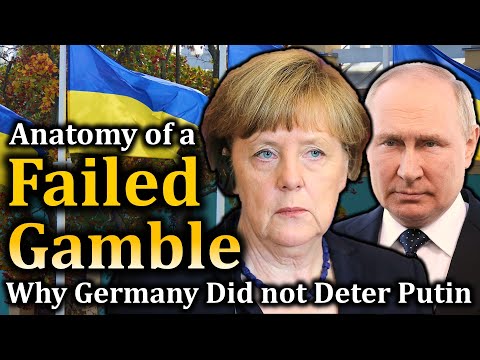
Germany's Gamble: Why the Ostpolitik Putin Policy Backfired
Understanding the Background
This section provides an overview of the events leading up to the current situation between Europe and Russia.
The Bottom of the Relationship
- In 2014, there was a significant strain in the relationship between Europe and Russia.
- The annexation of Crimea by Russia during Ukraine's revolution caused outrage in Europe.
- Sanctions were imposed on Russia, which damaged its economy but did not affect Putin's domestic popularity.
Germany's Refreshed Relationship
- Germany attempted to improve its relationship with Russia after the Crimea annexation.
- The Nord Stream 1 pipeline had been delivering cheap gas to Germany, and plans for Nord Stream 2 began in 2011.
- Germany aimed to forgive and move forward, using this as a modern-day version of Ostpolitik.
Criticism and Skepticism
- Critics, including U.S. President Donald Trump, expressed concerns about the new deal between Germany and Russia.
- Some compared it to a notorious pact between Nazi Germany and the Soviet Union.
- German Chancellor Angela Merkel remained undeterred, considering it a sensible policy recommendation.
Economic Interdependence: Theory and Failures
This section explores the concept of economic interdependence as a policy recommendation and how it can fail under certain circumstances.
The Theory of Economic Interdependence
- Economic interdependence is based on Immanuel Kant's theory that states that trade together stay together.
- It suggests that trading nations have strong incentives to resolve conflicts diplomatically to protect their economic interests.
Impact on Both Sides' Bank Accounts
- Even if trade flows predominantly in one direction, disrupting that relationship still affects both sides economically.
- Using the example of gas trade between Russia and Germany, a breakdown in the relationship would harm both countries' economies.
Peace-Inducing Effect of Trade
- Trade creates incentives for leaders to resolve differences at the bargaining table.
- Disruptions in trade can lead to public unrest and financial losses, motivating leaders to seek peaceful resolutions.
Conclusion: Reevaluating Germany's Policy
This section reflects on Germany's policy towards Russia and highlights its shortcomings in light of recent events.
Revisiting Germany's Policy
- The theory of economic interdependence was challenged when Russia invaded Ukraine in 2022.
- Some argue that Germany's policy towards Russia was flawed, leading to unfavorable outcomes.
Understanding Economic Interdependence
- While economic interdependence is generally a sensible policy recommendation, it can fail under specific circumstances.
- It is important to examine the history of economic interdependence and its limitations.
Looking Ahead
- The video promises further exploration of economic interdependence failures and discusses Zelensky visiting a McDonald's.
- The topic will be examined with lines on maps or similar visual aids.
New Section
This section discusses the concept of negotiating space and how economic interdependence can influence conflict resolution.
Negotiating Space and Economic Interdependence
- The red arrow represents the expected amount of Ukrainian self-determination in a conflict, while the yellow arrow represents Germany's costs of conflict.
- The lack of a border between Russia and Germany creates a unidimensional policy space instead of territory, with economic war replacing kinetic war.
- Economic interdependence increases the set of solutions acceptable to both parties as the costs of conflict rise.
New Section
This section explores how economic sacrifice affects compliance in negotiations.
Economic Sacrifice and Compliance
- Additional economic sacrifice expands the negotiating space, making Russia more compliant due to potential loss of high profit margins.
- Germany also becomes more compliant as trade increases both parties' costs.
- Germany's plan to allow Russia to build Nord Stream is based on anticipating Russia's compliance due to potential loss of profits.
New Section
This section examines how different demands can affect freedom levels and outcomes for Germany.
Impact on Freedom Levels
- If Russia controls which policy to propose, it can convince Germany to accept a lower value on the freedom index than before.
- Despite coercion from Russia, Germany is not worse off as its loss on one line is offset by gains from trade.
- Germany may impose externalities on others if it decides to prioritize its own interests.
New Section
This section raises the question of which effect dominates in international bargaining scenarios.
Dominating Effects
- Determining which effect dominates requires considering resolved states' level of care about abstract issues like freedom versus money and human life.
- Uncertainty plays a role in international bargaining, as seen in the eve of war when Russian intelligence gambled on Western powers' priorities.
- The difference between two possible limit lines, known as the "peace premium," influences Russia's inclination to take risks.
New Section
This section highlights two less obvious factors that can impact the success of Germany's integration policy.
Factors Affecting Success
- The difference between limit lines determines whether Russia prefers a risky or safe policy, with a larger difference increasing Russia's inclination for risk-taking.
- Uncertainty and risk-return tradeoffs play a role in international bargaining scenarios.
- Two less obvious pieces of the puzzle jeopardize the success of Germany's integration policy.
The transcript provided does not include additional timestamps beyond 0:11:17.
New Section
In this section, the speaker discusses the concept of taking risks and the economic costs of war in relation to peace.
Taking Risks for Peace
- Taking a risk becomes more appealing when the price paid for peace is high.
- Simply conceding a large unnecessary concession does not seem like a good idea.
Economic Costs of War
- The larger economic costs of war interact with the concept of taking risks for peace.
- Economic interdependence can be detrimental to peace.
- A YouTube AI in 2019 highlighted that economic interdependence can be bad for peace.
New Section
This section explores how high initial costs and trade benefits affect Russia's aggressive demands and Germany's gains from trade.
Incentives for Aggressive Demands
- If the initial cost of conflict favors Russia and trade benefits favor Germany, it incentivizes Russia to make aggressive demands.
- High initial Russian costs would have originally incentivized small demands.
- Disproportionate German gains from trade exacerbate the central problem highlighted in the video.
Uncertainty
- It is unclear if these conditions hold true in this case. The effects of lost trade are currently being observed, with Germany seeking alternative energy sources and Russia finding new markets for its exports.
- Germany initially responded to the invasion by purchasing Russian natural gas, indicating the impact of lost trade.
New Section
The speaker provides recommendations and references additional information related to the topic.
Recommendations
- The speaker does not recommend binge buying Russian energy or personally blowing up a pipeline.
- The speaker recommends reading their book on the causes of the Russian invasion of Ukraine for further understanding.
Sign Off and Comments
- The speaker mentions a previous attempt at using predictive text for a sign off.
- Silly comments were posted by viewers, including references to realtors, Zelensky as the first Russian president of Russia, and tying him to McDonald's.
- The speaker recalls a campaign film featuring Zelensky ordering from a drive-thru and discusses uncertainty regarding whether comments were genuine or part of disinformation campaigns.