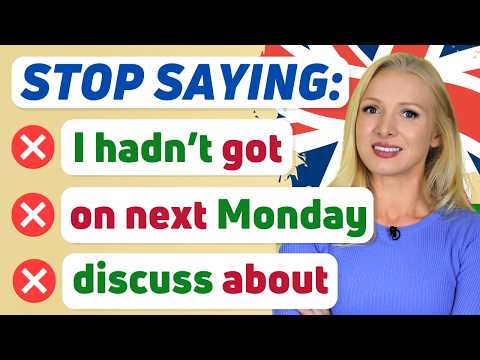
Are YOU Saying it WRONG? 5 Highly Common Mistakes in English
Common English Mistakes and How to Fix Them
Introduction to Common Mistakes
- The speaker introduces the topic of common mistakes in English, promising to cover five prevalent errors and their corrections.
- An announcement is made about a free ebook titled "35 Common Mistakes English Learners Make and How to Fix Them," which includes additional mistakes beyond today's lesson.
Mistake 1: Confusing 'Boring' and 'Bored'
- The sentence "I'm so boring" is highlighted as grammatically correct but contextually incorrect; the intended meaning is likely "I'm so bored."
- A distinction is made between adjectives ending in -ed (describing feelings) and -ing (describing what causes those feelings). Examples include "interested" vs. "interesting."
Mistake 2: Incorrect Use of Prepositions with Days
- The phrase "I'll see you on next Monday" is identified as incorrect; it should be either "on Monday" or "next Monday."
- A rule is established that prepositions like in, on, or at are not used directly before words like next, last, this, and every because they already indicate time. Examples are provided for clarity.
Understanding Prepositions
- Clarification on when to use different prepositions:
- On for days (e.g., “on Wednesday”).
- At for times (e.g., “at 2 PM”).
- In for months/years/longer periods (e.g., “in June”).
Mistake 3: Misuse of 'Discuss About'
- The phrase "We need to discuss about the proposal" is corrected to simply "discuss the proposal," emphasizing no preposition follows 'discuss.'
- Reasons for this common error include language transfer from other languages and confusion with similar phrases like 'talk about.'
Mistake 4: Redundant Comparatives
- The example sentence “This phone is more better than my old one” illustrates redundancy; it should simply be “better.”
- Explanation of comparative forms highlights that some adjectives are irregular (e.g., good → better), while others follow standard rules (e.g., happy → happier).
Mistake 5: Incorrect Past Tense Usage
- The phrase “I hadn't got time” needs correction; it should be “I didn't have time.” This emphasizes proper past tense usage without ‘got.’
- Discussion includes how ‘have got’ functions in present tense but not in past contexts across British and North American English.
Quiz Time!
- A quiz prompts viewers to correct sentences containing the discussed mistakes, reinforcing learning through practice. Examples include correcting phrases like “I’m interesting in history.”
Review of Answers
- Corrections are provided for each quiz question, reiterating key points such as using ‘interested’ instead of ‘interesting’ and omitting unnecessary prepositions after ‘discuss.’