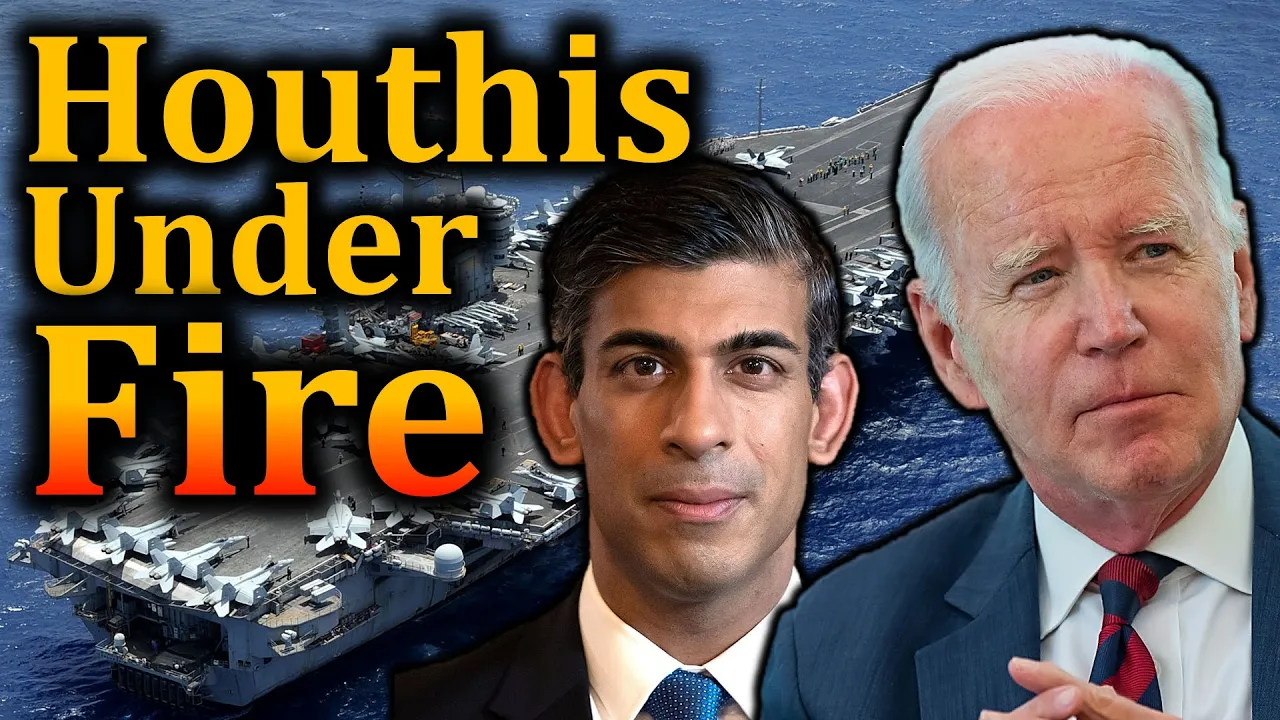
The West Strikes Back: 5 Takeaways from the Yemen Operation
Introduction and Background
This section provides an introduction to the topic and gives a brief background on the crisis in Yemen.
The World Keeps Getting More Interesting
- On January 12, 2024, the United States and United Kingdom conducted a large bombing campaign against Houthi rebels in Yemen.
- The crisis in the Red Sea had been escalating for two months prior to this event.
- The situation has critical implications for the global economy.
Overview of the Crisis
- The video will cover a brief overview of the crisis, including the January 12 operation, asymmetry problem faced by the coalition, potential diversionary incentives behind the strikes, role of the United Nations, possible continuation of conflict, and associated problems.
Background of Attack on Houthis
- Houthi rebels in Yemen attacked shipping routes as retaliation for Israel's operations in Gaza.
- This resulted in international condemnation due to its impact on global trade passing through the Suez Canal.
- In response, Operation Prosperity Guardian was initiated by the United States to protect shipping lanes.
Operation Details
This section provides information about the operation against Houthi rebels and highlights key participants.
Operation Details
- Specific details about the operation are still emerging and subject to change.
- The coalition launched strikes on land-based targets in Yemen on January 12.
- The United States and United Kingdom were major participants, with support from Australia, Bahrain, Canada, and Netherlands.
Contributions from Participants
- Prime Minister Rishi Sunak of UK sent four Typhoon jets from Cyprus to participate in bombing runs using Paveway IV bombs.
- The US launched F/A-18s from its Eisenhower carrier and fired tomahawk cruise missiles.
- Multiple targets within Houthi-controlled locations, including the capital, were hit.
Impact and Analysis
This section discusses the impact of the strikes and analyzes the asymmetry problem faced by the coalition.
Impact of Strikes
- The strikes targeted Houthi's technology used for targeting ships, including unmanned aerial vehicles and ballistic and cruise missiles.
- Coastal radar and air surveillance capabilities were also hit, potentially setting the stage for further attacks.
Asymmetry Problem
- The coalition faces an asymmetry in the mode of attack, with relatively inexpensive missiles and drones being used by Houthis.
- Defending against each attack is costly for the coalition while Houthis spend significantly less to carry out attacks.
- This creates a challenge for defense strategies.
Offense vs Defense
This section explores the concept of offense versus defense in deterring attacks.
Offense vs Defense
- When offense is easier than defense, it can lead to increased instability in the world.
- The proliferation of cheap missiles and drones makes offense more favorable for attackers like Houthis.
- To deter attacks, defensive measures alone are not sufficient. Going on the offensive becomes necessary.
Motivations and Support
This section examines motivations behind the strikes and bipartisan support for them.
Motivations Behind Strikes
- The United States and United Kingdom launched strikes to make Houthis concerned about retaliation.
- Domestic diversionary expectations do not seem to be driving this operation.
Bipartisan Support
- Senate Minority Leader Mitch McConnell welcomed the operations, indicating bipartisan agreement.
- Speaker of the House Mike Johnson also expressed support and called for further action if needed.
Conclusion
This section concludes the analysis and highlights support for the operation.
Conclusion
- The United States being in an election year and facing a minor scandal does not seem to have influenced the decision to launch strikes.
- Leader of the Opposition Keir Starmer in the UK also voiced support for the operation.
- Bipartisan support indicates that diversion was not a factor, and there is agreement that the operation was necessary.
Timestamps are approximate and may vary slightly.
New Section
This section discusses the adoption of Resolution 2722 by the Council, which called on the Houthis to cease attacks in the Red Sea. Russia and China abstained from voting, allowing the motion to pass.
Adoption of Resolution 2722
- The Council adopted Resolution 2722 on January 10, which called for a cessation of attacks in the Red Sea by the Houthis.
- Russia and China abstained from voting, indicating their skepticism but not vetoing the resolution.
PR Blitz from the West
This section focuses on a public relations campaign led by Secretary of State Antony Blinken to increase support for the coalition in the region despite growing frustration with Israel.
PR Campaign
- Secretary of State Antony Blinken traveled to the region to boost support for the coalition.
- The campaign aimed to counter growing frustration with Israel and demonstrate commitment to taking action.
Toned-down Resolution
This section highlights that Russia and China secured a toned-down resolution as their concession, which becomes the official position of the Security Council.
Toned-down Resolution
- The resolution adopted is a toned-down version, serving as an "official" position of the Security Council.
- It condemns Houthi actions without directly authorizing kinetic response.
End or New Chapter?
This section explores whether this event marks an end or just the beginning of a new chapter in this ongoing saga.
Possible Outcomes
- If this is considered as an end, it raises questions about resolving underlying issues causing broader crises.
- The strikes were relatively minimal, not leading to a full military conclusion like in a real war.
- The optimistic outlook is that the coalition's willingness to escalate will resolve the crisis quickly.
- Another interpretation is that the Houthis are using the crisis as an advertisement for their cause and may prolong it.
Potential Retaliation
This section discusses the possibility of Houthi retaliation and its implications.
Houthi Response
- The Houthis have promised to retaliate, but skepticism remains about their credibility in following through with threats.
- Oil exchanges indicate short-term instability as a consequence of the strike.
Challenges Faced by the West
This section highlights two challenges faced by the West in dealing with this situation.
Challenges Faced
- Much of the valuable property that could be threatened was already taken care of by Saudi Arabia during its intervention in Yemen's civil war.
- The Houthis being an Iranian proxy complicates matters, as targeting Iran could escalate the conflict further.
Next Steps and Predictions
This section explores potential next steps and predictions regarding future developments in the Red Sea region.
Next Steps
- Washington has left open the option to escalate from military targets to political targets if necessary.
- It remains uncertain whether Iran will force or influence the Houthis towards further escalation or negotiation.