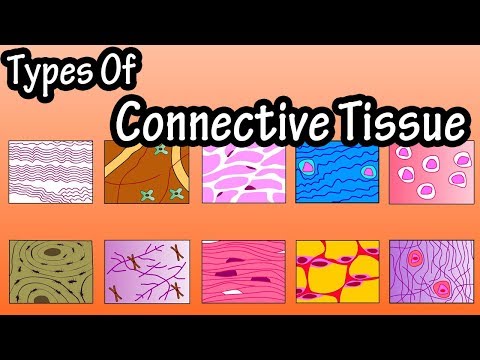
Types Of Connective Tissue - What Is Connective Tissue - Functions Of Connective Tissue
Connective Tissue Overview
Connective tissue is the most widespread and diverse of all tissues. It consists of cells, protein fibers, and ground substance. This section provides an introduction to connective tissue and its components.
Components of Connective Tissue
- Connective tissue has three main components: cells, protein fibers, and ground substance.
- Ground substance is a non-cellular material produced by connective tissue cells. It can be solid, semisolid, or viscous.
- Cells and protein fibers reside within the ground substance.
- The combination of ground substance and protein fibers is referred to as the extracellular matrix.
Functions of Connective Tissue
This section discusses the various functions performed by different types of connective tissues.
Functions of Connective Tissue
- Provides protection for internal organs.
- Offers structural support, such as bones providing a framework for the body.
- Connects and binds structures together, like ligaments binding bone to bone and tendons binding muscles to bones.
- Stores nutrients, with bones storing calcium and phosphorus.
- Facilitates transportation through blood acting as a connective tissue that transports nutrients, gases, and wastes throughout the body.
- Assists in immune function by containing white blood cells that protect the body from invaders.
Types of Connective Tissues
This section explores the different types of connective tissues and their basic structures.
Classification of Connective Tissues
- There are three main classifications of connective tissues:
- Connective tissue proper (fibrous)
- Supporting connective tissue (cartilage and bone)
- Fluid connective tissue (blood)
Connective Tissue Proper
- Connective tissue proper is divided into two subgroups based on the proportions of cells, fibers, and ground substance.
- Subgroup one: Loose connective tissue
- Contains fewer cells and fibers but more ground substance compared to subgroup two.
- Types of loose connective tissue include areolar connective tissue, adipose connective tissue, and reticular connective tissue.
- Subgroup two: Dense connective tissue
- Contains tightly packed parallel collagen fibers with limited ground substance and fibroblast cells squeezed between the fiber layers.
- Types of dense connective tissue include dense regular connective tissue, dense irregular connective tissue, and elastic connective tissue.
Supporting Connective Tissue
- Supporting connective tissue has two subgroups: cartilage and bone.
- Cartilage has a semisolid matrix while bone has a solid matrix.
- Types of cartilage include hyaline cartilage, fibrocartilage, and elastic cartilage.
Types of Cartilage
This section focuses on the three main types of cartilage.
Hyaline Cartilage
- Consists of chondrocyte cells scattered throughout the matrix in small spaces called lacunae.
- It caps the bones of synovial joints, is found in the nose, and in the respiratory passage.
Fibrocartilage
- Comprised of dense collagen fibers arranged in a wavy pattern with chondrocyte cells in lacunae.
- Acts as a shock absorber and is resistant to compression.
- Found in intervertebral discs and meniscus in the knee joint.
Elastic Cartilage
- Contains both collagen fibers and a high number of elastic fibers along with chondrocyte cells in lacunae.
- Provides flexibility.
- Found in the external ear and epiglottis.
Bone
This section provides an overview of bone as a type of supporting connective tissue.
Bone
- More solid than cartilage.
- Consists of a solid matrix.
- Provides structural support and protection for organs.
- Contains osteocytes within lacunae, which are responsible for maintaining the bone matrix.
- Highly vascularized, allowing for efficient nutrient and waste exchange.
The transcript does not provide information on fluid connective tissue (blood).
New Section
Compact bone and spongy bone are two classifications of connective tissues found in bones. Compact bone forms cylindrical structures called osteons, which surround a central canal housing nerves and blood vessels. Spongy bone has a lattice-like structure and is located in the interior of a bone, providing strength while remaining lightweight.
Classification of Connective Tissues
- Compact bone: Forms cylindrical structures called osteons, surrounds a central canal with nerves and blood vessels.
- Spongy bone: Located in the interior of a bone, has a lattice-like structure, strong but lightweight.
- Fluid connective tissue: Includes blood and lymph as subgroups.
Blood Tissue
- Comprised of formed elements and plasma.
- Formed elements include red and white blood cells, as well as platelets.
- Plasma is the liquid ground substance containing proteins.
- Red blood cells transport oxygen and carbon dioxide.
- White blood cells protect the body from foreign invaders.
- Platelets help with clotting the blood.
- Plasma transports nutrients, wastes, and hormones throughout the body.
Lymph
- Originates from interstitial fluid surrounding tissue cells.
- Transports fats and white blood cells throughout the body.