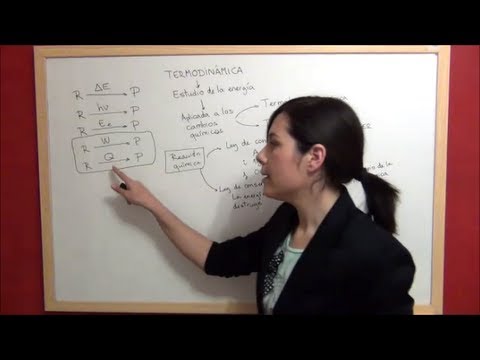
TERMOQUIMICA Teoría 1: Introducción a la termodinámica química. Sistemas termodinámicos.
Understanding Thermodynamics and Energy Conservation
Introduction to Thermodynamics
- The science that studies energy in its various manifestations is known as thermodynamics.
- Thermodynamics examines energy transformations, particularly in chemical reactions.
Key Laws of Chemistry
- The study of a chemical reaction is crucial for defining the reaction's characteristics.
- The law of conservation of mass states that matter cannot be created or destroyed during a chemical reaction.
Conservation Principles
- In a reaction, if reactant A completely transforms into product B, the total mass remains constant.
- Similarly, the law of conservation of energy asserts that energy cannot be created or destroyed; it can only be transferred or transformed.
First Principle of Thermodynamics
- This principle emphasizes that energy transfer occurs in all chemical reactions, leading to variations in energy levels between reactants and products.
- Energy changes are expressed as delta E (ΔE), indicating the difference in energy before and after a reaction.
Types of Energy Changes
- Chemical reactions may involve different types of energy changes, such as light (luminous energy).
- For example, galvanic cells convert chemical reactions into electrical energy.
Energy Transfer and System Boundaries
Defining Systems and Surroundings
- In studying thermodynamic systems, boundaries can be physical (like a glass container) or imaginary (as with combustion processes).
Imaginary Boundaries in Reactions
- When analyzing reactions without physical walls (e.g., fire), one must define an imaginary boundary around the system for study purposes.
Example: Fire as a System
Thermodynamic Systems Classification
Understanding Thermodynamic Systems
- The study begins with defining the environment and system in thermodynamics, emphasizing that not all thermodynamic systems are identical.
- Thermodynamic systems are classified based on their ability to transfer material and energy, leading to three main types: open systems, closed systems, and isolated systems.
Types of Thermodynamic Systems
Open Systems
- An open system allows for the exchange of both matter and energy with its surroundings. For example, a chemical reaction producing gas can release it into the environment.
- In an open system, the universe is viewed as a portion under study while everything surrounding it constitutes the environment.
Closed Systems
- A closed system permits energy transfer but restricts matter exchange. An example includes heating milk in a sealed glass bottle in a microwave; heat can enter or leave but not the milk itself.
- The walls of a closed system may be real (like glass) or imaginary (conceptual boundaries), allowing for thermal energy exchange without material transfer.
Isolated Systems
- Isolated systems do not allow any transfer of matter or energy. They represent extreme cases where no interaction occurs with the surroundings.
Additional Classifications
- Beyond basic classifications, thermodynamic reactions can also be categorized based on physical states (gases, solids, liquids).
- The state of aggregation plays a crucial role in understanding how components interact within these systems during reactions.
Examples and Applications
- A practical illustration involves methane combustion where gaseous reactants produce gaseous products while transferring heat through diathermic vessel walls.
Thermodynamic Systems and Their Classifications
Understanding Heat Transfer in Thermodynamic Systems
- The discussion begins with the concept of heat release during reactions, indicating that energy transfer occurs within an open system, allowing both heat and matter exchange.
- In contrast, a closed system is introduced, which does not allow for matter exchange but can still transfer energy.
Types of Thermodynamic Systems
Open vs. Closed Systems
- A closed system exchanges energy but not matter; for example, a sealed bottle can allow thermal energy to escape while retaining its contents.
Isolated Systems
- An isolated system permits no exchange of either matter or energy. This is exemplified by a thermos (or "vaso de hualo"), which retains temperature without losing liquid or vapor.
- It is noted that truly isolated systems are theoretical since some minimal energy exchange always occurs in practice.
Classification Based on State of Matter
Homogeneous vs. Heterogeneous Systems
- Chemical reactions can be classified based on the state of aggregation (solid, liquid, gas) of reactants and products.
- A homogeneous system contains all components in the same state; for instance, when methane gas combusts with oxygen gas to produce carbon dioxide and water vapor—all gaseous states.
Turn any video into a summary like this
YouTube links, meetings, lectures — with transcripts, search, and chat.