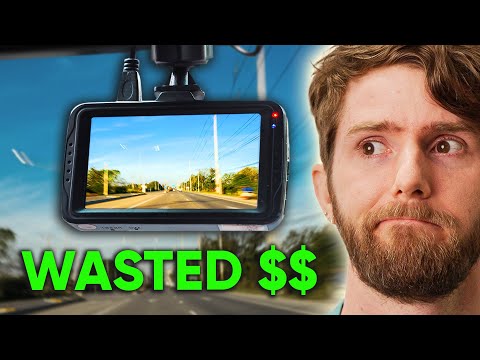
Almost EVERYONE is Wasting Money on Dash Cams.
Buying a Car: The Dash Cam Dilemma
Introduction to Dash Cams
- Buying a car is a significant investment, and protecting it is crucial. The narrator experiences an accident where dash cam footage becomes essential.
- Despite spending over $1000 on top-rated dash cams, the narrator finds most of them unusable, raising questions about their reliability.
Initial Research and Findings
- The journey began three years ago when the narrator's wife suggested purchasing dash cams after seeing examples of insurance fraud caught on camera.
- Upon researching, the narrator discovers that many dash cams are overpriced with misleading specifications and questionable reviews.
Challenges in Dash Cam Selection
- The market for dash cams is complicated; marketing materials can be confusing, making it hard to compare performance without real-world testing.
- Evaluating usability features like parking mode, discreetness, loop recording, and cable length adds complexity to choosing the right device.
Value Recommendations
- For basic proof in accidents, the Thinkware F70 emerges as a solid value pick at $70. It lacks advanced features but performs adequately in identifying vehicles and license plates.
Budget Options Explored
- Various models under $100 are reviewed:
- Biuone A20 ($60): Poor night quality; screen does not dim automatically.
- Chortau BT 13 ($70): Slightly better daylight quality but still poor at night; offers mini HDMI input for rear camera use.
Performance Issues Noted
- Both Biuone A20 and Chortau BT 13 struggle with image quality during low light conditions.
- IIWEY T1: Struggles with sign readability even in ideal conditions; designed more for rideshare drivers due to its cabin-facing camera.
Advanced Features Considered
- Pruveeo D30H claims to be 4K but only delivers 1080p out of the box; however, it has improved daytime performance compared to previous models.
Battery Technology Insights
- D30H uses capacitors instead of lithium batteries which may offer better longevity under heat exposure compared to traditional battery types.
Best Budget Dash Cams Reviewed
Overview of Dash Cam Performance
- The dash cam in question is noted for its 4K capability and was recognized by Forbes as the "Best dash cam for a tighter budget" in 2022. Initial impressions show it performs slightly better than a cheaper model, but overall quality remains similar.
- The Garmin Mini 2, priced at $110, offers brand recognition but does not significantly outperform the previous model. It has some appealing features that require an app and user information, raising privacy concerns.
- The Rove R2-4K, priced at $120, fails to impress during dusk and night conditions compared to the budget F70. Despite being popular on Amazon, it does not deliver superior image quality.
Exploring Alternatives
- The Viofo A119 V3 stands out with true 1440p recording and community-driven updates. However, despite being the best performer so far, there are still disappointments regarding image clarity across various brands.
- High-end models like BlackVue Dr750X+ ($270) and Thinkware U1000 (flagship device) offer advanced features such as dual-band Wi-Fi and geofencing but do not provide significant improvements in video quality compared to lower-priced options.
Quality Concerns Across Brands
- Both high-end cameras perform poorly relative to expectations; even with added features like red light camera alerts or cloud storage options, they fail to justify their higher price points due to lackluster video capture quality.
- There is frustration over the lack of substantial improvement in video quality among all tested models. A suggestion is made that using a GoPro could yield much better results than these dedicated dash cams.
Manufacturing Insights
- Many dash cams share similar components due to limited manufacturers producing key parts like SOC (System on Chip) and CMOS sensors. This leads to uniformity in performance across different brands.
- Novatek is identified as a major player in SOC manufacturing for dash cams; most budget models utilize older technology from this manufacturer which limits advancements in image processing capabilities.
Technical Specifications Breakdown
- Information about Novatek's chips indicates many cameras use outdated technology (circa 2017), resulting in subpar performance across multiple devices within the same price range.
Dash Cam Sensor Insights
Overview of Dash Cam Sensors
- The IMX335 sensor is commonly used in dash cams, providing decent low-light performance and capable of 1440p video clarity. Both Rove and Viofo utilize this sensor.
- Despite using the same sensor, image quality differs between brands; Rove's processing power may limit its ability to upscale images to 4K compared to Viofo's newer NT96670 processor.
Comparison of Higher-End Sensors
- The Thinkware U1000 features a STARVIX IMX334 sensor, which is an upgrade from the IMX335 but does not show significant improvements in image quality for the price increase.
- Upgrading from a 3070 to a 3070 Ti graphics card serves as an analogy for the minimal difference in performance versus cost when moving to higher-end sensors.
Limitations and Market Trends
- There exists a hard limit on achievable image quality across current dash cam models, with lower-end models nearing this threshold. Users may have to settle for "good enough" options or consider alternatives like GoPro.
- Major dash cam manufacturers focus more on adding features (e.g., multi-camera setups, gyroscopic readouts) rather than improving core functionalities like license plate recognition.
Recommendations for Consumers
- For budget-conscious buyers, the F70 is recommended; for general users, the Viofo A119 V3 offers excellent value without compromising too much on video quality.