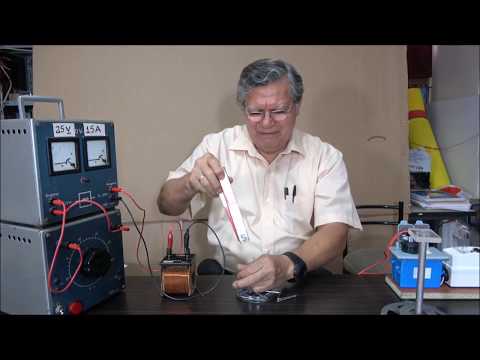
EL MAGNETIZADOR - CÓMO HACER IMANES
Introduction and Problem Statement
The speaker introduces the topic of magnets and mentions that they have two magnets that have lost their magnetism. They observe that there is no attraction or repulsion between the magnets.
Magnets without Magnetism
- The speaker demonstrates that when they place the two magnets in front of each other, there is no manifestation of attraction or repulsion, which should occur according to our understanding of magnets.
- They explain that unlike poles attract and like poles repel, but since there is no magnetism in these magnets, there is no interaction.
Magnetizing Magnets
The speaker explains how to magnetize magnets using a coil of wire called a bobbin. They mention using a coil with 600 turns and passing direct current through it to create an electromagnet.
Creating an Electromagnet
- To magnetize materials like steel, iron, cobalt, or nickel, which are ferromagnetic materials capable of becoming magnets, the coil (bobbin) is placed on the body to be magnetized.
- By passing direct current through the coil, a magnetic field is generated. The positive pole creates a north magnetic pole at one end of the coil, while the negative pole creates a south magnetic pole at the other end.
- To magnetize an object such as a magnet, the north pole of the electromagnet (coil) is placed near its positive side.
Demonstrating Magnetization
The speaker demonstrates how they can magnetize objects using their "magnetizer" device powered by 25 volts of direct current. They show strong magnetic properties after magnetization.
Successful Magnetization
- After using their "magnetizer" device, the magnets become strong and exhibit a significant amount of magnetic force.
- The speaker demonstrates the magnetism by showing how the magnets attract and lift metal objects.
Losing Magnetism
The speaker discusses various ways in which magnets can lose their magnetism, such as exposure to high temperatures or strong impacts.
Ways to Lose Magnetism
- Magnets can lose their magnetism when subjected to high temperatures or excessive heat.
- Strong impacts or physical force can also cause magnets to lose their magnetism. This is because the alignment of electrons responsible for creating the magnetic field gets disrupted.
Electron Spin and Magnetism
The speaker explains that the spin of electrons plays a crucial role in generating magnetism. They describe how an object becomes a magnet when its electrons align in a specific direction.
Electron Spin and Magnetic Force
- Electrons in atoms not exhibiting magnetic properties have arbitrary spins, rotating in different directions.
- When an object acquires a specific alignment of electron spins, it generates energy known as magnetism.
- A magnet contains trillions of electrons with aligned spins, resulting in a magnetic force known as the magnetic field.
Demagnetizing Magnets
The speaker demonstrates how they can demagnetize magnets using a transformer with a rectifier. They show that passing alternating current through the magnets causes them to lose their magnetism.
Demagnetization Process
- By removing the rectifier part from the transformer, it functions solely as a transformer and converts 120 volts AC input into 25 volts AC output without defined poles.
- When this alternating current flows through the magnets, they lose their fixed magnetism.
- The speaker shows that after applying this demagnetization process, the magnets no longer exhibit magnetic properties.
Unexpected Observation
The speaker makes an unexpected observation during the demagnetization process using alternating current.
Unusual Phenomenon
- When the speaker disconnects a part of the transformer and connects it to a 120-volt AC power source, they notice that another element in the circuit starts functioning.
- This suggests that there is still some magnetism present, even though it is not fixed or stable.
The transcript ends abruptly without further explanation or conclusion.
New Section
The speaker discusses the concept of magnetism and its relationship with electric current. They explore the behavior of magnets when exposed to different types of currents.
Understanding Magnetism and Electric Current
- The speaker explains that although there will be positive and negative changes, they will focus on fixed magnetic fields.
- They mention the polarity of magnets, specifically the north and south poles.
- The speaker states that by removing magnetism from a magnet, it can be recharged by applying a high voltage discharge.
- The force of the current determines the strength of the magnetic field.
New Section
The speaker continues discussing magnetism and electric current, explaining how to recharge magnets using alternating current.
Recharging Magnets with Alternating Current
- The speaker mentions placing the north pole of an electromagnet to their right.
- They explain that by using alternating current and disconnecting it at a specific moment, the spinning direction of electrons becomes fixed, resulting in magnetization.
- According to their theory, this fixed orientation creates magnetism when the current is disconnected.
New Section
The speaker further explores their theory about magnetization through alternating current.
Investigating Magnetization with Alternating Current
- The speaker suggests investigating their theory further.
- They propose that when alternating current flows through a circuit, at a certain moment, electrons' spins become oriented in one direction, leading to magnetization.
- This theory explains why magnets created using alternating current are stronger than those created using direct current.
New Section
The speaker continues discussing their theory on how alternating current leads to magnetization.
Theory on Magnetization with Alternating Current
- When disconnecting the alternating current, they believe that the fixed spinning direction of electrons remains, resulting in magnetization.
- The speaker acknowledges that this is a small theory but suggests it as a possible explanation for magnetism.
- They mention observing the behavior of magnets to support their theory.
New Section
The speaker concludes their discussion on magnetism and alternating current.
Behavior of Magnets with Alternating Current
- The speaker observes that magnets created using alternating current are stronger than those created using direct current.
- They note that these magnets attract and repel each other.
Timestamps have been associated with bullet points to help navigate the transcript.