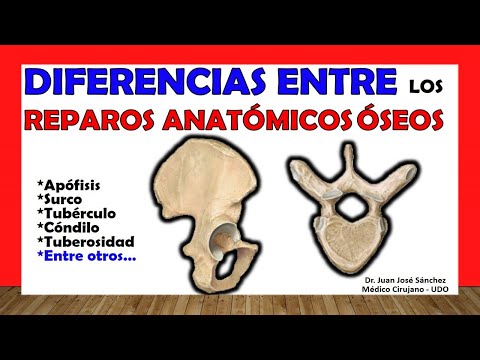
🥇 REPAROS ANATÓMICOS ÓSEOS - Detalles, diferencias.
Anatomical Details of Bones
In this video, the presenter delves into the intricate details of anatomical landmarks on bones, exploring the differences between various bony structures such as processes, grooves, tubercles, condyles, trochleae, fossae, and foramina.
Elevations, Depressions, and Holes on Bones
- The discussion categorizes bone surface features into three main groups: elevations (prominences), depressions (excavations), and holes.
- Elevations are further divided into articular prominences that facilitate bone articulation with other bones and non-articular eminences.
- Condyle: Defined as a convex elevation for articulation; examples include distal femur condyles and humeral condyles.
Trochlea and Articular Structures
- Trochlea: Described as a pulley-like structure found in areas like the distal humerus; enables hinge-like movements in joints.
- Trochlea's presence in various bones like the húmero and its significance in forming hinge joints.
Heads and Necks of Bones
- Discussion on heads of bones being generally spherical for articulation purposes; examples from long bones like humerus are provided.
- After heads come necks that connect to the rest of the bone body; comparison made to cervical region in humans.
Branches or Projections from Bones
New Section
In this section, the speaker discusses anatomical terms related to bone structures such as prominences, processes, and terminology shifts from "apófisis" to "proceso."
Anatomical Terminology
- Prominences like maxillary branches and the zygomatic process in the temporal bone are termed as branches or processes.
- The shift in anatomical terminology from using "apófisis" (Greek origin) to "proceso" (Latin origin) due to the preference for Latin terms in anatomy.
- Differentiating between articulating and non-articulating processes like the zygomatic process of the temporal bone.
- Exploring how apófisis contribute to bone growth through muscle contractions stimulating periosteum.
New Section
This part delves into specific examples of apófisis like coracoid process and discusses terminologies related to crest, line, spine, and tubercle structures.
Bone Structures
- Detailing non-articular apófisis such as coracoid process that serve as muscle and ligament attachment sites.
- Distinguishing between crests (elongated bony prominences), lines (thin elevations on bones), and their variations in curvature.
- Identifying examples of lines on bones like pectineal line on femur and superior nuchal line on occipital bone.
New Section
This segment focuses on spines, describing them as wider than tall with sharp or blunt edges. It also touches upon tubercles' characteristics compared to tuberosities.
Spines and Tubercles
- Defining spines as wider-than-tall bony structures with sharp or blunt edges found notably in pelvic bones.
- Discussing pointed structures like spinous processes at the base of the skull and sphenoid spine.
Anatomical Landmarks: Depressions, Grooves, and Notches
In this section, the speaker discusses anatomical depressions, focusing on various structures such as fosas (depressions), surcos (grooves), canales (channels), and ranuras (notches).
Fosas (Depressions)
- The term "fosa" refers to a cavity or concave area in bones.
- Examples include the fosa radial and fosa coronoidea in the distal humerus.
- Fosas serve as specific bone fitting sites or muscle origins.
Surcos (Grooves) and Canales (Channels)
- Surcos are deep, rounded excavations that often house vascular or nervous structures.
- An example is the surco del nervio cubital in the distal humerus.
- Canales are wider than surcos and typically accommodate vascular structures like the canal for the nervio radial.
Ranuras (Notches) and Escotaduras
- Ranuras have a V-shaped form with sharp edges like the ranura digástrica in the temporal bone.
- Escotaduras are concavities found at bone edges; for instance, escotadura del esternón on the manubrium of sternum.
Continuation: Anatomical Landmarks
This part elaborates on ranuras, escotaduras, and their significance in anatomical structures.
Ranuras (Notches) Continued
- The ranura maxilar is another example of a notch found at the level of maxilla.
- These notches often serve as attachment points for muscles like those originating from ranura digástrica.
Escotaduras
- Escotaduras exhibit U or V shapes and are commonly located at bone edges.
New Section
In this section, the speaker discusses various anatomical structures such as notches, sinuses, cells, facets, fissures, and meatuses.
Anatomical Structures
- The sciatic greater and lesser notches resemble a U shape. These notches are found in bones known as pneumatic bones.
- Sinuses are generally open structures within pneumatic bones like the frontal sinus, sphenoid sinus, maxillary sinus, and ethmoidal sinuses.
- Cells or small sinuses are slightly smaller than cavities or larger sinuses found in bones like the mastoid air cells in the temporal bone.
- Facets are minimal depressions that can be flat or slightly concave. They serve as articulations; for example, the costal facet on vertebral bodies for rib heads.
- Fissures are narrow openings formed by two bones or parts of the same bone. They allow the passage of vascular structures, tendons, and nerves. Examples include superior and inferior orbital fissures.
New Section
This section delves into meatuses which are spaces between nasal conchae containing openings leading to these spaces.
Meatuses
- Meatuses like middle and inferior nasal meatuses exist between nasal conchae with openings that lead to these spaces.
- These areas have duct openings; for instance, the external auditory canal exit is termed the acoustic meatus from an osseous perspective.
- Other non-osseous duct openings like urinary meatus also exist despite morphological exceptions beyond bony definitions.
New Section
The discussion shifts towards clarifying terms such as hiatus versus meatus while exploring orifices referred to as holes at the base of the skull where structures emerge.
Orifices
- Orifices at the skull base called foramina serve as exits for cranial structures like spinal cord through magnum foramen or nerves through oval and anterior/posterior lacerated foramina.
- Unlike excavating holes in bones, these simple holes do not create prolonged cavities; otherwise termed conduits which differ from true foramina like auditory canals traversing bones forming tunnels rather than mere holes.
Turn any video into a summary like this
YouTube links, meetings, lectures. With transcripts, search, and chat.