Megafabricas Jack Daniels
Introduction to Jack Daniels Whisky
This section introduces Jack Daniels whisky and its production process.
Production Process of Jack Daniels Whisky
- Jack Daniels is a beloved whisky brand produced in two unique factories.
- The production process combines tradition and automation to create a world-renowned liquor.
- Every new bottle of Jack Daniels is made in the factory located in Lynchburg, Tennessee.
- The factory is situated in an abstinent county, making it an unexpected location for a whisky producer.
- The production complex consists of nine production zones, including the Spring Cave, cereal mill, fermentation area, distillation stills, storage yard, filtration warehouse, barrel filling area, warehouses, and bottling plant.
- The whisky is made using high-quality corn as the main ingredient along with rye and malted barley.
- The water used in the production comes from a natural spring cave on-site that provides perfect water for whisky-making by filtering out iron content.
- The corn is milled into fine flour-like consistency before being mixed with water from the spring cave to create the magical blend that forms the base of each bottle of Jack Daniels.
Control Room and Production Monitoring
This section focuses on the control room where the production process is monitored.
Monitoring and Control in the Distillery
- A control room filled with computers monitors every aspect of the production process at Jack Daniels distillery.
- Operators keep track of water supply, grain processing, yeast fermentation, and other critical steps through multiple screens displaying thousands of images captured by cameras placed throughout the facility.
- The control room ensures efficient and quality-controlled production by constantly monitoring various parameters and setting alarms for any deviations.
Water Source - Spring Cave
This section highlights the importance of the spring cave as a water source for Jack Daniels whisky.
The Spring Cave and Water Filtration
- The spring cave is a natural source of water that provides every drop used in Jack Daniels whisky production.
- The water from the spring cave maintains a constant temperature of 13.3°C and has never dried up.
- It passes through a limestone bedrock, which filters out iron impurities, making it perfect for whisky production.
- The water is collected below the surface and distributed through pipelines to various stages of production.
Grain Processing - Cereal Mill
This section focuses on the processing of grains at the cereal mill.
Processing Grains for Whisky Production
- High-quality corn, rye, and malted barley are processed at the cereal mill.
- Approximately 400,000 kg of cereals are unloaded daily and weighed to ensure accurate measurements.
- Corn constitutes 80% of the grain used in Jack Daniels whisky production due to its high starch content.
- Rye adds flavor while malted barley contains enzymes that convert starch into fermentable sugars.
- Processed grains are stored in sealed silos until they are ready to be mixed with water from the spring cave.
Founder's Legacy - Jasper Newton Daniel
This section explores the legacy of Jack Daniels' founder, Jasper Newton Daniel.
The Legacy of Jasper Newton Daniel
- Jack Daniels was not just a brand name but an actual person named Jasper Newton Daniel.
- He learned how to make whisky from a local preacher when he was a teenager.
- In 1866, his distillery became the first registered distillery by the Federal Government.
- Many details about his life and his whisky remain mysterious, adding intrigue to the brand.
- The origin of the famous "old number seven" and the reason behind the square-shaped bottles are still unknown.
- Regardless of the mysteries, Jack Daniels whisky continues to follow its original recipe and tradition while incorporating new technologies.
Conclusion
Jack Daniels whisky is produced in Lynchburg, Tennessee, using high-quality corn, rye, and malted barley. The production process involves monitoring and control from a central control room. The water used in production comes from a natural spring cave that filters out iron impurities. Grains are processed at the cereal mill before being mixed with water to create the base blend for each bottle of Jack Daniels. The legacy of Jasper Newton Daniel adds to the allure of this iconic whisky brand.
The Cultivation of Yeast in Jack Daniel's Distillery
This section discusses the cultivation of yeast in Jack Daniel's distillery and its importance in maintaining the characteristic personality of the distilled liquor.
Cultivating Yeast for Consistency
- The same yeast culture has been maintained since the early days when Jack Daniel ran the distillery.
- Under a microscope, Jack Daniel's yeast has a distinctive lemon drop shape.
- The yeast cells are checked for their form, size, and active reproduction.
- A healthy yeast cell is identified by its budding process, where a small bud appears on the cell and grows to almost the size of the mother cell before separating.
- The yeast culture is kept sterile to prevent any bacterial contamination.
- Maintaining an active yeast culture ensures rapid fermentation when it enters the fermenter.
Fermentation Process at Jack Daniel's Distillery
This section explores the fermentation process at Jack Daniel's distillery and highlights its significance in converting sugars into alcohol.
Controlled Fermentation
- The fermentation takes place in a laboratory under highly controlled conditions.
- The live yeast cells are transferred to a nutrient solution that complements their growth.
- As the yeast reproduces and more nutrients are added, it is transferred to larger containers until it reaches huge tanks where it will work its magic.
- The fermentation area at Jack Daniel's distillery houses 64 enormous steel tanks with a capacity of 150,000 liters each.
- During fermentation, yeast feeds on cereal sugars slowly at first and then vigorously within hours, producing CO2 bubbles and foam.
Distillation Process: Transforming Mash into Pure Alcohol
This section delves into the distillation process at Jack Daniel's distillery, which separates volatile materials from mash to obtain pure alcohol.
Distillation Process
- Four massive stills in an 18-meter-high building transform the fermented mash into purer and stronger alcohol.
- The distillation process involves separating volatile materials from the mash.
- The mixture enters the system through an observation window and passes through a series of heated metal plates, raising its temperature to 93°C.
- As alcohol vaporizes at a lower temperature than water, it separates and rises to the top of the still.
- The vapor then enters a condenser where it is converted back into liquid form before descending to the bottom of the still.
- The distilled liquor exits the still at high speed, ready for further processing.
Importance of Barrels in Whiskey Production
This section emphasizes the significance of barrels in whiskey production, including their role in providing color and flavor.
Barrel Construction and Impact
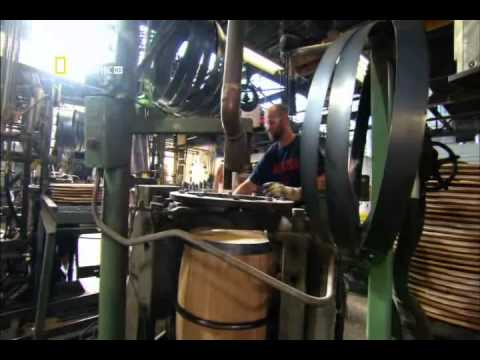
- Jack Daniel's barrels are traditionally constructed without screws or glue, ensuring no interference with their essential function.
- Barrels play a crucial role in whiskey production as they contribute 100% to its color and 40-50% to its flavor.
- Skilled workers called "cuberos" assemble barrels using traditional methods at a dedicated facility.
- The entire plant operates on generators fueled by waste wood.
Barrel Making Process
This section explores the process of making barrels at Jack Daniel's distillery, from wood selection to assembly.
Barrel Making Steps
- Wood is sourced from an assemblage yard located 37 km north of Jack Daniel's distillery.
- The wood is carefully dried before being transported to the cooperage area for barrel assembly.
- In this artisanal process, planks or staves go through cutting machines to achieve appropriate sizes.
- The wood is polished for proper fitting and bending without gaps or holes.
- Duela joining machines use rotating blades to remove excess material from the ends, making the staves wider in the center for a wider barrel shape.
Environmental Sustainability at Jack Daniel's Distillery
This section highlights the environmental sustainability practices employed at Jack Daniel's distillery.
Sustainable Practices
- The entire plant operates on generators fueled by waste wood.
- The wood is sourced from an assemblage yard located 37 km north of Jack Daniel's distillery.
- After arriving at the distillery, the wood is dried to perfection before being used in barrel production.
New Section
This section discusses the process of making barrels for whiskey production, including the use of white oak, assembly, and shaping with a saw and robot.
Making Barrels
- The barrels are made using white oak without screws or glue.
- The wood is shaped using a saw and a robot.
- Paraffin is used to temporarily hold the pieces together.
New Section
This section does not contain any relevant information.
New Section
This section introduces an employee known as "El hombre del punto" who tracks the staves before they move to the assembly area.
Tracking Staves
- "El hombre del punto" tracks the staves that come out of production before they go to the assembly area.
New Section
This section describes the assembly area where staves are joined together to form a barrel. It also mentions the use of metal hoops to temporarily hold the barrel in place.
Assembly Area
- Staves are assembled into a hoop to keep them upright.
- Barrel assemblers work hard to meet production goals displayed on giant LED screens.
- Metal hoops are used to temporarily hold the barrel together during assembly.
New Section
This section explains how metal hoops are used to maintain the shape of barrels during construction. It also emphasizes the importance of selecting and alternating different sizes of staves for proper curvature.
Selecting and Alternating Staves
- Barrels are constructed with 31 irregular wooden pieces carefully selected by hand.
- Alternating narrow and wide staves ensures proper curvature.
- Too many narrow or wide staves can result in incorrect curvature.
New Section
This section highlights the importance of bending the wood and using metal hoops to hold the barrel together during construction.
Bending Wood and Metal Hoops
- Barrels are steamed for approximately 25 minutes at 65.6 degrees Celsius to soften the wood.
- Steaming allows for bending and placement of metal hoops without breaking the staves.
New Section
This section does not contain any relevant information.
New Section
This section does not contain any relevant information.
New Section
This section explains how barrels undergo a unique toasting process to enhance flavor. It also mentions the use of mirrors to check for uniform toasting.
Toasting Process
- Barrels are subjected to radiant heat, similar to toasting marshmallows or bread.
- The heat brings out sugars and caramelizes them on the surface of the wood.
- Mirrors are used to check for uniform toasting, ensuring consistent flavor transfer during aging.
New Section
This section does not contain any relevant information.
New Section
This section describes a secret room where barrels undergo a unique process known only by Jack Daniel's. It involves exposing barrels to flames for a short period of time, resulting in a golden glow inside the barrel.
Unique Process
- Barrels pass through a secret room where they are exposed to flames.
- Flames enhance flavors by bringing out sugars and caramelizing them on the inner surface of the barrel.
- The inside of the barrel develops a golden glow after exposure to flames.
New Section
This section explains the use of a machine called "El Búfalo" to tighten the metal hoops and ensure a secure fit.
Tightening Metal Hoops
- Barrels are placed in a machine called "El Búfalo."
- The machine tightens the metal hoops using centrifugal force.
- A powerful lathe applies nearly 1000 tons of force to tighten the hoops.
New Section
This section describes how barrels are subjected to fire for a short period of time, resulting in blackened interiors. It also mentions the importance of staying focused and vigilant during this intense process.
Fire Treatment
- Barrels are placed upside down on a steel conveyor belt and exposed to flames.
- Flames burn the interior of the barrel, giving it a black color.
- Approximately 150 barrels are burned per hour.
- Vigilance is crucial during this process to prevent accidents or injuries.
New Section
This section does not contain any relevant information.
New Section
This section introduces a final phase where barrels undergo inspections for defects before being sealed and approved for use.
Final Inspections
- Barrels undergo inspections for holes, cracks, faulty joints, and other defects.
- Defective barrels may need repairs by skilled coopers.
- After passing inspections, barrels are sealed with cork and tested for air leaks.
- Approved barrels receive an official seal indicating readiness for use.
New Section
This section emphasizes the importance of using barrels immediately after production to prevent drying out and loosening of metal hoops. It also mentions that empty barrels are prone to falling apart if not used promptly.
Immediate Use of Barrels
- It is crucial to use barrels immediately after production.
- If not filled with liquid, the wood dries out and the metal hoops become loose.
- Barrels are shipped within hours of completion to prevent deterioration.
New Section
This section highlights the significance of barrels in whiskey production
New Section
This section discusses the process of reducing the fire and turning wood into charcoal.
Reducing the Fire and Turning Wood into Charcoal
- After approximately an hour, the bonfire collapses and the wood is reduced to charcoal.
- The employees reduce the fire and pass it through a crusher to turn the charcoal into small balls.
- The freshly ground charcoal is directed downhill to the filtering room where it joins whiskey transported directly from the stills through a network of pipes.
- The copper pipes in the shape of a fir tree are perforated with tiny holes for slow dripping of whiskey over 3 meters of charcoal, acting as a water filter.
- Each drop of whiskey has to travel through 3 meters of charcoal, resulting in a lighter, sweeter, and clarified whiskey.
New Section
This section explores how Jack Daniel's Tennessee Whiskey is distinguished from bourbon through its filtration process.
Filtration Process and Distinction from Bourbon
- Jack Daniel's Tennessee Whiskey undergoes filtration with sweet maple charcoal, giving it its distinction from bourbon.
- Jack Daniel was innovative in his use of music for attracting crowds, which helped establish his brand reputation.
- In 1904, Jack Daniels presented his whiskey at a competition where judges recognized its exceptional quality by awarding it a gold medal.
- Despite being originally filtered with charcoal like other distilled liquors, Jack Daniel's skillful public relations set it apart.
New Section
This section highlights the connection between Jack Daniel's and its founder, as well as the traditional charcoal filtration process.
Connection to Founder and Traditional Filtration
- Jack Daniel started from nothing and became the richest man in several counties. His house had a ballroom, library, and a Steinway piano.
- During Mr. Jack's time, the daily production of the distillery never exceeded 3,500 liters of whiskey.
- The traditional filtration with charcoal is completed before the liquor enters the barrel for aging.
New Section
This section focuses on safety measures during whiskey production and the filling process.
Safety Measures and Filling Process
- Safety measures are crucial due to the flammability of whiskey vapors during production. Gas meters provide warnings for potential hazards.
- Once filled with filtered whiskey, barrels weighing approximately 225 kg are stacked using specific techniques to prevent movement or damage.
- Filled barrels are transported to warehouses where they undergo transformation over time. The warehouses contain over 400,000 tons of whiskey-filled barrels.
New Section
This section discusses how employees handle filled barrels in warehouses.
Handling Filled Barrels in Warehouses
- Employees manually transport barrels weighing 225 kg to an old elevator that takes them up to selected shelves in the warehouse.
- Plumb lines are used as rudimentary safety devices to ensure proper weight distribution within warehouses filled with barrels.
New Section
This section discusses the process of handling and aging whisky barrels in the warehouse.
Handling and Aging Whisky Barrels
- The workers in the warehouse carry up to 1000 barrels a day, which can weigh as much as 100 camionetas (trucks). Handling these heavy barrels requires caution.
- The warehouse stores up to 20,000 whisky barrels that age on wooden shelves.
- The interaction between whisky and wood is an important part of the maturation process. Temperature variations caused by seasonal changes cause the wood and alcohol to expand and contract, allowing the whisky to penetrate into the pores of the wood. This interaction gives whisky its color and flavor.
- The specific location of the barrels in the warehouse has a significant effect on how the whisky matures. Higher locations experience more temperature variations, resulting in more flavor development.
- The top floor of the warehouse is reserved for single barrel whiskies, known for their special flavor characteristics. This area is referred to as "el nido del Ángel" (the Angel's Nest) due to high evaporation rates, resulting in a loss of 30% per barrel.
New Section
This section explores how Jack Daniels whiskey matures in the warehouse and acquires its unique characteristics.
Maturation Process
- Jack Daniels whiskey matures in the warehouse for 4 to 7 years before being bottled.
- The aroma and appearance are crucial factors in determining when a whiskey is ready for bottling rather than relying solely on time.
- To determine readiness, a sample is taken from the barrel and a cedar stake is inserted into the hole. If the stake fits easily and doesn't rot, it indicates that the whiskey has acquired quality, flavor, and character. Over-aging can result in bitterness and reduced enjoyment.
- The years of contact with the toasted wood of the barrel infuse unique flavors into the whiskey, including vanilla, caramel, and hints of roasted oak. This process also gives Jack Daniels its warm amber color.
- After just over 3 years, Jack Daniels whiskey already exhibits its characteristic amber color due to infusion from the barrel's wood.
New Section
This section focuses on the bottling process of Jack Daniels whiskey.
Bottling Process
- Bottling is a complex process that requires attention to detail to ensure safety and quality.
- The bottling area is highly volatile due to whisky vapors, making it a restricted area for cameras and requiring caution during operations.
- Empty bottles are flipped by a machine onto an upper line before being filled with whiskey diluted with demineralized water to achieve a 40% alcohol content. A plexiglass protector prevents any particles from contaminating the liquid.
- X-ray machines check for proper filling levels and securely placed caps on each bottle.
- Labels are applied using a machine that applies glue to one side while gently attaching them to each bottle manually when necessary. Despite automation, human touch remains essential in this process.
New Section
This section highlights how Jack Daniels extends its brand beyond whiskey.
Extending the Brand
- Jack Daniels has expanded its brand to include various products such as coffee, clothing, mustard, and motorcycles.
- However, the focus remains on the quality and consistency of their whiskey.
New Section
This section emphasizes the importance of quality control in the bottling process.
Quality Control
- Before leaving the warehouse, each box of bottles undergoes a final quality control test conducted by master taster Jeff Norman. The goal is to ensure that every bottle maintains the high standards set by Jack Daniels.
- A sample bottle from each batch is kept in the sample room for reference and comparison purposes.
New Section
In this section, around 100 tasters participate in an objective whisky tasting to ensure quality before distribution.
Whisky Tasting Process
- Around 100 tasters participate in a whisky tasting process before distribution.
- The tasters are tasked with identifying any differences in the whisky samples provided.
- The samples may vary from different batches, but today they are all from the same batch.
- The tasters carefully smell and taste the whisky to detect any variations.
- If there is no difference detected, the whisky is considered ready for distribution.
This section provides insights into the rigorous quality control process of whisky tasting before it is released to the market.
Turn any video into a summary like this
YouTube links, meetings, lectures. With transcripts, search, and chat.