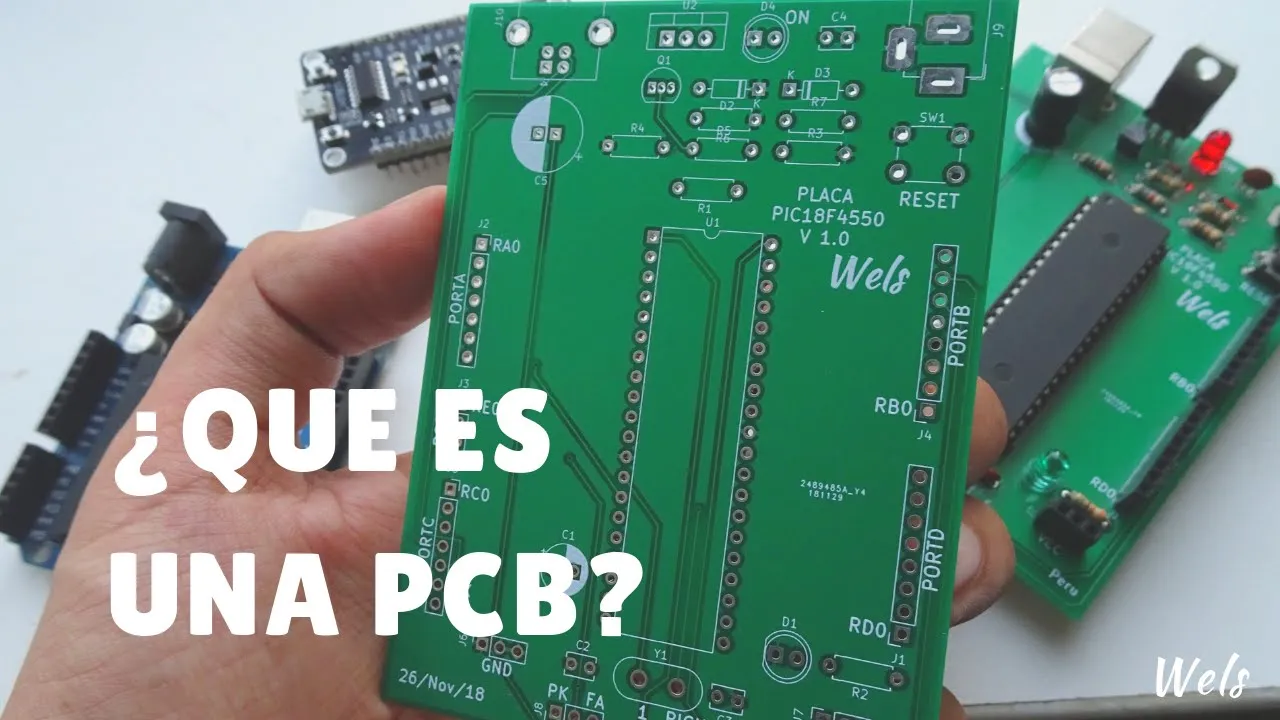
¿Qué es un PCB? - 5 Minutos de miércoles! - Wels Theory
What is a PCB (Printed Circuit Board)?
In this section, the speaker introduces the concept of a Printed Circuit Board (PCB) and explains its significance in electronic hardware.
Definition of PCB
- A PCB, or Printer Circuit Board, is essentially a board that serves as the foundation for all electronic components like radios, Arduinos, and cellphones.
Layers and Types of PCBs
- PCBs typically consist of layers of copper sheets; they can range from two layers to more complex structures with 4, 8, 16, 32 layers.
- Different types of PCBs include single-layer (copper on one side), double-layer (copper on both sides), and multi-layer boards commonly found in cellphones.
Substrate and Components of a PCB
- The substrate is often fiberglass known as FR4, visible as the white and transparent part in PCBs.
- Components such as tracks (pistas), holes (huecos), pads (huellas), vias are integral parts of a PCB design.
Types and Features of PCB
This section delves into the various types of vias present in a Printed Circuit Board design.
Types of Vias
- Vias serve as connections between different layers; examples include normal vias passing through all layers and buried vias connecting specific inner layers.
- Other types include blind vias connecting an outer layer to specific inner layers without traversing the entire board thickness.
Additional Elements in a PCB Design
Here, the speaker discusses footprints, solder mask, silkscreen, and different types of PCB materials.
Footprints and Solder Mask
- Footprints indicate component placement on the board; solder mask acts as protective paint over the board's surface.
Silkscreen
- Silkscreen refers to logos or text printed on the board for identification purposes.
Varieties of PCB Boards
This segment explores rigid, flexible, and aluminum-based PCB boards along with their unique characteristics.
Types of PCB Boards
- Rigid boards do not bend easily; flexible boards are pliable like those connecting laptop screens to motherboards. Aluminum-based boards withstand extreme conditions like high temperatures.