MAGNETRON - Teardown + How It Works - Dangerous!
New Section
This section introduces the topic of the tear down of a microwave oven and highlights the potential dangers associated with its components, particularly the magnetron.
Introduction to Microwave Tear Down
- The speaker introduces a magnetron, a component found in microwave ovens, which can be dangerous due to the presence of beryllium oxide in its ceramic insulators. Inhaling this dust can lead to suffocation or cancer.
- The rest of the magnetron is made up of metal parts and magnets, which are safe as long as they are kept away from high voltage.
- The video aims to explore the components inside an old microwave oven and explain how a magnetron works.
New Section
The speaker mentions PCB Way, a company that offers high-quality PCB manufacturing services at affordable prices.
Introduction to PCB Way
- PCB Way is recommended for ordering high-quality PCBs for prototyping at low cost.
- The speaker shares positive experiences with using their services, highlighting precise finishes and various customizable options.
- In addition to PCB manufacturing, PCB Way also offers other services such as CNC metal engraving, 3D printing, and mold injected parts.
New Section
The speaker begins the tear down process of the microwave oven by explaining why it is being dismantled instead of being thrown away.
Tear Down Process Initiated
- Due to a malfunctioning metal part in the microwave oven, causing sparks and improper functioning, instead of discarding it, the speaker decides to perform a tear down.
- Various components inside the microwave oven will be examined one by one.
- Notable components include a high voltage transformer, capacitor, magnetron (the main focus), AC fan, buttons, fuses, light bulb, wires, PCB components, and relays.
New Section
The speaker explains the significance of three main components in the microwave oven - transformer, capacitor, and magnetron - which are responsible for generating microwaves to heat food.
Main Components for Microwave Heating
- Microwaves are a form of electromagnetic radiation with specific wavelengths and frequencies.
- The waves are contained within a metal cavity in the microwave oven to heat up food.
- The three key components involved in generating microwaves are the transformer, capacitor, and magnetron.
New Section
The speaker provides an overview of the parts inside a magnetron and emphasizes caution regarding potential dangers associated with certain insulators.
Exploring Magnetron Components
- The RF output antenna is where microwaves are emitted.
- Pink insulators may contain beryllium oxide (dangerous if inhaled) or aluminum oxide (safe).
- Breaking ceramic insulators should be avoided to prevent dust release.
- Other components include mounting plate, permanent magnets, radiator for heat dissipation, thermal switch for temperature control.
New Section
The speaker explains the working principle of a magnetron based on LC oscillation and demonstrates it using an oscilloscope setup.
Understanding Magnetron Working Principle
- An LC tank circuit consisting of a coil and capacitor creates resonance at a specific frequency.
- Oscillations occur when voltage is applied and removed from the circuit.
- Current flow through the coil generates a magnetic field that collapses when current stops flowing.
- This collapse induces voltage with inverse polarity that charges up the capacitor again.
- This process repeats to create an LC resonating frequency necessary for the magnetron's operation.
New Section
The speaker explains the process of magnetic field generation and collapse in a coil-capacitor setup, which is crucial for the functioning of a magnetron.
Magnetic Field Generation and Collapse
- When voltage is applied, current flows through the coil, creating a magnetic field around it.
- When current stops flowing, the magnetic field collapses, inducing voltage with inverse polarity that charges up the capacitor.
- Once the capacitor is fully charged again, it creates another current flow and generates another magnetic field.
- This cycle repeats to create an oscillating magnetic field necessary for microwave generation in a magnetron.
The summary has been provided based on the available transcript.
New Section
This section explains the process of opening the magnetron and removing its components.
Opening the Magnetron
- To open the magnetron, be careful with the ceramic insulators.
- Bend a few metal parts to open the main case.
Removing Components
- Remove the top metal washer carefully.
- Remove the first magnet.
- Cut the filter's wires to get the tube out.
- Pull upwards to remove the tube.
- Carefully remove the heat dissipator, which is pressed down on top of each other.
New Section
This section discusses the main components of a magnetron and how it works.
Main Components and Operation
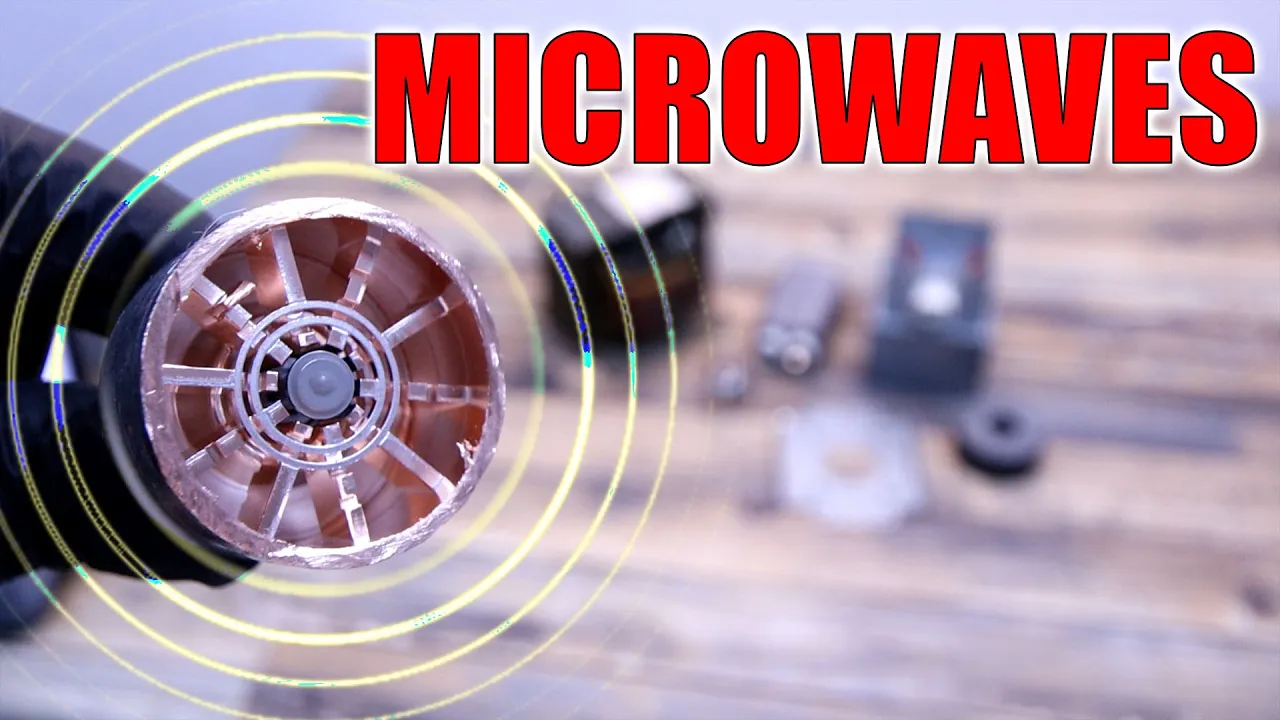
- The main tube is made of copper and cannot be used as a high voltage diode yet.
- The tube has 10 electrodes, with a filament made of tungsten and thorium in the middle.
- Applying a high voltage between the filament and copper anode causes thermionic emission, where electrons are emitted from the filament due to its high temperature.
- Electrons are accelerated towards the copper anode, creating radiation when they are accelerated. This process is not efficient due to short electron travel time.
New Section
This section explains how magnets are used in a magnetron to improve efficiency.
Magnetic Field for Efficiency
- To increase efficiency, permanent magnets are added below and above the electron path.
- The magnetic field created by these magnets makes electrons spin around, increasing their travel time from filament to anode.
- This type of magnetron is called a Hall magnetron.
New Section
This section explores how cavities in a magnetron contribute to its operation.
Cavities for Oscillation
- The anode of the magnetron is designed with cavities.
- The cavities, made of copper, act as an LC tank for oscillation.
- Passing electrons create positive and negative charge regions near the cavities, acting as capacitors.
- The curved part of the copper anode acts as an inductor.
- Oscillation occurs when charges in the capacitors connected through the anode wall oscillate.
New Section
This section explains how microwaves are generated in a magnetron.
Microwave Generation
- The huge oscillation in the LC tank is extracted with the antenna.
- The antenna radiates microwaves more efficiently.
- Microwaves are emitted from the cavity tube connected to the copper cavity and antenna.
- The cavities are under vacuum to prevent interference from other particles.
New Section
This section discusses safety precautions and future topics related to microwave ovens.
Safety Precautions and Future Topics
- Microwaves can be dangerous if not contained within the metal casing of a microwave oven.
- Thousands of volts are involved in this process, delivered by a transformer.
- A future video will explain how microwaves hit food and how microwave ovens work internally.
Turn any video into a summary like this
YouTube links, meetings, lectures. With transcripts, search, and chat.