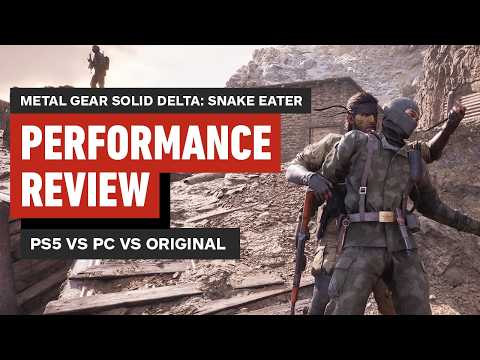
Metal Gear Solid Delta: Snake Eater PC vs PS5 Performance Review
Metal Gear Solid Delta: Snake Eater - A Remake Overview
Introduction to Metal Gear Solid Delta
- The speaker expresses excitement about the remake of "Metal Gear Solid Delta: Snake Eater," highlighting its status as a legendary title from the PlayStation 2 era.
- Originally designed with the PlayStation 3 in mind, the game pushed the limits of its hardware, leading to performance issues that were only resolved in 2023's Master Collection.
Remake vs. Remaster
- Konami has returned to remastering roots with a remake for modern consoles and PC using Unreal Engine 5, though it is not a complete ground-up remake.
- Significant graphical improvements include high-quality textures, denser geometry, and enhanced effects like tessellated mud and global illumination.
Visual Enhancements
- New character models feature richer animations, particularly in facial expressions; hair systems react dynamically to environmental factors such as wind.
- Enhanced detail includes millions of triangles for various elements (eyes, guns), improving realism and immersion in gameplay.
Gameplay Mechanics Changes
- The camera system has been updated; players can choose between legacy mode (fixed angle) or a new over-the-shoulder view that allows full 360-degree movement.
- This new control scheme enhances gameplay experience by allowing better appreciation of the environment and enemy patterns.
Environmental Details and Lighting
- Modern hardware allows for more detailed environments with realistic motion effects (e.g., exploding barrels, wildlife interactions).
- Advanced lighting techniques using Unreal Engine 5 provide improved depth and color accuracy through virtualized shadow maps.
Animation and Sound Quality
- While animation quality has improved due to better rigs and expressions, much of it remains based on original motion capture data from 2004.
Game Performance and Visual Quality Analysis
Modernization of the Game
- The new mode enhances the game's technical quality, allowing players to appreciate both the original game and its visual improvements. However, audio quality has not progressed significantly.
Dialogue Quality
- Some dialogue in the game is criticized as cringe-worthy, with examples like "Enemy sighted. Requesting backup." highlighting a lack of depth.
Graphics Modes on PS5
- The PS5 version offers two modes: Quality (dynamic 4K at 30 fps) and Performance (dynamic 4K at 60 fps), with varying resolutions from native 1440p down to 1080p or even lower during action sequences.
Image Reconstruction Techniques
- Both modes utilize AMD's FSR2 or FSR3 for image reconstruction; however, PC users benefit from newer technologies like DLSS3 that provide superior performance without ghosting issues.
PS5 Pro Performance Insights
- The PS5 Pro targets dynamic 4K at 60fps but often operates around 1080p native resolution. While it reduces artifacts compared to base PS5, it suffers from softness in texture clarity.
Ghosting and Artifacts Issues
- Both consoles experience ghosting issues, particularly noticeable against high contrast backgrounds. Despite some improvements on the PS5 Pro, image quality can still break down under certain conditions.
Overall Performance Struggles
- The game struggles with performance on both PS5 models, especially in performance mode where frame rates fluctuate significantly below expected levels during intense scenes.
Frame Rate Inconsistencies
- The quality mode frequently fails to maintain a steady frame rate of 30 fps due to memory constraints and CPU limitations, leading to jarring gameplay experiences during camera pans or cutscenes.
Combat Situations Impact on Performance
- During combat scenarios or when heavy foliage is present, frame rates can drop into the low 50s or even lower, affecting overall gameplay smoothness.
Cutscene Frame Rate Issues
- Even though cutscenes aim for a target of 60fps on the PS5 Pro, they rarely achieve this consistently across different sections of gameplay.
Legacy Limitations Affecting New Release
- The remaster's performance is only marginally better than the original PS2 version despite being released over two decades later. This raises concerns about authenticity and expectations for modern updates.
Cross-platform Concerns
- There are doubts regarding whether Xbox Series X and S will perform better than PlayStation consoles given similar underlying technology limitations affecting all platforms.
Metal Gear Solid Remake: A Missed Opportunity?
AI and Gameplay Mechanics
- The enemy AI in the remake is criticized for being outdated, reminiscent of early 2000s games like Fear and Splinter Cell, lacking the sophistication seen in modern titles such as Red Dead Redemption 2 and The Last of Us 2.
- There is a significant missed opportunity to enhance gameplay by improving enemy intelligence; enemies exhibit poor awareness, failing to react appropriately even when players are directly in front of them.
- The game appears to be a simple "lift and shift" from the PS2 original with minimal enhancements beyond visual upgrades, leading to a lackluster experience.
Performance on PC vs. Consoles
- High demands on PC hardware are noted; even high-end setups like an RTX 5080 can struggle during intense combat scenarios despite options for DLSS or FSR3 that improve image quality.
- Weaker CPUs may face limitations due to dual-core constraints, affecting performance when multiple enemies are present on screen simultaneously.
Development Quality Concerns
- Despite visual improvements and better control systems, there are concerns about the overall development time and quality of the final product; it feels rushed with many UE5 technologies integrated without proper consideration.
- The game's performance issues extend beyond consoles, indicating developer shortcomings rather than platform limitations; FSR solutions do not align well with the game's art style.
Legacy and Expectations
- Critics argue that while visually appealing, the remake ultimately fails to capture the essence of its predecessor, presenting itself as a reskinned version rather than a true remake.
- The game suffers from loading issues similar to those experienced on PS2 due to memory limits; cutscenes also disrupt immersion with fade-to-black transitions.
Conclusion on Metal Gear Solid Remake