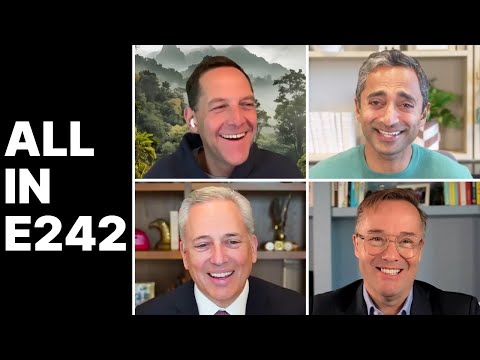
Inside the White House Tech Dinner, Weak Jobs Report, Tariffs Court Challenge, Google Wins Antitrust
Introduction and Context
Opening Remarks
- The hosts greet each other, with one host dressed in a tie for a government day in Washington, D.C.
- A humorous exchange about an invitation to the White House being eaten by a pet named Moose.
Podcast Transition
- The show has been moved to Fridays, with apologies for the delay in release.
- Discussion of a recent tech dinner at the White House attended by notable figures from the tech industry.
The Tech Dinner at the White House
Overview of Attendees
- Notable attendees included Mark Zuckerberg, Chamath Palihapitiya, Sam Altman, and Tim Cook among others.
- The gathering was described as remarkable due to its diverse representation from major tech companies.
Purpose and Significance
- The dinner was organized initially by Chimath and aimed to foster collaboration among top tech leaders.
- There was a sense of alignment and cooperation among attendees regarding President Trump's agenda.
Insights from the Dinner
Menu and Atmosphere
- An elegant menu featuring light dishes like burrata salad and filet mignon was served to maintain an enjoyable atmosphere.
Reactions from Attendees
- Attendees expressed support for President Trump’s policies that facilitate business growth compared to previous administrations.
- Noteworthy is how traditionally liberal figures like Tim Cook have shown support for Trump’s agenda during this event.
Personal Reflections on Attendance
Recognition of Contributions
- Hosts reflected on their pride in seeing Sachs recognized positively by influential leaders at the dinner.
Absence of Other Guests
- Freeberg humorously notes his absence due to working in agriculture while discussing future events he plans to attend.
Interview Highlights with Senator Rand Paul
Key Takeaways from Interview
- Freeberg shares insights from his interview with Senator Rand Paul, highlighting Paul's independent thinking and libertarian beliefs.
Political Dynamics
Discussion on Independent Thinkers in Congress
The Role of Independent Voices
- There is a call for more independent thinkers in Congress, as the current two-party system often leads to uniform voting along party lines, which is seen as a weakness.
- The discussion highlights Rand Paul's role as an agitator and the importance of having diverse viewpoints, including libertarian perspectives, within the political discourse.
Insights from Tech Leaders' Dinner
- A dinner attended by tech leaders revealed a surprising consensus among competing companies regarding economic conditions and support needed for the tech industry.
- Many attendees expressed satisfaction with the Trump administration's pro-innovation and pro-worker policies, which they believe contribute positively to both the tech sector and the U.S. economy.
President's Engagement with Tech Leaders
- The president's AI summit speech was well-received, emphasizing innovation and infrastructure that supports energy exports and international sales.
- The dinner served as an opportunity for tech leaders to voice their concerns directly to the president, who was described as a great listener eager to incorporate feedback into economic growth strategies.
Behind-the-Scenes Dynamics
- Details about seating arrangements at events indicate that the president takes meticulous control over logistics during meetings with influential figures.
- An anecdote about a tour of the Oval Office illustrates how personal interactions can reveal historical significance while fostering informal discussions among attendees.
Surreal Experience in Roosevelt Room
- Attendees experienced surreal moments meeting powerful business leaders in an intimate setting where they were reminded of their roles as American citizens engaging with government officials.
Meeting in the Oval Office
Introduction to the Meeting
- The meeting takes place at the Resolute desk, where attendees are introduced one by one, creating a personal atmosphere as they hear their names called.
- A light-hearted moment occurs when a husband requests a pen from the president, who responds positively and shares challenge coins with everyone present.
Initial Conversations
- After photo opportunities, Sergey initiates discussions while seated at the desk, prompting an engaging conversation among attendees.
- As they transition to dinner in the Rose Garden, Sunonny Madro asks about a music playlist that leads to lively background music being played.
Dinner Arrangements
- Attendees move into the East Wing for dinner; notable figures include Tim and Jamie Simmonoff along with Sham Sankar and Dave Limp.
- An innovative seating arrangement is described where guests can see their assigned seats on a model of the table before being escorted to them.
First Lady's Involvement
- Melania Trump is highlighted for her interest in AI education; she chairs an AI education task force aimed at providing resources for schools across America.
- The importance of ensuring every school child has access to AI education is emphasized through pledges made by various companies during an earlier event.
Press Interaction During Dinner
- The press enters unexpectedly, leading to chaotic interactions as reporters vie for attention and questions from CEOs begin.
- The president attempts to regain control over the situation by allowing key figures like Gates to speak first amidst overwhelming noise from reporters.
Discussion Dynamics
- Questions posed by reporters vary widely; some are challenging while others seem trivial. Zuck faces inquiries about free speech issues related to his platform.
Discussion on Presidential Engagement and Industry Challenges
Candid Questions and Challenging Topics
- The conversation begins with a reflection on the nature of questions posed to the President, emphasizing that attendees were not there to "gotcha" him but rather to discuss real issues they face.
- Participants raised specific challenges related to their industries, indicating a desire for constructive dialogue rather than confrontational questioning.
Immigration and Business Concerns
- Immigration, particularly high-skilled immigration, is highlighted as a significant concern for American companies looking to operate effectively.
- Attendees expressed appreciation for previous administration policies that facilitated business operations, noting a sense of respect towards David's contributions in this context.
Economic and Technical Supremacy
- The discussion shifts to the importance of economic and military supremacy as foundational elements of the American dream, which are driven by technical advancements.
- The President is portrayed as an advocate for industry leaders who contribute significantly to technological progress, fostering an inspiring atmosphere during discussions.
Lighthearted Moments During Serious Discussions
- A humorous moment arises when the President jokes about filming a segment for David's podcast, lightening the mood among attendees.
- Zuck adds humor by commenting on parts of the podcast being "dumb," showcasing camaraderie among participants despite serious topics being discussed.
Personal Touches in Presidential Care
- A notable moment occurs when Chimat interacts with fans after leaving the White House, highlighting personal connections beyond formal engagements.
- Insights into how much care the President takes regarding White House aesthetics are shared; he actively participates in selecting art and landscaping improvements.
Accountability in Leadership
- An anecdote reveals how the President addressed damage caused by contractors at the Rose Garden patio, demonstrating his hands-on approach and commitment to quality control.
Discussion on Political Engagement and Business Relations
Democrats' Missed Opportunities
- The speaker notes that 19 lifelong Democrats have switched parties, suggesting a significant opportunity for the Democratic Party to engage with these individuals.
- A call for dialogue is emphasized; if Biden or Kamala had invited this group to the White House, it could have led to meaningful discussions on key issues like wages and healthcare.
- Criticism of the current Democratic agenda is presented, highlighting a disconnect between party leaders and constituents who feel unheard.
Importance of Access and Dialogue
- The speaker commends efforts made by Saxs in facilitating access between business leaders and the president, allowing important discussions to take place.
- It’s noted that 90% of Americans aspire to be billionaires, indicating a cultural admiration for success that Democrats should recognize rather than dismiss.
Celebrating American Success
- The discussion highlights that 70% of the top 50 companies by market cap are American, showcasing the strength of American entrepreneurship as part of the national identity.
- Trump’s approach is described as engaging with business communities to foster growth and competitiveness against global players like Modi's alliance with China and Russia.
Economic Growth Context
- The speaker attributes low unemployment rates not solely to presidential actions but primarily to successful companies contributing positively to the economy.
- There’s an acknowledgment of public affection for major brands (e.g., iPhone, Tesla), reinforcing a narrative that celebrates innovation and economic contributions from businesses.
Bridging Political Divides
- Clarification is made regarding existing relationships between business leaders and the president prior to recent engagements; policy assistance has been provided without overstating influence.
- An example is given about Mark Pinkis, a former Democrat frustrated by lack of communication with party leaders, illustrating how moderates can feel alienated from their own party.
Shifts in Political Alignment
- Some attendees at recent dinners have shifted politically towards more centrist or right positions while others maintain their original views but seek constructive relationships with government.
- The importance of dialogue between CEOs and government representatives is stressed as beneficial for overall economic growth without necessitating political alignment changes.
Constructive Engagement
Court Ruling on Trump's Tariffs
Overview of the Court's Decision
- The court ruled that Trump exceeded his authority under the Emergency Economic Powers Act regarding tariffs, historically a congressional responsibility during national emergencies.
- A group representing small businesses sued the White House; two federal courts agreed with them, stating Trump wrongfully invoked the Emergency Act. The White House has appealed this decision.
Impact and Popularity of Tariffs
- Despite being unpopular among 70-80% of business leaders, Trump's tariffs generated over $150 billion in revenue within months and could potentially yield trillions over the next decade.
- Discussion on whether aggressive executive actions are a natural extension of current administration strategies; concerns about Supreme Court rulings on tariffs were raised.
Legal Authority for Tariffs
- There are five different laws granting the president authority to impose tariffs: sections 232, 2011, 301, 122, and 338. This suggests a low likelihood of significant changes from the Supreme Court.
- The Supreme Court may not view tariff policy as an urgent matter requiring quick resolution; thus, future reversals by subsequent presidents seem unlikely.
Revenue Generation through Tariffs
- Changing public perception about tariffs could hinge on framing them as a means to raise $4 trillion for government funding rather than simply imposing taxes.
- The Congressional Budget Office (CBO) projects that tariffs will raise approximately $400 billion annually over the next decade.
Business Perspectives on Tariffs
- A survey indicated that 72% of manufacturers reported negative impacts from higher tariffs; only 3.7% felt they helped their businesses.
- While unpopular in retail and manufacturing sectors, some argue that American workers might favor tariffs due to potential new revenue streams.
Strategic Implications of Tariffs
- Some experts believe that initial economic predictions against tariffs lacked practical data; recent outcomes suggest close to half a trillion dollars in incremental revenue could be realized.
Impact of Tariffs on Business and Legislative Powers
Business Implications of Tariffs
- The speaker discusses starting a battery factory in Michigan to reduce reliance on China, highlighting the positive impact of tariffs on business operations.
- A significant advantage is noted with 100% depreciation on capital expenditures (capex), improving internal funding capabilities and enhancing project IRR (Internal Rate of Return).
- The speaker anticipates an increase in revenue due to tariffs, emphasizing the importance of reevaluating financial projections after the factory's completion in two years.
- The underwriting landscape for U.S. investments has shifted positively due to tax savings from depreciation, making it easier for businesses to secure funding.
Tariff Revenue and Inflation Concerns
- Discussion around whether tariffs will generate over $250 billion annually; current estimates suggest a potential shortfall but optimism remains about reaching targets.
- Concerns are raised regarding inflation as businesses absorb tariff costs temporarily but may not sustain this indefinitely, potentially leading to price increases.
Legal Framework Surrounding Emergency Powers
- The conversation shifts to the legal implications of presidential emergency powers used for implementing tariffs without congressional approval.
- Reference is made to discussions with Senator Rand Paul about legislative challenges posed by emergency authorizations under the National Emergencies Act of 1976.
Future Legislative Changes
- Proposed changes include requiring congressional reauthorization for emergency powers beyond 30 days, aiming to limit executive authority in future administrations.
- Emphasis is placed on ensuring that any use of emergency powers requires ongoing legislative support, reflecting concerns about unchecked presidential power.
Fiscal Responsibility and Long-term Effects
- The speaker expresses concern over using tariff revenue as a means to offset spending rather than addressing deficit reduction directly.
Discussion on Executive Powers and Tariffs
The Role of Congress in Approving Tariffs
- A suggestion is made about the president seeking Congressional approval for tariffs, questioning if this would be a negative approach.
- Concerns are raised regarding potential executive actions by President AOC that may conflict with Republican interests if she wins in 2028.
Codifying Policies into Law
- The importance of codifying policies into law is emphasized, as executive orders can be easily overturned by subsequent administrations.
- It is suggested that after winning legal battles, efforts should focus on making these policies permanent through legislation rather than waiting for Congressional action.
Impact of Trump's Tariff Policy
- Trump’s unilateral actions shifted the tariff debate significantly, challenging both major political parties' previous stances against tariffs.
- There is speculation that once established, tariffs will remain popular and unlikely to be rescinded by future presidents due to their financial implications.
National Guard Deployment and Public Safety
Legal Challenges and Public Perception
- Recent court rulings have deemed some of Trump's actions illegal, including the deployment of the National Guard.
- The discussion highlights public support for safety measures and questions how tax money is utilized if local governments fail to ensure safety.
Perspectives on National Guard Intervention
- There's a belief that citizens affected by crime would welcome National Guard intervention to address issues like drug dealing and encampments.
- Concerns are raised about state sovereignty versus federal intervention when it comes to deploying the National Guard in states with high crime rates.
Trump's Approval Ratings Amid Crime Reduction Efforts
Swift Actions Leading to Popularity
- The speaker argues that swift executive actions taken by Trump have led to increased approval ratings, particularly due to reduced crime rates in Washington D.C.
- Positive feedback from local officials indicates satisfaction with federal assistance during times of unrest.
Contextualizing California's Situation
- Clarification is provided regarding the circumstances under which the National Guard was deployed in California, emphasizing it was a response to riots rather than an overreach of power.
Job Market Analysis and Economic Data Reliability
Job Growth and Revisions
- The job market showed disappointing results with only 22,000 jobs added compared to the expected 75,000. Most gains were in part-time positions, while full-time jobs decreased by 357.
- Revisions indicated a slight increase in July's job numbers (up by 6K), but June was significantly revised downwards, marking it as the first month since July 2021 with a net loss of jobs.
- A chart highlighted that revisions for May and June were substantial, often in the six figures, indicating ongoing adjustments to previously reported data.
Concerns Over Data Reliability
- There are conflicting interpretations of the job report; some view it positively while others suggest underlying issues based on birth statistics that could indicate negative trends.
- The Bureau of Labor Statistics (BLS) is criticized for its unreliable data collection methods, which complicate economic decision-making.
Blockchain as a Solution
- A proposal was made for critical economic data to be reported anonymously on blockchains to improve accuracy and reliability. This would allow better insights into economic conditions.
- Companies like ADP and Stripe are encouraged to contribute their data to create a more comprehensive understanding of the economy.
Historical Context of Job Data Accuracy
- Research revealed significant discrepancies in job reporting over recent years: 2021 saw an underestimation by 1.9 million jobs (15%), while other years also had notable inaccuracies.
- In the first half of this year alone, initial readings were off by about 50%, raising concerns about how accurately these figures reflect reality.
Implications for Federal Actions
- The lack of reliable data may lead federal actors to hesitate in making necessary economic adjustments until overwhelming evidence emerges.
- Current expectations suggest a conservative approach from the Fed regarding interest rate cuts despite potential needs for more aggressive action due to faulty data interpretation.
Broader Economic Perspectives
- The discussion emphasizes that merely cutting rates without a clear strategy does not address underlying economic issues; accurate data is crucial for informed decision-making.
Economic Insights and Job Market Analysis
Job Data Interpretation
- The discussion begins with a contradiction in job data: 22,000 jobs were added in August, yet unemployment rose from 4.2% to 4.3%. This is attributed to more people entering the job market.
- There are significant error margins in employment data, with revisions of about 50% over time, leading to varied interpretations among analysts.
Diverging Economic Perspectives
- Pessimistic views come from economists like Mark Zandi of Moody's, who warns of a potential recession. In contrast, Poly Market shows only an 8% bet against a recession this year.
- Despite concerns, recent GDP growth at 3.3% for Q2 suggests economic resilience; many believe the economy remains strong.
Employment Trends
- A notable trend is the increase in American-born workers' employment by around 2 million since early 2025, while foreign-born workers have lost approximately one million jobs.
- The federal government has reduced its workforce by about 100,000 jobs this year alone; fewer federal employees may positively impact the economy.
Wage Growth and Investment Outlook
- Blue-collar wages are experiencing significant growth (3.7%) compared to inflation (2.7%), resulting in a net wage increase during Biden's presidency after previous declines.
- Optimism stems from substantial investments projected at $8 trillion from private companies and foreign governments alongside an AI boom expected to enhance various sectors.
Future Economic Predictions
- Key factors for future economic growth include new tax incentives for business expansion and anticipated interest rate cuts that could stimulate further economic activity.
Antitrust Case Against Google
- Google was found liable in an antitrust case; however, sanctions were less severe than expected as the judge emphasized competition within a free market.
- The ruling reflects a shift towards recognizing competitive dynamics rather than succumbing to political pressures that might have influenced earlier decisions.
The Future of Google: Market Dynamics and AI Disruption
The Role of the Free Market in Competition
- The judge noted that severe remedies are unnecessary as the free market effectively addresses competition issues, highlighting its ability to self-correct.
- Consumers favor "creative destruction," seeking better prices and services, which incentivizes companies to innovate and improve.
- With reduced external pressures, Google may feel emboldened to compete more aggressively without internal slowdowns from employees.
Implications of Exclusive Deals
- The ruling restricts exclusive deals for monopolistic players like Google, preventing them from securing partnerships solely with major browsers like Firefox and Apple.
- This opens opportunities for competitors (e.g., DuckDuckGo or Bing) to bid for search traffic, potentially altering the competitive landscape.
Evolving Perspectives on Google's Monopoly
- Initially advocating for breaking up Google due to its perceived invulnerability, a shift in perspective acknowledges that monopolies can be challenged by market forces.
- AI poses an existential threat to Google's core business model; traditional search is being overshadowed by AI-driven alternatives.
The Shift Towards AI in Search
- A significant portion of AI revenue is currently dominated by OpenAI, indicating a competitive landscape where multiple firms are vying for consumer attention.
- The nature of search is evolving into an "answers business," moving away from traditional link-based results towards direct answers provided by AI chatbots.
Google's Response to Competitive Threats
- As quality improves in AI responses, users may prefer these over conventional search results. Google's speed advantage could diminish if AI response times improve significantly.
- Sergey Brin's return indicates heightened urgency within Google as they confront serious competition and seek innovative solutions through DeepMind involvement.
Antitrust Considerations Moving Forward
- Opponents of strict antitrust measures argue that market dynamics will naturally disrupt monopolies without heavy-handed intervention; this appears to be unfolding with Google.
- While not advocating for unrestricted anti-competitive practices, there’s agreement on allowing healthy competition among new entrants while maintaining basic regulatory frameworks.
Conclusion: Navigating Market Challenges
- Establishing clear rules against exclusive deals while promoting fair competition aligns with FTC goals—ensuring consumers benefit from improved products at lower prices.
Event Announcements and Future Content
Upcoming Content and Engagement
- The hosts mention that a significant amount of content will be released in the upcoming week or two following the event, encouraging listeners to stay engaged.
- Listeners are urged to subscribe to the YouTube channel and enable notifications by clicking the bell icon for alerts on new content.
- The website allin.com is highlighted as a platform where fans can sign up with their email to receive invitations for future events.
Fun Activities Planned
- There are hints at potential activities involving poker, suggesting that hosts Chamath and another participant may engage in this space, which could be entertaining for fans.
- Another activity mentioned includes a backgammon tournament planned between one of the hosts (referred to as TK) and another participant, indicating a mix of gaming and social interaction.
Closing Remarks
Farewell Messages
- The podcast concludes with warm farewells from the hosts, expressing love towards their audience ("Love you guys") before signing off.
- A light-hearted comment about "letting your winners ride" is made, possibly referring to gambling or investment strategies discussed earlier in the podcast.
Humorous Commentary
Lighthearted Banter
- One host humorously suggests that they should all gather in one room due to perceived "uselessness," implying an exaggerated sense of camaraderie among them.
Turn any video into a summary like this
YouTube links, meetings, lectures. With transcripts, search, and chat.