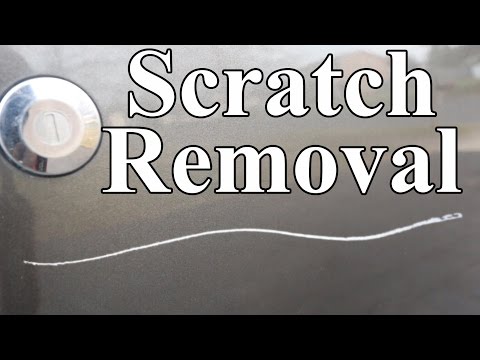
How to Remove Scratches from Car PERMANENTLY (EASY)
New Section
In this video, Chris Fix demonstrates how to remove scratches from a car's paint. He explains the different types of scratches and focuses on fixing clear coat scratches using five simple steps that can be done at home.
Introduction
- Chris Fix introduces himself and explains that he will show how to remove scratches from a car's paint.
- Different types of scratches are mentioned, with a focus on clear coat scratches.
- Various causes of clear coat scratches are discussed, such as rubbing against the car or having grit on the surface.
Five Steps to Remove Scratches
- Wash the area with soapy water and a towel.
- Mask the area to identify the scratch location.
- Sand the scratch with 3000 grit and then 5000 grit sandpaper.
- Use polish to further improve the appearance of the scratched area.
- Buff the area with wax for added protection and shine.
Understanding Car Paint Layers
- The three main layers of car paint are explained:
- Primer (first coat) over bare metal.
- Base coat (second coat) providing color.
- Clear coat (third coat), which is thick and glossy, protecting the paint.
- The importance of a protective wax layer is mentioned, filling in small imperfections and guarding against light scratches and water marks.
How Scratches Are Visible
- The reason why scratches in clear coats are visible is explained:
- Light hitting a scratch reflects differently than scratch-free paint, catching one's eye.
- The goal is to smooth out the scratch so that light no longer catches it.
Identifying Clear Coat Scratches
- A simple test to determine if a scratch is a clear coat scratch is demonstrated:
- Spray soapy water on the scratch; if it disappears temporarily, it's a clear coat scratch.
- The scratch becomes visible again when the water dries up.
- Deep scratches that reveal primer or do not disappear with water require additional paint and clear coat repair.
Example Scratch Removal
- Chris Fix creates a deep scratch as an example of worst-case scenario.
- The five-step process is applied to remove the created scratch, demonstrating its effectiveness.
Timestamps are approximate and may vary slightly depending on the video version.
New Section
This section discusses the process of checking if a scratch disappears and masking it off before starting the repair.
Checking for Scratch Disappearance
- To verify if a scratch is a clear coat scratch, check if it disappears.
- If the scratch disappears, proceed with the repair.
Masking Off the Scratch
- Use tape to mask off the scratch, leaving about half an inch on each side.
- Ripping off the ends of the tape ensures that the end of the scratch aligns with the end of the tape on both sides.
Identifying Work Area
- By masking off the scratch, you have a clear area to work on.
- Move the tape up and down to create a larger area for each step.
Sanding Process
- Start sanding with 3000 grit sandpaper if the scratch is deep and catches your fingernail. If not, start with 5000 grit.
- Sand perpendicular to the direction of the scratch using a kitchen sponge wrapped in sandpaper for even pressure distribution.
- Spray down both the area and sandpaper with water before sanding.
- Sand for about 15 seconds and check if the scratch is still visible. Repeat until almost gone.
- For deep scratches, apply more pressure by removing the sponge from under sandpaper.
- Feather in surrounding areas while working with 5000 grit sandpaper.
Final Inspection
- Clean off any residue and inspect your work. Remove masking tape to see repaired area clearly.
New Section
In this section, the speaker discusses the process of polishing a scratched surface to restore its appearance.
Polishing Process
- The speaker mentions that there is no mark where the scratch used to be.
- They state that they cannot see anything on the surface.
- The speaker points out an area that needs to be polished to match the rest of the paint.
- If the scratch is still visible, they recommend continuing with 5000 grit sandpaper until it disappears completely.
- The next step involves using a fine polish (between 5000 and 10,000 grit) to remove fine scratches and swirl marks. It is important to clean the surface before applying polish to avoid rubbing dirt into the paint.
- The speaker instructs to apply polish on a clean microfiber towel and rub it in circular motions, focusing on the hazy area and feathering it out into surrounding paint.
- They emphasize using medium to heavy pressure while polishing with a microfiber towel.
- If a slight haze remains after polishing, another coat of polish should be applied using a clean part of the microfiber towel.
- After polishing, lightly buffing the surface with a clean microfiber towel helps remove any excess polish residue.
Final Steps
- The speaker expresses amazement at how well the surface looks after polishing, stating that there is no trace of the scratch anymore.
- They highlight that this simple process can be done at home without any special tools or equipment.
- Applying paste wax is the final step to provide a protective layer, fill in microscopic scratches, and preserve the clear coat.
- The speaker demonstrates applying wax on the surface and allowing it to haze up for a minute.
- They then remove the wax using a clean cloth.
- The result is a scratch-free surface with a beautiful reflection.
Conclusion
- The speaker encourages viewers not to get upset about scratches as they can be easily removed using this method.
- They share before and after images of a scratched surface to demonstrate the effectiveness of the process.
- Product recommendations and tools used are provided in the video description for easy access.
- A top tip is given to avoid sanding too far if the scratch is deep, as it may damage the clear coat.
Timestamps have been associated with relevant bullet points based on their content.