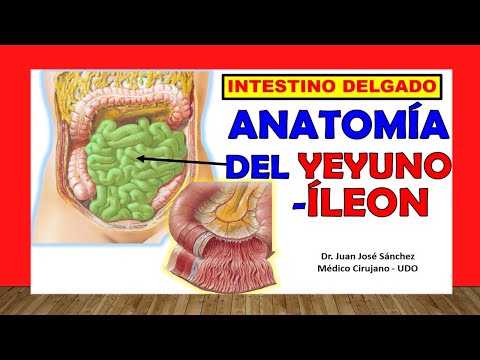
🥇 Anatomía del YEYUNO-ÍLEON, (Intestino Delgado). ¡Explicación Sencilla!
Understanding the Small Intestine
Overview of the Small Intestine
- The small intestine is crucial for digestion, primarily responsible for nutrient absorption.
- It follows the stomach in the digestive tract and is considered the longest part of the intestinal system, measuring 6 to 8 meters in living individuals.
- Autopsy studies show that it can measure up to 9 meters due to relaxation after death, which contrasts with its contracted state during life.
Anatomy and Structure
- The small intestine begins at the pyloric sphincter (the valve separating it from the stomach) and ends at the ileocecal valve (where it meets the large intestine).
- It consists of three main portions: duodenum, jejunum, and ileum. The duodenum is studied separately due to its distinct anatomical features.
Jejunum and Ileum Characteristics
- Many texts group jejunum and ileum together because distinguishing between them anatomically in living subjects is challenging.
- Unlike the duodenum, which has a clear demarcation point (duodenojejunal angle), identifying where jejunum ends and ileum begins is difficult.
Anatomical Differences Between Jejunum and Ileum
- The small intestine has a conical shape; its first portion (duodenum) is wider than its final portion (ileum), which narrows down towards the large intestine.
Understanding the Anatomy of the Abdominal Cavity
The Greater Omentum and Its Role
- The greater omentum is a structure of visceral peritoneum that resembles an apron, hanging from the transverse colon.
- It frames the small intestine, specifically highlighting its relationship with the jejunum and ileum within the colonic framework.
Differences Between Duodenum, Jejunum, and Ileum
- The duodenum is fixed to the posterior abdominal wall by parietal peritoneum, while jejunum and ileum are highly mobile.
- The mesentery supports the small intestine (jejunum and ileum), allowing for mobility while keeping it attached to the posterior abdominal wall.
Characteristics of Mesentery
- Mesentery is a fold of visceral peritoneum that holds small intestines in place but allows movement; it does not support the duodenum.
- In cross-section views, mesentery appears as a fold holding small intestinal structures without affecting other organs like ascending or descending colon.
Anatomical Positioning of Jejunum and Ileum
- Jejunum occupies primarily the upper left quadrant while ileum extends into lower left quadrant; this positioning can be confusing based on traditional descriptions.
- The jejunum comprises two-fifths of total intestinal length compared to three-fifths for ileum; this highlights their relative sizes.
Key Differences Between Jejunum and Ileum
- Jejunum has wider loops oriented horizontally, whereas ileal loops are more oblique or vertical due to its narrower lumen.
- Vascularization differs significantly: jejunum has richer blood supply (darker red color), essential for absorption, while ileal vascularization is less robust (lighter red).
Structural Variations in Intestinal Walls
Differences Between Jejunum and Ileum
Structural Characteristics
- The jejunum has a thicker mesentery with abundant adipose tissue compared to the ileum, indicating basic structural differences.
- Conniving folds are present throughout the intestine; however, they are more pronounced in the jejunum than in the ileum, particularly absent in the most distal part of the ileum.
Vascularization
- The arteries supplying the jejunum are significantly thicker and more vascularized than those for the ileum, highlighting another key difference between these two sections of the small intestine.
Understanding Mesentery and Its Role
Mesenteric Structure
- The mesentery is a structure of visceral peritoneum that supports the small intestine. It divides into supramesocolic (above transverse colon) and inframesocolic compartments (below transverse colon).
- The root of the mesentery measures approximately 15 centimeters long from its origin at the duodeno-jejunal angle to where it reaches the colon.
Functionality
- The visceral edge of the mesentery extends along with the small intestine, measuring about 5 to 6 meters in length while having a maximum width of up to 20 centimeters at its widest point.
Blood Supply and Drainage
Superior Mesenteric Vessels
- The mesentery contains superior mesenteric vessels, including both artery and vein, which play crucial roles in supplying blood to and draining blood from both jejunum and ileum.
Venous Drainage System