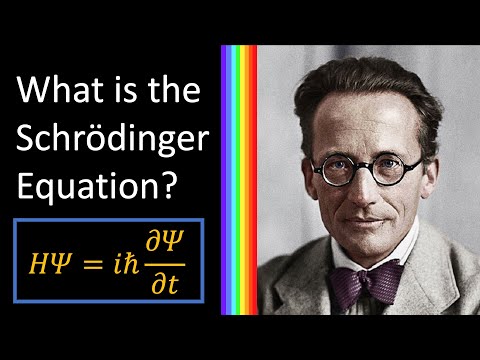
What is the Schrödinger Equation? A basic introduction to Quantum Mechanics
Introduction to the Schrodinger Equation
In this video, the speaker introduces the Schrodinger equation, which is a fundamental equation in quantum mechanics. The goal is to provide an overview of the equation and its significance.
Early Life and Education of Erwin Schrodinger
- Erwin Schrodinger was born in Vienna on August 12, 1887.
- He received his education at home until the age of 11 before attending a local gymnasium school.
- Schrodinger excelled in mathematics and physics during his time at the University of Vienna.
- In 1910, he received his doctorate and later joined the university as an assistant of experimental physics.
Journey to Discovering the Wave-Particle Duality
- After World War I, Schrodinger moved between various institutions in Europe before settling in Zurich, Switzerland.
- At the age of 37, he began to question if he would make a significant contribution to physics.
- In October 1925, Schrodinger read a paper by Einstein that mentioned Louis de Broglie's thesis on wave-particle duality.
- De Broglie proposed that matter particles could behave like waves with associated wavelengths and frequencies.
- Inspired by de Broglie's ideas, Schrodinger set out to find a wave equation that described these waves.
Development of Quantum Mechanics
- Within a few months, Schrodinger developed a fully blown theory of quantum mechanics based on de Broglie's wave-particle duality concept.
- The remainder of the video will provide a simplified overview of Schrodinger's theory.
Overview of Classical Waves and Wave Equations
This section provides an introduction to classical waves and their mathematical description using wave equations.
Properties of Classical Waves
- A simple progressive wave can be described using a cosine function, where amplitude (A), wavelength (λ), and frequency (f) are key parameters.
- The displacement function (y) represents the wave's motion at a given position (x) and time (t).
Wave Equations for Classical Waves
- The general wave equation involves partial derivatives and describes the relationship between displacement, position, and time.
- The displacement function is a solution to this wave equation.
Conclusion
The video provides an introduction to the Schrodinger equation, highlighting its importance in quantum mechanics. It explores Erwin Schrodinger's journey towards discovering the wave-particle duality concept and developing a wave equation to describe matter particles. Additionally, it introduces classical waves and their mathematical representation using wave equations.
The Wave Equation and Green's Expression
In this section, the wave equation and its solution are discussed, along with the relationship between velocity, frequency, and wavelength.
Wave Equation Solution
- The wave equation is derived, and a solution for the displacement function is found.
- Dividing both sides of the equation by y yields v^2 = ω^2 / k^2.
- This shows that the displacement function is a solution to the wave equation when v = ω / k.
Velocity-Frequency-Wavelength Relationship
- By substituting in the definitions of ω and k, it is found that v = fλ (velocity equals frequency times wavelength).
- The structure of the wave equation ensures that the expected wave function is a solution.
- It also ensures that there is a correct relationship between velocity, frequency, and wavelength.
Emphasizing Points about Wave Equation
This section emphasizes key points regarding the structure of the wave equation and its implications.
Key Points
- The structure of the wave equation guarantees that a wave function is a solution.
- It also ensures that there exists a relationship between frequency and wavelength.
- These outcomes can be traced back to differentiation with respect to space (k^2) and time (ω^2).
Relationship Between Frequency, Wavelength, and Wave Function
This section explores how a wave function serves as a solution to a wave equation when there is a specific relationship between frequency and wavelength.
Summary
- A wave function acts as a solution to a wave equation if there exists a certain relationship between frequency and wavelength.
- For classical waves, this relationship aligns with what we expect for traveling waves: v = fλ.
- Schrödinger began considering this relationship in 1925, inspired by de Broglie's idea that particles behave like waves.
Developing a Wave Equation for Particle Waves
This section delves into the challenge of developing a wave equation for particles behaving as waves and the assumptions made in this process.
Particle Waves and Wave Equation
- If particles behave as waves, their associated wave functions should be solutions to a wave equation.
- The first assumption is that the wave function can be described by a progressive traveling wave.
- This initial guess aligns with fixed frequency, wavelength, momentum, and energy for freely moving particles.
Challenges in Describing Changing Wavelengths
This section discusses the challenges faced when describing changing wavelengths due to forces acting on particles.
Defining Wavelength
- Wavelength becomes difficult to define if it changes rapidly.
- Variable wavelength is challenging when adjacent maxima and minima have unequal separations.
- A more complex wave function than cos(kx - ωt) is required when linear momentum changes due to forces acting on particles.
Schrödinger's Goal: Developing a General Wave Equation
Schrödinger aimed to develop a wave equation that could determine the form of the wave function based on information about the force acting on the associated particle.
Objective
- Schrödinger sought to construct a suitable quantum mechanical wave equation.
- The goal was to determine the form of the wave function given information about the force acting on the particle.
- This was achieved by specifying the potential energy corresponding to the force.
Assumptions for Constructing Quantum Mechanical Wave Equation
This section outlines reasonable assumptions made while constructing a quantum mechanical wave equation.
Assumptions
- Consistency with de Broglie-Einstein postulates connecting wavelength, momentum, frequency, and energy.
- Consistency with the energy equation for a particle (total energy = kinetic energy + potential energy).
- Linearity in the wave function to allow for constructive and destructive interference patterns.
- Sinusoidal traveling wave solutions of constant wavelength and frequency when potential energy is constant.
Expression for Schrödinger Wave Equation
This section presents an expression for the Schrödinger wave equation based on the assumptions made.
Schrödinger Wave Equation
- The energy relation is rewritten using de Broglie-Einstein postulates.
- The resulting expression serves as a basis for constructing the Schrödinger wave equation.
Timestamps are approximate and may vary depending on the source video.
New Section
This section discusses the derivation of the quantum mechanical wave equation for a freely moving particle.
Derivation of the Wave Equation
- The energy expression for a sinusoidal wave function is derived by substituting relations into it.
- The left-hand side of the energy expression contains a factor of k squared, while the right-hand side contains a factor of omega.
- To have sinusoidal traveling wave solutions, the differential equation should contain a second derivative with respect to x and a first derivative with respect to time. It should also include a term with potential energy that is linear and contains a factor of the wave function.
- A proposed wave function and wave equation are introduced, which leads to an unsatisfactory result due to a mixture of sine and cosine terms.
- A more general wave function is considered, involving a combination of cosine and sine functions. Differentiating this function leads to equations that can be substituted into the proposed wave equation.
- By setting gamma equal to i (the square root of -1), cancellation of terms in the equation occurs, resulting in an expression that matches the energy-momentum relationship derived from de Broglie's relation.
- Substituting these expressions back into the proposed wave equation yields the final quantum mechanical wave equation.
New Section
This section concludes the derivation process and emphasizes that although it was done for a free particle with constant potential energy, it can be postulated that the same form applies in general cases.
Conclusion and Postulation
- The derived quantum mechanical wave equation satisfies all four assumptions regarding its form for freely moving particles with constant potential energy.
- It is postulated that the same form of the wave equation applies in general cases where potential energy can vary as a function of space and time, although this cannot be proven.
- The validity of the postulate will be judged by comparing its implications with experimental results.
- The derived wave equation provides the wave function associated with the motion of a particle under the influence of quantum mechanics.
New Section
This section discusses the significance of the Schrodinger equation and its use in determining the structure of wave functions associated with particles.
The Significance of the Schrodinger Equation
- The Schrodinger equation is used to determine the structure of wave functions associated with particles.
- To use the Schrodinger equation, one needs to specify the potential energy function, which describes the forces acting on the particle.
- Solving the corresponding partial differential equation allows us to find the wave function.
Understanding Wave Functions
- Wave functions represent particles and are complex functions.
- Complex numbers can be represented as z = a + ib, where a is the real component and b is the imaginary component.
- The complex wave function specifies two real functions: its real part and its imaginary part.
- In classical mechanics, wave functions are not complex because they do not contain an imaginary component.
Complex Numbers and Modulus Squared
- Complex numbers can be plotted on a graph using their real and imaginary components.
- The modulus squared of a complex number represents a real number that can never be negative.
- In quantum mechanics, wave functions are complex but should not be assigned physical existence like water waves.
- The modulus squared of a wave function represents the probability of finding a particle at a particular location in space.
Born's Postulate
- Max Born suggested that the modulus squared of a wave function represents the probability of finding a particle at a specific coordinate in space.
- By integrating the modulus squared over a given region, we can determine probabilities for finding particles within that region.
New Section
This section explores what complex wave functions represent and how they relate to localized particles. It also introduces Max Born's postulate regarding probabilities.
Interpreting Complex Wave Functions
- Complex wave functions represent particles, but they are spread out in space.
- The modulus squared of a complex wave function represents a real number that can be experimentally determined.
- Max Born's postulate suggests that the modulus squared of the wave function represents the probability of finding a particle at a specific location.
Probability Calculation
- The probability of finding a particle between two points A and B is given by integrating the modulus squared over that region.
- The modulus squared is calculated by multiplying the wave function with its complex conjugate.
New Section
This section further explains Max Born's postulate and how it relates to determining probabilities in quantum mechanics.
Understanding Probabilities
- Max Born's postulate states that the modulus squared of the wave function represents the probability of finding a particle at a particular location.
- When measuring the position of a particle associated with a wave function, the probability is given by multiplying the wave function with its complex conjugate.
- Integrating the modulus squared over a region allows us to determine probabilities for finding particles within that region.
Calculating Probabilities
- To find the probability of locating a particle between two points A and B, we integrate the modulus squared over that interval.
- The integral evaluates to give us the probability value for that specific region.
Please note that these summaries are based on limited information from timestamps provided in the transcript.
New Section
This section discusses the interpretation of the wave function in quantum mechanics and introduces the concept of indeterminacy.
Interpretation of Wave Function
- The wave function represents the probability density of a particle.
- The wave function is complex, while the probability density is real and positive.
- Bourne's interpretation suggests that the squared modulus of the wave function refers to a measurable quantity.
- Quantum mechanics provides statistical information about measurement outcomes rather than deterministic predictions.
New Section
This section focuses on solving the Schrödinger equation using the separation of variables technique.
Solving Schrödinger Equation
- The separation of variables technique involves finding solutions where the wave function can be written as a product of two terms, one dependent on position (x) and one dependent on time (t).
- This method is valid when potential energy is independent of time.
- Substituting this expression into the time-dependent Schrödinger equation leads to a pair of ordinary differential equations involving x and t separately.
- By rearranging these equations, we find a common constant value called the separation constant (k).
New Section
This section focuses on solving the time-dependent part of the Schrödinger equation.
Solving Time Dependent Equation
- Rearranging the time-dependent equation reveals that its solution, phi(t), has an exponential form.
- Assuming phi(t) = e^(-i k t / h-bar), where alpha = -i k / h-bar, satisfies this differential equation.
- Euler's equation allows us to rewrite phi(t) in terms of trigonometric functions.
- The angular frequency (omega) is related to the separation constant (k) and frequency (f) by omega = 2 pi k / h.
- The separation constant (k) is related to the energy (E) of a quantum particle.
New Section
This section focuses on solving the space-dependent part of the Schrödinger equation.
Solving Space Dependent Equation
- Substituting k = E into the space-dependent equation yields a time-independent Schrödinger equation.
- Solutions of this equation determine the spatial dependence of the wave function and are called eigenfunctions.
- The solution for psi(x), the space-dependent part, is not explicitly provided in this section.
New Section
This section provides an overview of the separation of variables approach and its application to the time-independent Schrodinger equation. It also introduces the concept of eigenfunctions and their role in determining the space and time dependence of the wave function.
Separation of Variables Approach
- The separation of variables approach leads to the conclusion that the eigenfunction psi(x), which specifies the space dependence of the wave function, is a solution to the time-independent Schrodinger equation.
- The time dependence of the wave function is governed by phi(t) = e^(-iEt/hbar), where E is the total energy of the particle in the system.
Application to a Specific Example: Infinite Square Well
- The example considered is a particle confined to a one-dimensional box with width 'a'. The particle can move freely inside but cannot escape. This example is known as an infinite square well.
- Outside the box, the wave function must be zero since there is no probability of finding the particle there. Inside, where V(x) = 0, except at x = 0 and x = a where an infinite force prevents escape.
- To determine the form of the wave function inside the box, we solve for it using the time-independent Schrodinger equation with V(x) = 0. This simplifies to d^2(psi)/dx^2 + k^2(psi) = 0, where k = sqrt(2mE/hbar).
- By considering boundary conditions (psi(0) = psi(a) = 0), we find that psi(x) takes on a sine function form: psi(x) = A*sin(kx). The allowed values of k are determined by the condition sin(ka) = 0, leading to quantized energy levels.
- The energy levels are given by E_n = (n^2pi^2hbar^2)/(2ma^2), where n is an integer representing different energy states. The ground state energy is non-zero and given by E_1 = (pi^2*hbar^2)/(2ma^2).
Conclusion
- The separation of variables approach allows us to determine the space and time dependence of the wave function in quantum mechanics. In the case of the infinite square well, we find quantized energy levels and corresponding eigenfunctions that resemble standing waves on a string.
Determining the Value of a
In this section, we use Bourne's probability rule to determine the value of a in the wave function.
Evaluating the Integral for Probability
- The probability of finding a particle in a region is given by the integral with respect to x of the modulus squared of the wave function.
- For a particle confined to a box, we expect the probability inside the box to be equal to one.
- We evaluate this integral and simplify it using trigonometric identities and rules of exponents.
Normalizing the Wave Function
Here, we discuss normalizing the wave function and its implications.
Normalizing the Wave Function
- To ensure that the total probability of finding the particle somewhere in space is one, we normalize the wave function.
- The process of determining wave function coefficients for normalization is referred to as normalizing the wave function.
- The normalized wave function for each quantum state in a box is determined.
Properties of Stationary States
- A wave function with no time dependence describes a stationary state.
- Stationary states have sharply defined energies corresponding to each value of n.
- The modulus squared of the wave function determines where we are most likely to find the particle within the box for each eigenstate.
Quantum Mechanical Predictions vs. Classical Mechanics
This section explores how quantum mechanical predictions approach classical mechanics predictions as energy increases.
Approaching Classical Mechanics Predictions
- As n (quantum number) approaches infinity or energy increases, quantum mechanical predictions approach classical mechanics predictions.
- In this limit, there is equal probability for finding particles at any location within the box.
- The discreteness of energy cannot be resolved, and it appears as if energy varies continuously.
Calculating Probability in a Given Region
Here, we discuss how to calculate the probability of finding a particle in a specific energy state within a particular region of space.
Integrating the Wave Function
- To calculate the probability, we integrate the modulus squared of the corresponding wave function over the region of interest.
- We change variables and use trigonometric identities to simplify the integral expression.
- The resulting integral provides the probability of finding the particle in that region.
Introduction to Probability Theory
This section introduces probability theory and notation in the context of quantum mechanics.
Probability Theory Example
- A group of 12 people with different ages is used as an example.
- Notations are introduced to represent age distribution and total number of people.
The transcript is already in English.
Probability and Average Age
This section discusses the concept of probability in relation to age. It explains how the probability of selecting a person with a specific age can be calculated using the ratio of the number of people with that age to the total number of people. The sum of all probabilities must equal 1, indicating that someone must have some age. The average age is calculated by adding together all ages and dividing by the total number of people.
- The probability of selecting a person with a specific age is given by the ratio of the number of people with that age to the total number of people.
- The sum of all probabilities must equal 1, indicating that someone must have some age.
- The average age is calculated by adding together all ages and dividing by the total number of people.
Expectation Value and Spread
This section introduces the concept of expectation value in quantum mechanics. It explains how expectation value represents an average quantity and how it can be calculated for different functions. It also discusses the spread or uncertainty in a distribution, which is measured by variance and standard deviation.
- In quantum mechanics, expectation value represents an average quantity.
- Expectation value for a function can be calculated using an expression involving probabilities.
- Variance measures the spread or uncertainty in a distribution.
- Standard deviation is another measure of spread and is often referred to as uncertainty.
- A smaller standard deviation indicates less spread or uncertainty in data.
Variance and Standard Deviation
This section explores variance and standard deviation further. It explains how variance can be expressed as the difference between the average square value and square value averaged over data points. It also highlights that when variance equals zero, there is no spread in the distribution. Standard deviation is referred to as uncertainty and is a measure of spread in a variable.
- Variance can be expressed as the difference between the average square value and square value averaged over data points.
- Standard deviation is the square root of variance and measures the spread or uncertainty in a variable.
- When variance equals zero, there is no spread in the distribution.
- Standard deviation is often referred to as uncertainty.
Continuous Distributions
This section discusses how probability theory applies to continuous distributions. It explains that for continuous variables, probabilities are represented by probability density functions. The expectation value for continuous variables can be calculated using integrals.
- For continuous variables, probabilities are represented by probability density functions.
- Probability that a variable lies between two values can be calculated using integrals.
- Expectation value for continuous variables can be calculated using an integral expression.
Probability Density Function in Quantum Mechanics
This section relates probability theory to quantum mechanics. It explains that in quantum mechanics, the modulus squared of the wave function represents the probability density function. The expectation value of a particle's position can be calculated using an integral involving the wave function.
- In quantum mechanics, modulus squared of the wave function represents the probability density function.
- The expectation value of a particle's position can be calculated using an integral involving the wave function.
Expectation Value of Position in Infinite Square Well Potential
This section focuses on applying probability theory to calculate the expectation value of position for a particle in the ground state of an infinite square well potential. It explains that this expectation value does not depend on time and remains constant. The ground state eigenfunction is used to calculate the expectation value.
- The expectation value of position for a particle in the ground state of an infinite square well potential does not depend on time and remains constant.
- The ground state eigenfunction is used to calculate the expectation value.
[t=56m34s] Calculating the Expectation Value of Position
In this section, the speaker discusses how to calculate the expectation value of position for a particle in a box. They explain the process of evaluating integrals and integrating by parts to find the expectation value.
Evaluating Integrals and Integrating by Parts
- The first integral is simple and evaluates to a over 2.
- The second integral involves integrating by parts. Setting f equal to x and dg equal to cos(2πx/a), we find that g equals a sine(2πx/a) divided by 2π.
- Plugging these results back into the integral, we simplify it to a single term.
Changing Variables and Integration
- To integrate the expression further, we change variables by letting u equal 2πx/a. This leads to du being equal to 2π/a dx.
- After performing the integration, we find that the result evaluates to zero.
Conclusion: Expectation Value of Position
- After evaluating all terms, we find that the expectation value of position for a particle in a box is simply equal to a over two.
- This result aligns with our expectations based on the plot of the modulus squared of the wave function.
- Additionally, it is important to note that this expectation value does not depend on time.
[t=57m44s] Stationary States and Definite Energy
In this section, the speaker discusses stationary states and their characteristic features. They explain how stationary states have definite energy and are described by eigenfunctions of the Hamiltonian operator.
Defining Stationary States
- Stationary states are characterized by having definite energy.
- These states do not change with time, as their probability density remains constant.
Energy Eigenvalue Equation
- The spatial shape of an eigenfunction is governed by the time-independent Schrödinger equation, which can be written as an energy eigenvalue equation involving the Hamiltonian operator.
- The function psi(x) is referred to as the eigenfunction of the Hamiltonian with energy eigenvalue E.
Eigenfunctions and Eigenvalues
- An eigenfunction of the Hamiltonian operator is a special mathematical function that, when acted upon by the Hamiltonian operator, returns the same eigenfunction multiplied by the energy of the quantum state.
- Each eigenvalue corresponds to a specific energy level.
Probability Theory and Energy Measurement
- Using probability theory, we can show that a wave function representing an eigenfunction describes a state with a sharply defined energy.
- When measuring the energy of a quantum system, there is no uncertainty (standard deviation) in the outcome if it is an eigenfunction of the Hamiltonian operator with eigenvalue E.
Conclusion: Stationary States
- Eigenfunctions of the Hamiltonian always describe states of definite energy.
- These states are known as stationary states because their probability density does not change with time.
[t=58m21s] Summary and Key Points
In this section, the speaker summarizes key points covered so far regarding time-dependent and time-independent Schrödinger equations, stationary states, and definite energy.
Recap of Key Points
- The general time-dependent Schrödinger equation describes quantum mechanical systems.
- If potential energy is time-independent, we can separate variables and write the wave function as a product of spatial and temporal terms.
- The time-independent Schrödinger equation involves an energy eigenvalue equation with the Hamiltonian operator.
- Stationary states have definite energy and their probability densities do not change with time.
- Acceptable solutions to the time-independent Schrödinger equation exist only for certain discrete values of energy (eigenvalues).
- Each eigenvalue corresponds to an energy eigenfunction, which is a solution to the time-independent Schrödinger equation.
- The wave function for each eigenvalue can be constructed by adding the time dependence.
- Eigenfunctions of the Hamiltonian describe states with definite energy and are known as stationary states.
This summary covers only a portion of the transcript.
The General Schrodinger Equation and Linear Superposition
In this section, the speaker discusses the general Schrodinger equation for a given potential energy function. They explain that since the Schrodinger equation is linear in the wave function, any linear combination of these wave functions will also be a solution to the equation. This leads to the concept of a linear superposition of quantum states.
- The general form of the solution to the Schrodinger equation for a given potential function is a linear superposition of different eigenfunctions combined in proportions governed by constants.
- Once separable eigenfunction solutions are found, a more general solution can be constructed using linear superposition.
Normalization and Linear Superposition
In this section, the speaker discusses normalization and how it relates to the coefficients in a general wave function expression. They explain that normalizing the wave function requires that the integral of its modulus squared is equal to one.
- The coefficients in a general wave function expression must satisfy certain conditions for normalization.
- Normalization requires that the sum of modulus squared coefficients equals one.
Evaluating Integrals for Cross Terms
In this section, the speaker explains how to evaluate integrals involving cross terms in order to normalize a general wave function expression. They discuss two types of integrals - those involving different energy eigenstates (cross terms) and those involving the same eigenstate.
- Cross-term integrals involve different energy eigenstates and can be evaluated using orthogonality relations.
- Orthogonality between different eigenstates results in cross-term integrals vanishing.
- Integrals involving the same eigenstate can be simplified using normalization conditions.
Orthogonality and Normalization
In this section, the speaker further explains orthogonality between different eigenstates and how it relates to cross-term integrals. They introduce the concept of the Kronecker delta and discuss its role in combining orthogonality and normalization conditions.
- Cross-term integrals involving different eigenstates vanish due to orthogonality.
- The Kronecker delta is used to combine orthogonality and normalization conditions.
- Eigenstates satisfying these conditions are referred to as orthonormal.
Physical Meaning of Coefficients
In this section, the speaker discusses the physical meaning of the complex coefficients in a general wave function expression. They explain that the modulus squared of a coefficient represents the probability of measuring a specific energy value.
- The modulus squared of a coefficient represents the probability of measuring a specific energy value.
- The sum of modulus squared coefficients must be equal to one, satisfying the normalization condition.
- Coefficients can be interpreted as probabilities based on measurement outcomes.
This summary provides an overview of key points discussed in each section. For more detailed information, please refer to the corresponding timestamps provided in each bullet point.
Understanding Linear Superposition and Probability in Quantum Mechanics
In this section, we explore the concept of linear superposition and how it relates to the probability of measuring energy eigenvalues in quantum mechanics. We use a specific example of a particle in an infinite square well potential to illustrate these concepts.
Linear Superposition and Probability
- A particle's wave function can be described as a linear superposition of different energy eigenstates.
- The probability of measuring a particular energy eigenvalue is given by the modulus squared of the coefficient associated with that eigenstate in the linear superposition.
Example: Particle in an Infinite Square Well Potential
- Consider a particle in an infinite square well potential with an initial wave function comprising an even mixture of the first two stationary states.
- Normalize the wave function by finding the constant 'a' that satisfies the normalization condition.
- Calculate the coefficients for each energy eigenstate by performing integrals and simplifying expressions.
- Determine that 'a' is equal to 1 over the square root of 2.
- Substitute 'a' back into the original wave function expression to obtain the normalized wave function.
Matching with General Solution
- The general solution for a particle in an infinite square well potential is a superposition of energy eigenstates.
- Set time (t) equals zero and match coefficients term by term between our initial wave function and the general solution.
- Find that c1 = 1 over root 2, c2 = 1 over root 2, and cn = 0 for n greater than or equal to three.
- Substitute these coefficients into the general solution to obtain our specific wave function.
Energy Eigenstates and Probabilities
- Express our specific wave function explicitly in terms of the first two energy eigenstates.
- Read off probabilities from coefficients: probability of measuring e1 is 1/2, probability of measuring e2 is 1/2.
- The measurement of the total energy of the particle could result in either eigenvalue e1 or eigenvalue e2.
Energy Uncertainty
- Calculate the expectation value of energy by multiplying probabilities with corresponding energies.
- Calculate the expectation value of the square of energy.
- Use these values to calculate the uncertainty in energy, which is not zero.
- Forming a linear combination of states introduces uncertainty into the energy of the particle.
Energy Uncertainty and Non-stationary States
In this section, we delve deeper into energy uncertainty and its implications for quantum states. We calculate the standard deviation of energy to quantify this uncertainty and discuss non-stationary states.
Energy Expectation Value
- Calculate the expectation value of energy by multiplying probabilities with corresponding energies.
- Obtain an expression for the average value we would obtain if we measured an infinite number of identical ensemble states.
Energy Square Expectation Value
- Calculate the expectation value of the square of energy using probabilities and squared energies.
Energy Uncertainty Calculation
- Substitute expressions for expectation values into the standard deviation equation.
- Determine that there is nonzero uncertainty in energy due to forming a linear combination of states.
- Quantum states with uncertain energy are called non-stationary states as their observable properties change with time.
Conclusion
In this transcript, we explored linear superposition and probability in quantum mechanics using an example of a particle in an infinite square well potential. We discussed how wave functions can be expressed as a linear superposition of different energy eigenstates, and how probabilities are determined by coefficients associated with each eigenstate. We also examined how forming a linear combination introduces uncertainty into the particle's energy. Finally, we calculated expectations values and uncertainties related to energy measurements, highlighting non-stationary states.
Understanding the Probability Density Function
In this section, we explore the probability density function and its relationship with time in quantum mechanics.
The Expression for Probability Density
- The general wave function is substituted into the expression for probability density.
- After multiplying out the brackets and grouping terms, a simplified expression is obtained.
- Euler's equation is used to rewrite a term as two cosine functions.
Oscillating Probability Density
- The presence of the time cosine term causes the probability density curve to oscillate about the center of the box.
- The oscillation frequency indicates that the location of where we're most likely to find the particle changes with time.
Expectation Value of Position
- The expectation value of position for a linear superposition is calculated.
- It is found that the expectation value oscillates about the center of the box.
Link to Emitted Light Frequency
- The angular frequency corresponding to ground state energy is calculated.
- By expressing it as a difference between energy levels, a connection to emitted light frequency in Bohr's model of atoms is established.
Linking Quantum Mechanics and Stability of Atoms
This section discusses how quantum mechanics resolves the paradox regarding atom stability and radiation emission predicted by classical electromagnetism.
Charge Distribution in Ground State
- According to Max Born's interpretation, an electron in a hydrogen atom's ground state can be found where probability density has appreciable values.
- Therefore, electron charge distribution would be distributed according to its probability density.
Stability of Atoms
- In classical electromagnetism, static charge distributions do not emit radiation.
- In quantum mechanics, when an electron is in its ground state, both energy and charge distribution are independent of time. Thus, stable atoms are explained.
Emission of Radiation
- Excited electrons making transitions emit radiation.
- The wave function describing a transition involves a linear superposition of excited and ground states, causing the probability density and charge distribution to oscillate.
Connection to Bohr's Model
- The frequency of emitted light during electron transitions matches the oscillation frequency of the charge distribution.
- This connection aligns with Bohr's model of atom stability and explains the stability of atoms in quantum mechanics.
New Section Charge Distribution
In this section, the speaker discusses the charge distribution in quantum mechanics and its application to the hydrogen atom.
Charge Distribution in Quantum Mechanics
- The speaker finds it remarkable that a simple one-dimensional particle in a box model can capture important features of the full quantum mechanical theory of atoms.
- Schrodinger applied his wave equation to the hydrogen atom and showed that it correctly predicts energy levels, frequencies of emitted photons, and probabilities of atomic transitions.
- Schrodinger believed his theory provided a physical picture of the process of radiation emission by atoms.
- Some disagreed with Schrodinger's interpretation, but his contribution to our understanding of the atom is undeniable.
- Schrodinger was awarded the Nobel Prize for his groundbreaking work, and his equation lies at the heart of modern particle physics.
New Section Conclusion
The speaker concludes this journey into quantum mechanics by highlighting key ideas covered so far and teasing upcoming topics.
Key Ideas Covered
- If you've made it this far, you have covered important concepts in introductory quantum mechanics.
- Quantum tunneling and its role in enabling stars to shine will be explored in the next video.
Quoting Schrodinger
Schrodinger's words on expressing thoughts through words are mentioned as a closing remark.