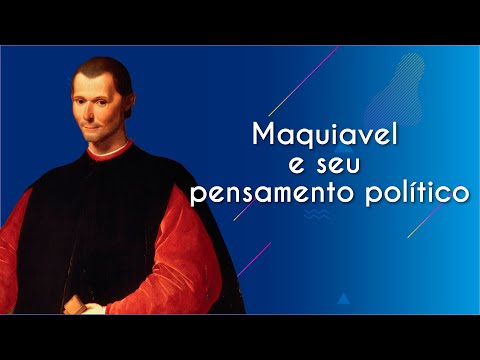
Maquiavel e seu pensamento político - Brasil Escola
Introduction to Machiavelli's Political Thought
Overview of Machiavelli
- Francisco Porfírio introduces the topic, focusing on Niccolò Machiavelli as a significant political theorist in history.
- Machiavelli is described as a Florentine philosopher and public servant, emphasizing his roots in Florence, Italy.
Historical Context
- The discussion highlights the independent city-states of Italy before unification, with Florence having a republican tradition during Machiavelli's time.
- The political landscape of Florence was marked by constant transformations and coups, influencing Machiavelli’s philosophical development.
Machiavelli's Life and Political Environment
Political Turmoil in Florence
- Up until 1490, Florence was under the control of the Medici family; this period shaped much of Machiavelli's experiences.
- A coup led by Savonarola resulted in a new republic that ousted the Medici family from power.
Return of the Medici
- After various political upheavals, including Savonarola’s excommunication and subsequent events, the Medici returned to power around 1512.
- This return reinstated previous political structures that influenced Machiavelli’s writings.
Machiavelli's Contributions to Political Theory
Key Works and Ideas
- "The Prince," dedicated to Lorenzo de' Medici, encapsulates much of Machiavelli’s political philosophy regarding power dynamics.
- Despite being published posthumously, "The Prince" serves as a manual on acquiring and maintaining power.
Philosophy on Power
- For Machiavelli, preserving power is crucial for maintaining order within society; he advocates for conservative governance structures.
- He is characterized as a conservative thinker who believed in stabilizing social structures to prevent serious political issues.
Interpretations of Machiavellian Thought
Centralization vs. Absolutism
- Some interpretations suggest that while he supports centralization for order maintenance, he does not fully align with absolutist theories like those proposed by Thomas Hobbes.
Understanding Machiavelli's Political Philosophy
Misinterpretations of Machiavelli
- Many people misinterpret Machiavelli as a theorist who advocates for power maintenance at all costs, associating him with the term "Machiavellian," which implies ruthless political tactics.
- The core of Machiavelli's argument is not about power for its own sake but rather about maintaining moral and social order within society.
- He proposes a separation between ethics and politics, suggesting that political actions may sometimes override moral considerations to preserve societal order.
The Purpose of Political Action
- Machiavelli introduces a consequentialist view where the morality of an action is judged by its outcomes, emphasizing the importance of preserving social stability over strict adherence to ethical norms.
- A notable quote from The Prince discusses whether it is better to be loved or feared: "It is much safer to be feared than loved" when one must choose between the two.
Leadership Qualities: Virtù and Fortuna
- According to Machiavelli, effective leaders must balance being loved and feared; however, if forced to choose, being feared ensures less likelihood of rebellion from subjects.
- The concepts of virtù (the ability to adapt and lead effectively) and fortuna (luck or fortune) are central in his theory. A leader’s success often hinges on their virtù in navigating challenges presented by fortuna.
Historical Examples in Machiavelli's Theory
- Two historical figures exemplify these concepts: Francesco Sforza, who rose through personal merit (virtù), and Cesare Borgia, whose rise was largely due to his father's good fortune (fortuna).
- Sforza managed to maintain his power through skillful leadership while Borgia lost control despite attempts at virtuous conduct because he lacked true qualities necessary for governance.
Conclusion and Reflection
- Ultimately, Borgia’s failure illustrates that without genuine virtù, reliance on fortuna can lead to loss of power. This highlights the necessity for leaders to cultivate both personal capabilities and navigate external circumstances wisely.