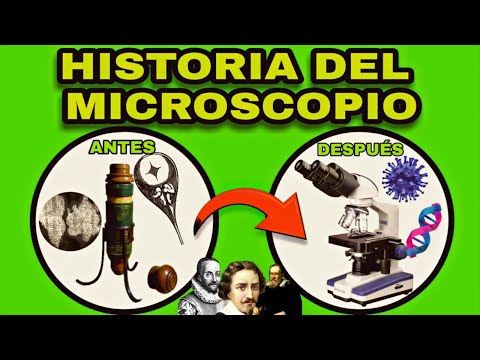
HISTORIA del microscopio
Introduction
The introduction discusses the marvel of nature and how man was unaware of a world that was closer to him than he thought.
The Marvel of Nature
- Man marveled at the stars in the universe.
- There was an unexplored world that was closer to man than he thought.
- Fascinating organisms were hidden from our senses.
The Microscope
This section discusses the microscope, its definition, and how it allowed us to know worlds of very small dimensions.
Definition of a Microscope
- A microscope is an apparatus that allows for the observation of small details in a sample given that cannot be perceived by the naked eye.
- It is one of the inventions that marked a before and after in science.
Invention and Development
- Ancient civilizations used magnifying glasses to observe images in an enlarged way.
- Simple microscopes were developed during the Middle Ages with unlimited magnification but poor optical quality lenses.
- The practical microscope would come later with better lenses, leading to its development during late 16th and early 17th century.
Early Inventors
This section discusses early inventors who contributed to developing the microscope as we know it today.
Hans Lippershey
- Hans Lippershey was an inventor and manufacturer who designed a practical telescope, which led many people to consider him as one of the inventors of the microscope.
Zacharias Janssen
- Zacharias Janssen, along with his father, made Dutch glasses and realized by accident that lengthening a telescope tube increased its magnification capacity.
- They modified a telescope for microscopic use but poor optical quality lenses made it inappropriate for observing microscopic life.
Galileo Galilei
- Galileo Galilei developed an 8x magnification telescope, which he adapted to independently invent the compound microscope.
- He was able to describe the cuticle of insects for the first time using his invention.
Giovanni Fiver
- Giovanni Fiver coined the word microscope to refer to this new invention.
- The development of microscopes was consolidated by several individuals.
Scientific Works
This section discusses scientific works that documented observations carried out under the microscope.
Robert Hooke
- Robert Hooke published his work, "Micrographia," a collection of biological micrographs in which he coined the word cell for structures that reveal cork bark.
- His work attracted public interest in modern sciences and many researchers based their work on observing tissues and materials through microscopes.
Anthony Mann
- Anthony Mann lived during this era and also documented observations carried out under the microscope.
The Evolution of Microscopy
This section discusses the history and evolution of microscopy, from the early days when lenses were first used to view biological specimens, to the development of more advanced microscopes that allowed for higher magnification and resolution.
Early Days of Microscopy
- During the early days of microscopy, it was believed that there was a small man inside sperm called homunculus.
- Interest in microscopy led to constant advances in lens polishing techniques, resulting in greater sharpness and resolution.
- Anthony van Leeuwenhoek built high-quality microscopes that allowed him to have 200x magnification. He described protozoa, bacteria, sperm, red blood cells, and many other microorganisms and tissues.
- Combined lenses were developed during the 18th and 19th centuries that canceled spherical and chromatic aberration. Mechanical construction techniques also improved stability.
Advances in Microscopic Techniques
- Ernest Abbe's theory of microscope imaging provided a scientific foundation for microscope construction. Working with Carl Zeiss, they developed more sophisticated types of microscopes for viewing biological specimens.
- Improvements in microscopic practices included immersion microscopes by substituting water for oil which allows obtaining higher magnifications.
- In the beginning of the 1930s, the theoretical limit for optical microscopes had been reached. Different types of microscope were developed that would allow a more detailed study such as transmission electron microscope.
- Electron microscopy takes a huge leap as different types are developed such as Ion microscope or scanning electron microscope until reaching atomic force microscope an instrument with incredible resolution.
Impact on Science
- Microscopy has had a significant impact on scientific development in the areas of biology and medicine, among others.
- The microscope allowed us to know the pillars of our reality, to understand the mechanism of what we do not see. It is a tool that changed the history of science and the way we see the world.