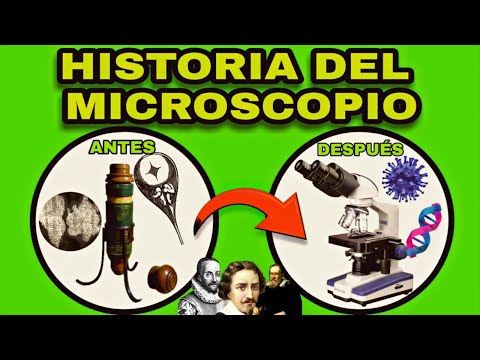
HISTORIA del microscopio
The Evolution of the Microscope
The Fascination with Nature
- The study of nature began with a marvel at the stars, but there exists an equally fascinating world closer to home—microscopic organisms and landscapes that are hidden from our senses.
Introduction to the Microscope
- The microscope is a scientific tool that reveals small details invisible to the naked eye, serving as a foundation for modern biological sciences.
- Before microscopes, ancient civilizations utilized magnifying glasses to concentrate light; these simple devices laid groundwork for later developments in microscopy.
Historical Development of Microscopes
- The practical microscope emerged in the late 16th and early 17th centuries, with contributions from various inventors. Hans Lippershey is noted for designing an early telescope which influenced microscope development.
- Zacarías Jensen and his father accidentally discovered that extending a telescope tube increased magnification, leading to adaptations for microscopic use despite initial poor optical quality.
Key Figures in Microscopy
- Galileo Galilei adapted telescopic lenses for microscopic observation around 1609, effectively creating what could be considered an early compound microscope.
- Giovanni Faber coined the term "microscope," combining Greek roots meaning "small" and "to look," acknowledging multiple contributors rather than a single inventor.
Advancements in Microscopy
- By the second half of the 17th century, significant scientific works documented observations made through microscopes. Notable figures include Robert Hooke and Antonie van Leeuwenhoek.
- Hooke's publication introduced the term "cell" after observing cork bark under a microscope, revolutionizing biological science by attracting public interest.
Challenges and Misconceptions
- Early lenses had defects causing optical aberrations; researchers often misinterpreted their observations. For instance, Gaudier de Gotti described sperm cells as containing tiny men (homunculus).
Innovations Leading to Modern Microscopy
- Continuous improvements in lens polishing led to sharper images. Antonie van Leeuwenhoek created high-quality microscopes capable of 200x magnification, identifying protozoa and bacteria.
Evolution of the Microscope and Its Impact on Science
The Foundation of Modern Microscopy
- Carl Zeiss collaborated with scientists to establish a scientific basis for microscope construction, moving away from trial-and-error methods. This led to improved imaging theories that enhanced microscope performance and reduced production costs.
- By the early 1930s, optical microscopes reached their theoretical limits, achieving magnifications up to 500x or 1000x.
Advancements in Microscopy Techniques
- The development of electron microscopes began as a response to limitations in optical microscopy. The transmission electron microscope was the first type developed, using electrons instead of light for magnification up to 100,000x.
- Subsequent advancements included ion microscopes capable of visualizing atoms and scanning electron microscopes. Eventually, atomic force microscopes emerged with exceptional resolution capabilities.
Historical Context and Scientific Relevance
- The evolution of microscopy from the last millennium into the present illustrates its relationship with physics and the industrial revolution, significantly impacting biology and medicine.