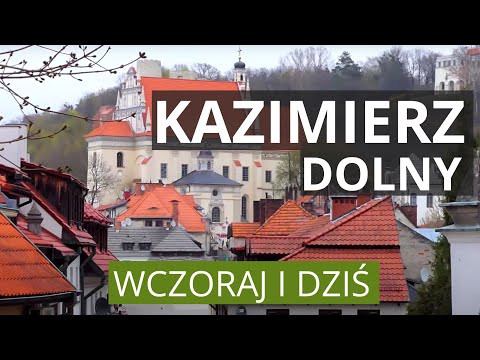
KAZIMIERZ DOLNY - Historia, Ludzie, Atrakcje, Magia Miejsca
Introduction
The speaker introduces the topic of the video, which is about a small town called Kazimierz Dolny with a rich history.
Kazimierz Dolny's History
- The town of Kazimierz Dolny has a rich history and is located in Poland.
- Time seems to have slowed down in this town, as it has not undergone major changes over time.
- The oldest building in the city is a watchtower that was built in the 14th century and served as a duty collection point and defended the crossing over the Vistula River.
- King Casimir the Great founded a castle 200 meters below the watchtower, which had high walls surrounding a spacious ward where local people could find shelter with their belongings.
Kazimierz Dolny's Church
- The castle defended the settlement developing below, which king Kazimierz most likely granted city rights and founded a parish church for it, which now bears the names of two patrons: St. John the Baptist and St. Bartholomew.
- The church was built after its predecessor burned down and contains many details typical of so-called Lublin Renaissance style.
- The interior of the church is richly equipped with valuable objects such as baptismal font by Santi Gucci himself and one of Poland's oldest preserved organs from around 1620.
Kazimierz Dolny's Granaries
- In the 16th and 17th centuries, Kazimierz became one of the largest river ports on Vistula River larger than Kraków. More than 60 granaries were used to store grain brought by the nobility, which was then floated to Gdańsk together with tar and wood ash.
- Some granaries function as hotels, while others were transformed into a nature museum.
The History of Kazimierz
This section covers the history of Kazimierz, including the construction of magnificent tenement houses and churches by local merchants. It also discusses the hard times that came with epidemics and wars.
Magnificent Buildings
- Local merchant Bartłomiej Celej built a magnificent tenement house on Senatorska Street.
- Mikołaj Przybyło and his father Bartłomiej founded the chapel of the Annunciation of the Blessed Virgin Mary, which later became a church with a Reformed monastery.
Hard Times
- Epidemics raged in Kazimierz, related to three crosses erected on a hill above the city at the beginning of the 18th century.
- The town and castle were burnt down during the Swedish invasion. Local merchants were no longer engaged in large-scale trade, granaries were deserted, and many houses fell into disrepair.
- In the second half of the 19th century, Kazimierz even lost its municipal rights but regained them in 1927 after nearly 60 years.
Artists in Kazimierz
This section discusses how artists began to be attracted to Kazimierz due to its picturesque landscapes, old buildings, castle ruins, and local colors.
Painters
- Zygmunt Vogel was one of the first painters to record views of towns and castles along Vistula River at King Stanisław August Poniatowski's request.
- Tadeusz Pruszkowski, called "Prusz" by students, was a lecturer at the School of Fine Arts in Warsaw. He organized summer painting workshops for students of the SSP in Kazimierz from 1923.
- Other painters who came to Kazimierz include Wojciech Gerson, Michał Andrioli, Władysław Skoczylas, Leon Wyczółkowski, Stanisław Czajkowski, Teresa Roszkowska, Władysław Filipiak and Jan Wydra. Some of them settled permanently in Kazimierz.
Galleries
- While strolling through the streets of modern town , you can come across numerous art galleries. The real movement in the world of Kazimierz galleries begins in May.
Writers and Poets
- Bolesław Prus, Kazimierz Brandys, Agnieszka Osiecka, Marek Hłasko, Waldemar Odorowski and Leszek Długosz are some writers and poets associated with Kazimierz.
- Maria Kuncewiczowa described Kazimierz Dolny as a magical place that could not be conveyed by words alone. She lived in Willa pod Wiewiórką (The Squirrel Villa) during her stays in Kazimierz.
Kazimierz: The Jewish District of Krakow
This section discusses the history of Kazimierz, a district in Krakow that was once home to a large Jewish population.
The 10th Muse and Other Productions
- Kazimierz was the backdrop for several popular Polish productions, including "A Journey for One Smile," "Osiecka," and "W Rytmie Serca."
- Yiddish films gained considerable publicity outside of Poland. Two famous productions in this language were created in Kazimierz during the 1930s - "Judeł Played the Violin" and "The Dybbuk."
- Both films featured Molly Picon, one of the most famous stars of Yiddish cinema.
History of Jews in Kazimierz
- Jews constituted an important part of Kazimierz's population. Legend has it that they lived there since Casimir the Great fell in love with Esther, daughter of a local merchant.
- According to preserved documents, Jews did not appear in Kazimierz until the next century. They were engaged in trade, crafts, and innkeeping.
- During World War II, the local Jewish population was exterminated. A ghetto was established in Mały Rynek (Small Market), which had over 2 thousand people. Its last inhabitants were transported to Belzec death camp in March 1942.
- Few mementos remain after centuries-long presence of Jews in Kazimierz. The brick synagogue from the 18th century is one such memento.
Other Places Related to Jewish History
- The cemetery at Czerniawy was established in the 18th century. During World War II, it was devastated and became a place of execution for Jews and Christians. In 1984, a symbolic monument was created from the remains of several hundred matzevot - a wall with a symbolic crack.
- Dr. Stanisław Świerz Zalewski arrived at the local post office on September 10, 1939, seeking help with transporting Wawel tapestries and other priceless treasures from Krakow. Leopold Pisz organized the transport of horse-drawn carriages, which allowed the treasures to continue their journey to Canada.
Overnight Stay at Synagogue
- The synagogue offers an attraction in the form of an overnight stay in rooms on the first floor, in the place of the former women's gallery.
- The view from inside windows of one of these rooms is unique.
Conclusion
Kazimierz was once home to a large Jewish population that played an important role in its history. Today, few mementos remain after centuries-long presence of Jews in Kazimierz.
Kazimierz Dolny - Introduction
This section introduces the town of Kazimierz Dolny and its attractions.
Attractions in Kazimierz Dolny
- Old photos show the views of Kazimierz and its numerous loess gorges.
- The most famous and picturesque is Korzeniowy Dół (the Root Hole) Ravine, which is 700 meters long.
- Roads leading on steep slopes led to a concentration of runoff of rainwater and that of spring thaw, which led to water erosion of loess rock and gouging of ravines.
- The Ravine Korzeniowy Dół owes its name to the characteristic, tangled tree roots visible on its walls.
- While wandering around Kazimierz, you can often meet a cat or a dog. One of the dogs named Werniks even got his monument.
Panoramic Views
This section discusses the panoramic views available in Kazimierz Dolny.
Beautiful Panoramas
- There is probably no more beautiful view than from the Hill of Three Crosses.
- For those who prefer to admire the Vistula River, the most magnificent views can be seen from the ruins of the castle and watchtower.
Nighttime in Kazimierz Dolny
This section describes what it's like at night in Kazimierz Dolny.
Nighttime Scenery
- It gets dark over Kazimierz with only discreetly lit parish church and tenement houses emerging from the darkness.
- The patron saints of the Przybyło brothers are invariably watching over their facades.
- The narrator wonders how many moons could be seen if this night was cloudless.
Conclusion
This section concludes the video and encourages viewers to subscribe to the channel for more travel content.
Traveling in Poland
- If you're interested in traveling around Poland with a small dose of historical knowledge, subscribe to our channel.