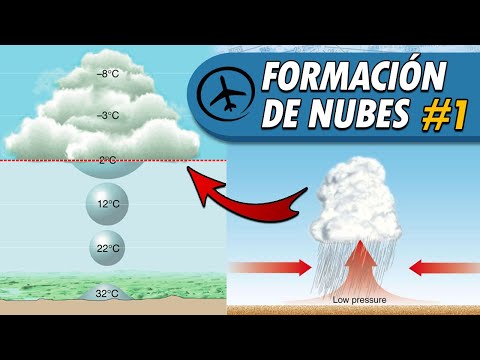
¿Cómo se forman las Nubes?
Formation of Clouds: Part 1
Introduction to Cloud Formation
- The video discusses cloud formation, divided into two parts. This first part covers the definition of clouds and their formation mechanisms, including condensation levels and air ascent processes.
- In the second part, topics will include orographic lifting, frontal lifting, surface convergence in low-pressure areas, turbulence-induced cloud formation, and conditions for cloud dissipation.
What is a Cloud?
- A cloud is defined as a visible collection of tiny water droplets or ice crystals suspended in the atmosphere; it is classified as a hydrometeor due to its association with water.
- Clouds consist of liquid water droplets or solid ice crystals rather than vapor; vapor is invisible while clouds remain suspended due to their small size.
Mechanisms of Cloud Formation
- Clouds form when water vapor condenses or sublimates into small droplets or ice crystals on condensation nuclei in the atmosphere.
- The state (liquid vs. solid) of the particles in clouds depends on temperature: higher temperatures favor liquid water while lower temperatures favor ice.
Conditions Required for Cloud Formation
- Several conditions must be met for cloud formation:
- Presence of water vapor (humidity).
- Availability of condensation nuclei for phase change from gas to liquid/solid.
- Cooling process that lowers temperature to achieve saturation.
Importance of Temperature in Cloud Formation
- Temperature plays a crucial role in determining how much water vapor air can hold; warmer air can contain more moisture compared to cooler air.
- An example illustrates that at 30°C, one cubic meter of air can hold up to 28 grams of water vapor but may only contain 8 grams initially (29% relative humidity).
Saturation and Condensation Process
- As air cools down (e.g., from 30°C to 20°C), its capacity for holding moisture decreases; this leads to increased relative humidity as cooling continues.
- When cooled sufficiently (to around 10°C), the air reaches saturation at which point any further cooling causes condensation into liquid droplets.
Adiabatic Processes Affecting Air Temperature
- The most common way air changes temperature in the atmosphere is through adiabatic processes where pressure changes affect temperature without heat exchange with surroundings.
- When atmospheric pressure decreases, expanding air cools adiabatically; conversely, compressing air increases its temperature under rising pressure conditions.
Implications for Air Parcels Ascending and Descending
- As an air parcel rises through the atmosphere, it expands and cools adiabatically due to decreasing pressure. Conversely, descending parcels compress and warm up due to increasing pressure.
Analysis of Air Volume and Humidity
Understanding Humidity and Temperature Changes
- A cubic meter of air can hold up to 14 grams of water vapor; if it contains only 8 grams, the relative humidity is 56%.
- As the air parcel rises to 1,000 feet, its temperature decreases by 3 degrees due to dry adiabatic lapse rate.
- The new temperature at 1,000 feet is 16 degrees Celsius; the capacity for water vapor drops to 11.5 grams, resulting in a relative humidity of 68%.
- Continuing to ascend to 2,000 feet lowers the temperature further to 13 degrees Celsius with a capacity of only 9.5 grams of water vapor, leading to an increased relative humidity of 82%.
- At an altitude of 3,000 feet and a temperature drop to 10 degrees Celsius, saturation occurs at exactly the amount of water vapor present (8 grams), indicating full humidity.
Condensation and Cloud Formation
- Once saturation is reached at this point (10 degrees Celsius), condensation begins on condensation nuclei in the atmosphere.
- The height where air reaches saturation is known as the condensation level; here, air's temperature equals its dew point.
- In this example, the condensation level is around 10,000 feet; below this height, temperatures change according to dry adiabatic lapse rate.
Mechanisms for Air Ascension
- Above the condensation level (10,000 feet), saturated air changes temperature based on moist adiabatic lapse rate.
- Various mechanisms force air parcels upward: thermal convection from surface heating; orographic lift over elevated terrain; frontal lifting when warm air rises over cold; and convergence in low-pressure areas.
Focus on Thermal Convection
- This video will primarily discuss thermal convection as a mechanism for cloud formation.
- Thermal convection occurs when surface-heated air becomes less dense and ascends until reaching its condensation level.
Example Scenario: Surface Heating Effects
- If surface temperature is initially at 20 degrees with a dew point at 16 degrees and heats up to 25 degrees due to solar radiation:
Understanding Cloud Formation and Condensation Levels
Temperature and Humidity at Different Altitudes
- At 1000 feet, the temperature is 22 degrees Celsius with a humidity of 77%.
- As altitude increases to 2000 feet, the temperature drops to 19 degrees Celsius and humidity rises to 88%.
- Eventually, if the air parcel continues to rise, it reaches a dew point of 16 degrees Celsius (100% humidity), leading to cloud formation.
Dew Point and Condensation Level Dynamics
- The dew point does not remain constant; it decreases by approximately 0.6 degrees Celsius for every additional 1000 feet in altitude.
- A graphical representation shows that as temperature decreases with altitude, the dew point also declines, affecting condensation levels.
Impact of Temperature-Dew Point Difference on Cloud Base Height
- The difference between surface temperature and dew point directly influences cloud base height; a smaller difference indicates higher humidity.
- For example, with a surface temperature of 20 degrees Celsius and a dew point of 17 degrees Celsius (3-degree difference), clouds form at about 1200 feet.
Calculating Cloud Base Height Using Dew Point
- An approximate formula for determining cloud base height is: Cloud Base = 400 x (Temperature - Dew Point).
- If the reported temperature is 30 degrees Celsius and the dew point is at 26 degrees Celsius, clouds would form around 1600 feet high.
Daily Variations in Cloud Base Height
- Throughout the day, as temperatures increase, so does the difference from the dew point; thus, cloud bases rise progressively from morning to afternoon.
- At dawn (6 AM), with minimal temperature differences (2 degrees), clouds may be at around 800 feet.
- By mid-morning (9 AM), increased temperatures raise cloud bases to approximately 2400 feet.
- At noon (12 PM) temperatures further increase resulting in cloud bases reaching about 4400 feet.
- By late afternoon (3 PM) with conditions set at a temperature of 30 degrees and a dew point of only 17 degrees, expect cloud bases around 5200 feet high.
Factors Influencing Cloud Development Limits
- The vertical development limit of clouds extends from their condensation level until stable atmospheric conditions are encountered again.
- Air parcels can only ascend under unstable conditions; this requires analyzing both environmental lapse rates and parcel temperatures for stability assessments.
Stability Conditions Affecting Air Parcel Ascension
- If an air parcel's temperature exceeds that of its surrounding environment's lapse rate gradient, instability allows continued ascent.
Understanding Cloud Formation and Atmospheric Stability
The Role of Temperature in Cloud Development
- The temperature of a parcel of air changes according to the moist adiabatic lapse rate, which is crucial for understanding cloud formation.
- When an air parcel ascends and reaches stable conditions, it can no longer rise, marking the top of cloud development where clouds are capped.
- The vertical development of clouds is significantly influenced by atmospheric stability; if unstable conditions exist at higher altitudes with sufficient moisture, clouds can grow vertically up to the tropopause.
Tropopause and Its Impact on Clouds
- The tropopause serves as a boundary for vertical cloud growth; above this level, temperatures either stabilize or increase with altitude, creating inherent stability that prevents further vertical development.
Conditions Necessary for Cloud Formation
- Not all instances of heated air lead to cloud formation; sometimes the surface temperature does not reach the condensation level necessary for ascent.
- An example illustrates that when an air parcel heats to 20 degrees Celsius but does not reach its dew point at 18 degrees Celsius, no clouds form despite initial ascent.
Critical Temperature and Humidity Factors
- At 10 AM, when an air parcel reaches a critical temperature of 25 degrees Celsius and meets its dew point, condensation occurs leading to cloud base formation.
- Successful cloud formation also depends on adequate water vapor and condensation nuclei; without these elements present in sufficient quantities (as seen in deserts), clouds may not form even under high temperatures.
Summary Insights
- Understanding how temperature gradients affect atmospheric stability is essential for predicting weather patterns and cloud formations.