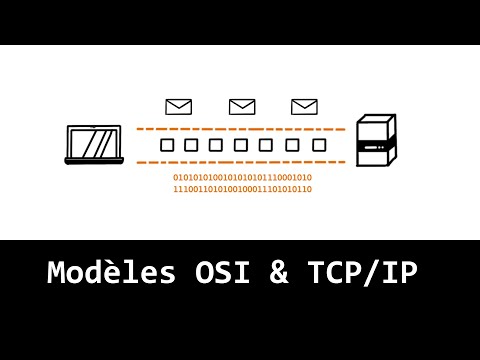
Comprendre les modèles OSI et TCP/IP
Introduction to OSI and TCP/IP Models
In this section, the speaker introduces the OSI (Open Systems Interconnection) model and the TCP/IP model, explaining their importance in understanding network communication.
The Need for a Common Language in Networking
- Communication between machines requires a common language defined by networking protocols.
- Without a common language, machines can only exchange data without understanding its meaning.
- The OSI and TCP/IP models define the rules of this shared communication language.
Understanding Network Communication
- The OSI model and the TCP/IP model provide guidelines for effective network communication.
- Each layer in these models has specific roles and protocols that contribute to the overall communication process.
- These models ensure that messages are properly understood and delivered to the intended recipient.
Analogy with Star Wars
The speaker uses an analogy from Star Wars to explain how network communication works using different layers.
Sending a Message in Star Wars
- Princess Leia needs to send a message to Obi-Wan Kenobi, who is far away.
- She records a hologram message that will be carried by R2-D2.
- To reach Obi-Wan, they need an X-wing spaceship to travel through hyperspace.
- Once arrived, R2-D2 delivers the message to Obi-Wan on Tatooine.
Importance of Sequential Steps in Network Communication
Sequential steps are crucial in network communication as each step plays a specific role in ensuring successful delivery of messages.
Importance of Sequential Steps
- Each step in the network communication process is necessary and cannot be skipped.
- Skipping steps or changing their order can lead to unsuccessful message delivery or misinterpretation.
Overview of the OSI Model
The OSI model defines the standard for network communication and is divided into different layers, each with its own specific role.
Layers of the OSI Model
- Application Layer:
- Provides access to application services for users.
- Examples: web browsers, email clients, FTP clients.
- Presentation Layer:
- Formats and translates data between different machines.
- Handles data compression and encryption.
- Session Layer:
- Manages sessions between machines.
- Establishes connections and terminates sessions.
- Transport Layer:
- Determines the best way to send information based on communication constraints.
- Includes protocols like UDP (Unreliable Datagram Protocol) and TCP (Transmission Control Protocol).
Continued Overview of the OSI Model
The speaker continues explaining the layers of the OSI model.
Layers of the OSI Model (continued)
- Network Layer:
- Handles packet routing between network nodes.
- Uses IP (Internet Protocol) for addressing.
- Data Link Layer:
- Establishes a connection between two machines on the same network.
- Uses MAC addresses for identification.
- Physical Layer:
- Deals with physical connections in network communication.
- Transmits and receives raw data bits over a physical medium.
Importance of Transport Protocols
The transport layer plays a crucial role in choosing the appropriate protocol for sending information based on communication requirements.
Transport Protocols
- UDP (User Datagram Protocol):
- Sends information without guaranteeing reception or retransmission.
- Similar to sending a simple letter without confirmation of delivery.
- TCP (Transmission Control Protocol):
- Ensures reliable communication by retransmitting lost data.
- Similar to sending a letter with acknowledgment of receipt.
Conclusion of OSI Model and Introduction to Physical Layer
The speaker concludes the explanation of the OSI model and introduces the physical layer.
Conclusion of OSI Model
- The OSI model defines the standard for network communication.
- Each layer has specific roles and protocols that contribute to successful communication.
Physical Layer
- The physical layer is responsible for the physical connection in network communication.
- It handles the transmission and reception of binary data over a physical medium.
Understanding the OSI and TCP/IP Models
In this section, we will explore the OSI (Open Systems Interconnection) model and its practical implementation in the TCP/IP model. We will also discuss how certain layers can perform the tasks of other layers in reality.
The OSI Model and TCP/IP Model
- The OSI model is a theoretical model used for understanding networks, while the TCP/IP model is a practical implementation of it with four simplified layers.
- The three upper layers of the OSI model (application, presentation, and session) are combined into a single application layer in the TCP/IP model.
- The application layer includes commonly used protocols such as HTTP, FTP, SMTP, etc.
- The physical and data link layers of the OSI model are merged into a single network access layer in the TCP/IP model.
- The network access layer handles connections between two machines.
Transport Layer
- The transport layer's role remains unchanged between both models. It primarily uses the TCP protocol to fragment messages for transmission over the internet layer.
- On the receiving machine, TCP reassembles fragments transmitted over the internet layer to reconstruct the original message.
Internet Layer
- The most commonly used protocol in the internet layer is IP (Internet Protocol).
- IP manages routing and ensures packet delivery from source to destination.
- It adds information such as sender's IP address, recipient's IP address, and additional data for proper message routing.
Communication Process in TCP/IP Model
- During transmission, data passes through each layer on the sending machine.
- Each layer adds an encapsulation header that defines its protocol.
- This process continues until data is transformed into bits for transmission over the network to another machine.
- On the receiving machine, each layer interprets and removes the corresponding encapsulation header.
- At the application level, the data is received in its original state.
- This process is known as decapsulation.
Protocol Data Unit (PDU)
- The PDU refers to the packet of data that changes its form at each layer.
- The names of PDUs vary based on the layers they belong to.
- For example, at the application layer, it is called a message, while at the transport layer, it is called a segment.
- In the internet layer, it is referred to as a datagram, and at the network access layer, it becomes a frame.
Different Equipment and OSI Layers
- Not all devices utilize all layers of the OSI model.
- Network equipment like switches only require layers one and two for MAC address-based forwarding.
- Routers need layers one, two, and three to connect different networks.
Partnership with AFPA for Professional Training
In this section, we learn about AFPA (Agence nationale pour la formation professionnelle des adultes), an organization that provides professional training opportunities. The speaker expresses gratitude for their sponsorship and highlights AFPA's role in promoting employment opportunities and social equality.
AFPA - Agence nationale pour la formation professionnelle des adultes
- AFPA is a public establishment that offers professional training programs leading to recognized qualifications from the Ministry of Labor.
- They focus on providing vocational training for adults to enhance their employability.
- AFPA plays a crucial role in supporting vulnerable individuals such as long-term unemployed or disabled persons by facilitating access to employment opportunities.
- They also promote equal access to information and training for both men and women.
The transcript ends abruptly after discussing AFPA's partnership without concluding any specific topic.
Turn any video into a summary like this
YouTube links, meetings, lectures — with transcripts, search, and chat.