Regulación de GASTO CARDÍACO
Heart Function and Cardiac Output
In this section, the video discusses cardiac function, specifically focusing on cardiac output and its regulation in different physiological conditions.
Understanding Cardiac Output
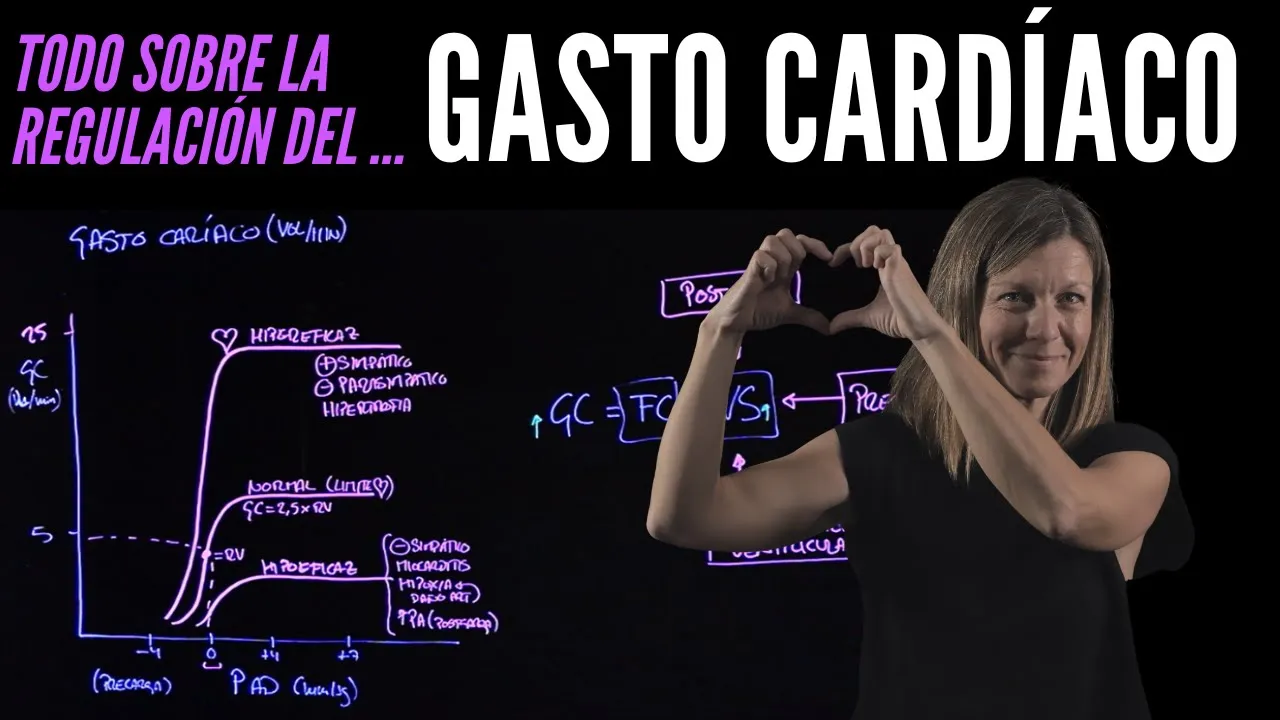
- Cardiac output is represented against right atrial pressure in millimeters of mercury. This pressure serves as a simple measure of preload.
- Under normal physiological conditions without neural stimulation, a typical cardiac output curve shows an increase with higher right atrial pressure up to a physiological limit set by the heart's anatomical and physiological characteristics.
- In normal conditions without neural intervention, the maximum achievable cardiac output is about 2.5 times the venous return, resembling a plateau phase where further increases in right atrial pressure do not elevate cardiac output significantly.
Variations in Cardiac Efficiency
- A hyper-efficient heart can reach outputs as high as 25 liters per minute through sympathetic stimulation or parasympathetic inhibition and myocardial hypertrophy.
- Conversely, a hypo-efficient heart exhibits inadequate cardiac outputs due to factors like sympathetic inhibition, myocarditis, ventricular hypoxia from coronary artery damage leading to impaired blood ejection efficiency.
Factors Influencing Cardiac Output
This part delves into the factors affecting cardiac output, emphasizing the interplay between heart rate and stroke volume in determining overall heart function.
Components of Cardiac Output
- Cardiac output equals heart rate multiplied by stroke volume. Stroke volume depends on preload (venous return), afterload (ventricular resistance during ejection), and contractility (ventricular muscle strength).
- Preload is influenced by blood volume circulation affecting ventricular filling pressure. Increased blood volume stretches myocardial fibers enhancing contraction force via Frank-Starling mechanism.
Preload Determinants
- Factors impacting preload include blood volume (volemia), which affects ventricular stretching and subsequent contraction force modulation.
Understanding Cardiac Physiology
In this section, the speaker delves into the dynamics of blood flow within the heart chambers during different phases of the cardiac cycle.
Blood Flow Dynamics in a Less Distensible Ventricle
- During late diastole, blood is passively sent to the ventricle.
- If the ventricle is not distensible and cannot stretch to accommodate increased volume, it could lead to a significant pressure rise due to the closed aortic valve.
- A less distensible ventricle decreases preload, reducing cardiac output by limiting blood entry into the ventricle.
Impact of Ventricle Distensibility on Blood Volume
- A distensible ventricle can stretch slightly upon blood entry without altering pressure, maintaining preload and allowing for increased blood volume.
- Atrial contractility aids in completing ventricular filling during late diastole, crucial when dealing with a less distensible ventricle.
Role of Atrial Contraction and Venous Return
- Atrial contraction contributes 15-20% to filling by overcoming impediments caused by poor ventricular distensibility.
- In normal physiology, both a distensible ventricle and atrial contraction work together for optimal filling; dysfunction in either can reduce preload and cardiac output.
Importance of Venous Return Regulation
- Impaired atrial function diminishes preload and subsequently reduces cardiac output.
- Venous return, akin to cardiac output, correlates with right atrial pressure. Understanding venous return is vital for comprehending cardiac function.
Factors Influencing Venous Return Curve
- The venous return curve depicts how venous blood flow varies with right atrial pressure under normal conditions.
- Negative pressures in the right atrium do not enhance venous return but rather flatten the curve due to vessel deformation within thoracic cavities.
Mechanisms Behind Venous Return Regulation
- Pressure gradients between arteries, veins, and the atrium drive venous blood flow back to the heart.
Understanding Cardiovascular Physiology
In this section, the discussion revolves around the factors influencing venous return and how various mechanisms such as sympathetic activation and respiratory movements impact systemic filling pressure.
Factors Influencing Venous Return
- Systemic filling pressure equalizes with right atrial pressure, halting venous return.
- Sympathetic activation increases venous return by elevating systemic filling pressure.
- Venous return can be calculated using the formula: Venous Return = Systemic Filling Pressure - Right Atrial Pressure.
- Factors affecting systemic filling pressure include muscle pump activation and respiratory movements.
- Muscle contractions compress veins, aiding blood flow towards the heart.
Impact of Respiratory Movements
- Respiration enhances systemic filling pressure through thoracic cavity expansion.
- Diaphragmatic and intercostal muscle movements aid in venous circulation during inspiration.
- Inspiratory actions create negative thoracic cavity pressure, promoting venous blood flow to the heart.
Sympathetic Nervous System Influence
- Sympathetic stimulation constricts veins, akin to muscle compression, facilitating blood return to the heart.
- Vasoconstriction induced by sympathetic activity aids in increasing systemic filling pressure.
Preload and Afterload Considerations
- Preload factors include systemic filling pressure, right atrial pressure, and resistance to venous return.
- Increased arterial resistance diminishes venous return significantly more than changes in venous resistance.
Understanding Cardiovascular Physiology
In this section, the speaker delves into the concept of blood flow regulation and its impact on cardiovascular dynamics.
Forces Affecting Blood Flow
- An increase in pressure in a circulatory system can lead to higher ventricular volume due to decreased expulsion capability, potentially resulting in increased force generation.
- Chronic elevation of arterial pressure can cause constant ventricular volume retention, limiting the heart's ability to counteract with increased force.
Regulation of Afterload
- The geometry of the ventricle plays a crucial role in overcoming impediments in afterload. Understanding Laplace's law helps comprehend how tension affects ventricular walls and influences contractile strength.
- Increased tension on the ventricular walls, akin to elevated peripheral resistance, does not directly raise afterload. However, heightened afterload reduces systolic volume and subsequently cardiac output.
Counteracting Increased Afterload
- To mitigate the effects of chronic peripheral vascular resistance elevation on afterload, the heart thickens its walls. This adaptation decreases tension, lowers afterload, and boosts cardiac output.
- Factors influencing afterload include ventricular contractility and heart rate regulation by the autonomic nervous system (ANS), particularly sympathetic control over contractility.
Influences on Cardiac Output
This segment explores how factors like contractility and heart rate modulation impact cardiac output through ANS intervention.
Autonomic Nervous System Control
- Myocardial cells contain receptors for norepinephrine and adrenaline that enhance calcium influx upon activation. This process heightens cross-bridge formation and contraction strength.
- ANS influence extends to regulating calcium reuptake into sarcoplasmic reticulum for optimal levels. Additionally, heart rate modulation involves activating sympathetic pathways while inhibiting parasympathetic signals for increased frequency.
Determinants of Heart Rate
- Heart rate is modulated by sympathetic and parasympathetic divisions of the ANS. Sympathetic activation increases heart rate by enhancing sodium influx via If channels, initiating pacemaker potentials.
- Noradrenaline or adrenaline binding to beta receptors amplifies If channel activity, stimulating pacemaker cells across the heart for enhanced rhythmic contractions.
Cardiac Function Assessment
The discussion shifts towards understanding factors governing cardiac function assessment through mechanisms like venous return curves under varying conditions.
Impact on Cardiac Output
- Venous return curves depict normal vs. artificially induced volume changes' effects on filling pressures. Artificially increasing blood volume can elevate filling pressures beyond sympathetic-induced levels, altering equilibrium points significantly.
New Section
In this section, the speaker discusses the mechanisms through which the circulatory system compensates for a significant increase in cardiac output due to a substantial rise in venous return.
Mechanisms of Circulatory System Compensation
- The circulatory system responds to a drastic increase in cardiac output by enhancing venous return artificially. This is compensated for through three main mechanisms:
- Increasing filtration in capillaries helps reduce excess blood volume, returning it to normal levels.
- The myogenic effect causes blood vessels to constrict when blood flow increases, reducing flow and decreasing arrival at the heart.