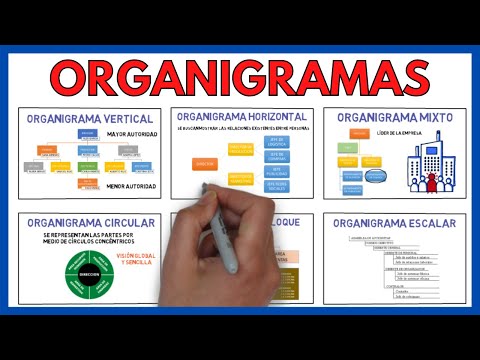
ORGANIGRAMA de una EMPRESA y sus TIPOS 🌃 | Economía de la Empresa 146#
Welcome to Business Economics
This section introduces the concept of an organization chart and its significance in depicting the structure of a company.
Understanding Organization Charts
- An organization chart is a visual representation of a company's organizational structure, illustrating relationships between different units and hierarchies. It aids in quickly grasping hierarchical relationships within the company.
- The primary functions of an organization chart are internal communication for employees to understand their roles and external communication as an introduction to outsiders about the company's structure.
- Essential requirements for an organization chart include accuracy in reflecting the current organizational structure, periodic updates to capture changes, and clarity for easy comprehension by users.
Types of Organization Charts
- Organization charts can be classified based on their purpose, such as analytical charts that focus on processes within the company or informative charts that provide external stakeholders with organizational information.
- Another classification criterion is based on the organization itself, leading to hierarchical charts suitable for control structures, matrix charts combining vertical and horizontal distributions for interdepartmental relationships, and flat charts eliminating middle management levels for direct employee-manager relationships.
Presentation Formats of Organization Charts
Circular and Block Organization Charts
This section discusses different types of organization charts, including circular and block organization charts, highlighting their structures and benefits in visualizing company hierarchies.
Circular Organization Chart
- A circular organization chart represents parts through concentric circles.
- General direction is placed in the center, with functional directions around it.
- Facilitates a global and simple vision of the company's structure.
Block Organization Chart
- Similar to a vertical organization chart but uses blocks forming a pyramid-shaped chart.
- Scalar organization chart uses indentations to indicate authority levels.
- Differentiates between Microadministrative, Macroadministrative, and Mesoadministrative types based on information scope.
Types of Organization Charts
This section explores various types of organization charts based on nature, scope, and content, providing insights into their functions within companies.
Nature-Based Types
- Microadministrative charts focus on a single company's general vision.
- Macroadministrative includes information from multiple companies.
- Mesoadministrative covers all companies within a sector; often produced by institutions due to its scale.
Scope-Based Types
- General charts show generic details at a hierarchical level without delving into internal relationships.
- Specific charts detail structures of specific areas like marketing departments.
Content-Based Types
- Integral charts display all administrative units with hierarchical relationships indicated through numbers.
- Functional charts not only represent structure but also outline departmental functions for efficient work division and communication enhancement within the company.