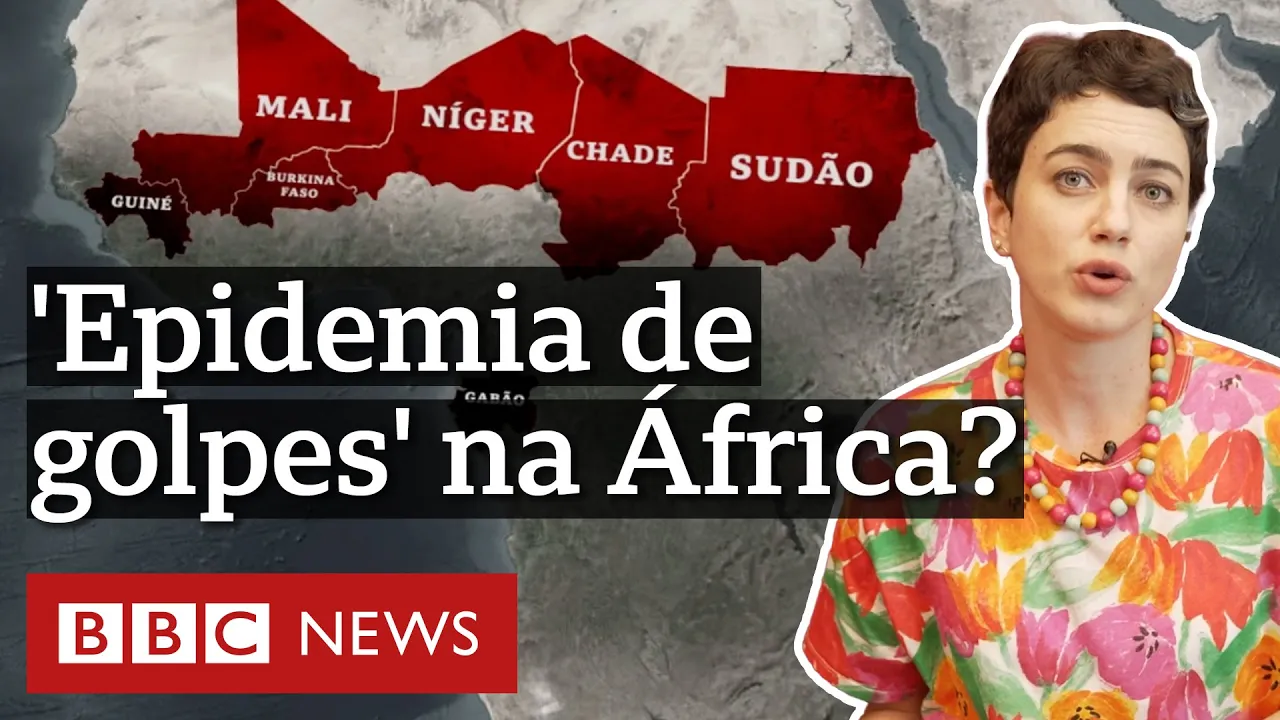
O que explica onda de golpes militares na África
Overview
The transcript discusses the rise of military takeovers in African countries, particularly in the Sahel region, and explores the underlying factors contributing to this trend.
Military Takeovers in Africa
- Military coups have occurred in several African countries over the past two years, signaling a shift in power dynamics and potential political impacts.
- Beyond the mentioned countries, military influence has also affected power transitions in Chad and Sudan, with failed coup attempts in four other nations recently.
- Historically, Africa has experienced a significant number of coup attempts, with 44% of global incidents occurring on the continent between 1950 and 2010.
Impact of Extremism and Power Vacuum
- The Sahel region has become a hotspot for violent extremist groups, leading to instability and power vacuums exploited by military or paramilitary forces.
- Mali exemplifies this situation with competing radical Islamist groups like Al-Qaeda and ISIS vying for control alongside Russian mercenaries supported by the government.
Rejection of Western Influence
- A wave of coups reflects growing anti-Western sentiment among populations previously colonized by France, questioning historical ties and military interventions.
- Criticism is directed at France's economic exploitation and failure to bring peace to the region, fueling resentment against colonial legacies.
Underlying Factors
The transcript delves into demographic and economic factors driving discontentment leading to military interventions across Africa.
Demographic Challenges
- Africa's youthful population presents both economic potential and social tensions due to high poverty rates, inflation, unemployment, disillusionment with traditional politics.
Political Frustrations
- Widespread frustration with corrupt political elites has created conditions where militaries intervene with public support from urban populations dissatisfied with governance.
New Section
The deposition of the government in Pond and Rida Miba is announced, with accusations of prioritizing politics over counterterrorism. This leads to tensions with France and protests against French institutions.
Deposition of Government and Accusations
- Accusations made against Pond and Rida Miba for focusing more on politics than combating terrorism.
- Rida Miba accused of collaborating with France to regain power, leading to his departure to Togo amid allegations.
New Section
Denials from both Miba and France regarding collaboration accusations, sparking attacks on French institutions due to resentment towards colonial powers like France.
Denials and Anti-French Sentiment
- Denials by both Miba and France regarding collaboration accusations.
- Manifestations of anti-French sentiment through attacks on French institutions.
- Belief that France interferes in internal affairs of countries like Burquina Faso.
New Section
The junta military in Burquina Faso seeks new external allies due to reduced access to Western funding, potentially turning towards Russia and China for military and financial support.
Seeking New Allies
- Junta military in Burquina Faso aims to establish alliances with new external partners.
- Reduced access to Western funding may lead countries like Burquina Faso to seek increased support from Russia and China.
New Section
Shift in political and economic influence towards Russia and China in Africa, impacting resource access, foreign policy support, and overall regional dynamics.
Changing Influence Dynamics
- Increasing reliance on Russia and China for military and financial aid due to shifting political landscape.
- Mercenary group Wagner's presence across African nations raises concerns about their methods involving brutality, exploitation of resources, and destabilization efforts.
New Section
Allegations against the mercenary group Wagner for brutal actions such as torture, executions, resource exploitation in exchange for security services across African nations.
Allegations Against Wagner Group
- Wagner group accused of brutal actions including torture, executions, resource exploitation across multiple African countries.
New Section
Complexities surrounding democratic crises in Central Africa highlighted by shifts away from Western influence but raising concerns about potential consequences such as increased military regimes leading to instability.
Democratic Crisis Complexities
- Transition away from Western influence celebrated by some but raises uncertainties about future governance stability.