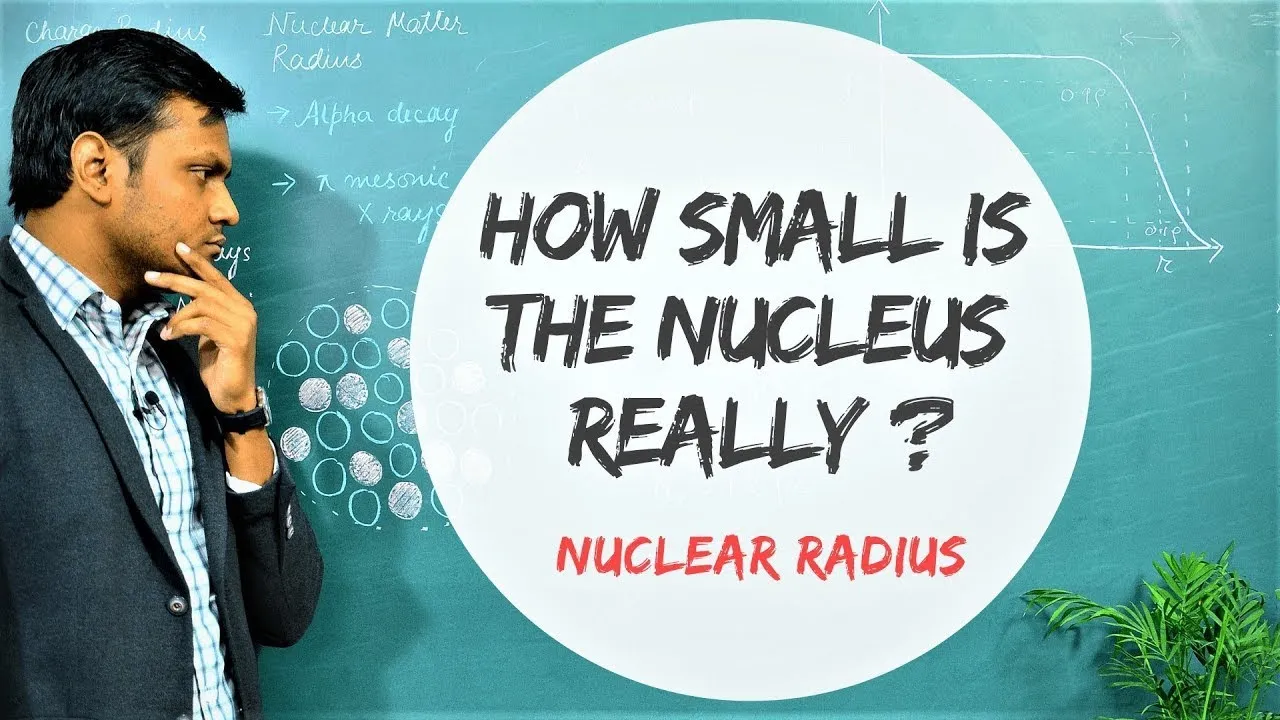
Nuclear Size / Radius
Nuclear Size
In this section, we explore the concept of nuclear size and discuss the experiments that led to our understanding of the small size of atomic nuclei.
Rutherford Scattering Experiments
- Rutherford and his team conducted experiments where they bombarded alpha particles onto a gold foil.
- Majority of the alpha particles passed through the foil undeviated, suggesting that most of the matter in atoms is concentrated in a tiny region.
- Some alpha particles experienced deviation, and a few even deviated at completely backward angles of 180 degrees.
Rutherford's Planetary Model
- Based on these experiments, Rutherford proposed his planetary model, which suggested that atoms have a small region called the nucleus at their center.
- According to Rutherford's estimates, the size of the nucleus was smaller than 10^-14 meters.
Precise Measurements
- Over time, more precise methods for measuring nuclear size have been developed.
- For example, hydrogen atom nuclei have a radius of approximately 0.8 femtometers (10^-15 meters).
- Larger atoms like uranium have nuclei with radii around 7 femtometers.
Comparison with Atom Size
- The ratio between atomic size and nuclear size can help us understand how small nuclei are compared to atoms.
- The radius of a hydrogen atom is around 5 million femtometers (50,000 angstroms), while its nucleus has a radius of only 0.8 femtometers.
- This means that the hydrogen nucleus is approximately 62,000 times smaller than the distance at which electrons exist from the nucleus.
Fun Comparison
- To put things into perspective, let's compare this ratio with other physical examples.
- If we imagine a golf ball as representing a hydrogen atom nucleus with a radius of 2 cm, then the nearest electron would be approximately 50,000 cm away.
Atom Size Comparison
In this section, we further explore the size comparison between atoms and their nuclei using a fun calculation.
Calculation
- The radius of a hydrogen atom is approximately 0.5 angstroms (0.5 x 10^-10 meters).
- The radius of a hydrogen nucleus is around 0.8 femtometers (0.8 x 10^-15 meters).
- Dividing the atomic size by the nuclear size gives us a ratio of approximately 62,500.
- This means that the hydrogen nucleus is about 62,000 times smaller than the distance at which electrons exist from the nucleus.
Golf Ball Comparison
- If we consider a golf ball with a radius of 2 cm as representing the nucleus of a hydrogen atom, then the nearest electron would be much farther away.
Fun Comparison
In this section, we continue our fun comparison between the ratio of atom size to nuclear size and other physical examples.
Golf Ball Radius
- Let's suppose we have a golf ball with a measured radius of 2 cm.
- If we imagine this golf ball as representing the nucleus of a hydrogen atom, we can calculate how far the nearest electron should be from it.
Timestamps are approximate and may not align perfectly with specific sections or bullet points in the transcript.
Size Comparison: Atom vs Nucleus
In this section, the speaker discusses the size comparison between an atom and its nucleus, using the example of a hydrogen atom and its nucleus.
Size of Hydrogen Atom compared to Nucleus
- The radius of a hydrogen atom is approximately 1 kilometer when compared to the size of its nucleus.
- This demonstrates that the nucleus is significantly smaller than the overall size of the atom.
Size Comparison: Solar System vs Sun
- The speaker introduces another comparison between the solar system and the sun.
- The radius of the sun is around 6.9 x 10^5 kilometers.
- The distance from the sun to Neptune, which represents the farthest planet in our solar system, is approximately 4.5 billion kilometers.
- By calculating their ratio, it is found that the solar system is about 6,500 times larger than the sun.
Comparing Atom-Nucleus and Solar System-Sun Ratios
- The speaker compares these two ratios to highlight how much smaller a nucleus is compared to an atom.
- While the sun is only 6,500 times smaller than our solar system, a hydrogen atom's nucleus is about 60,000 times smaller than its overall atomic size.
- This emphasizes how tiny and compact nuclei are within atoms.
Perspective on Sizes
- From one perspective, comparing a proton (nucleus) with a similar size as that of the sun would make an atom much larger than our solar system by tenfold.
- On another perspective, considering that protons are actually much smaller than atoms themselves shows how vast majority of space inside an atom is empty.
- These comparisons highlight both how small nuclei are and how most of an atom's volume consists of empty space.
Precise Methods for Calculating Nuclear Radius
In this section, the speaker discusses various methods used to calculate the nuclear radius more accurately than Rutherford's scattering experiments.
Two Types of Particles in Nucleus
- The nucleus consists of two types of particles: protons and neutrons.
- Protons are positively charged and interact with the coulomb field, while neutrons are neutral and do not interact with it.
Classification of Methods
- Methods for calculating nuclear radius can be classified into two categories based on their interaction with the coulomb field.
- Some experiments involve coulombic interaction, providing information about charge distribution (proton distribution) in the nucleus.
- Other experiments do not involve coulombic interaction, giving insights into nuclear matter distribution (overall particle distribution) within the nucleus.
Experiments for Charge Distribution
- Experiments that provide information about charge radius or charge distribution include high-energy electrons, cantary experiments, x-ray measurements, isotope shifts, mionic x-rays, and mirror nuclei.
Experiments for Nuclear Matter Distribution
- Experiments that give insights into nuclear matter distribution or nuclear matter radius include alpha decay processes and pi misonic x-rays.
- These experiments focus on understanding how particles other than protons (neutrons) are distributed within the nucleus.
Further Details on Experimental Methods
- The speaker mentions that a detailed explanation of these experimental methods is beyond the scope of this video.
- If viewers are interested in learning more about these methods and their outcomes, a separate video can be made to cover them comprehensively.
Conclusion from Various Experiments
- Over time, different experiments have shown that both nuclear matter distribution and charge distribution have approximately the same radius.
- This implies that protons and neutrons are uniformly distributed throughout the volume of the nucleus rather than being concentrated at its center or surface.
New Section
This section discusses the properties of the nucleus, including its density and boundary.
Properties of the Nucleus
- The nucleus does not have a sharp boundary and its density changes gradually over a certain distance.
- The skin thickness is the distance over which the density decreases from 90% to 10% of its maximum value.
- The mean radius refers to the point where the density reaches 50% of its maximum value.
- The nucleus has a constant density throughout its volume, except near the surface where it drops slightly.
New Section
This section compares the density distribution in the nucleus with that of Earth and explains how it relates to the force holding the nucleus together.
Density Distribution in Nucleus vs Earth
- Unlike Earth, where density increases as you go towards the center, the density of nuclear particles remains constant as you move towards the center of the nucleus.
- The force holding the nucleus together is called strong nuclear force or nuclear force, which acts between neutrons and protons. It creates a situation where all particles inside are at constant density.
New Section
This section explains how to calculate the radius of a given nucleus based on its mass number.
Calculating Nucleus Radius
- The volume of a nucleus is directly proportional to its mass number (number of particles).
- By knowing just its mass number (A), we can calculate its radius (r) using r = r₀ * A^(1/3), where r₀ is a constant approximately equal to 1.2 femtometers.
New Section
This section summarizes the key takeaways from the video.
Key Takeaways
- The nucleus is an extremely tiny object without a sharp boundary.
- The density of the nucleus is constant throughout its volume, indicating the nature of the force holding it together.
- The radius of a nucleus can be calculated based on its mass number using r = r₀ * A^(1/3).
Turn any video into a summary like this
YouTube links, meetings, lectures. With transcripts, search, and chat.