Pérdida de carga en tuberías
Pérdidas de Carga en Tuberías
Introducción a las Pérdidas de Carga
- El objetivo de una instalación hidrosanitaria es transportar agua de un punto a otro, enfrentando diversos obstáculos.
- Las pérdidas de energía son inevitables debido al rozamiento entre las partículas del agua y las paredes de la tubería.
Factores que Afectan las Pérdidas de Energía
- La teoría indica que las pérdidas son proporcionales a la carga de velocidad; mayor velocidad implica más pérdidas.
- La turbulencia dentro del flujo incrementa las pérdidas energéticas debido a colisiones entre partículas y fricción con las paredes.
Características del Fluido y Geometría
- Las características del flujo, como la velocidad y el tipo de fluido, influyen en las pérdidas.
- La geometría del elemento conductor (diámetro y forma de la tubería) también afecta el comportamiento del flujo.
Rugosidad y Materiales
- La rugosidad interna de la tubería provoca agitación en el fluido, aumentando así las pérdidas.
- Diferentes materiales (cristal, PVC, concreto, asbesto) tienen distintas rugosidades que impactan en el rendimiento hidráulico.
Clasificación de Pérdidas
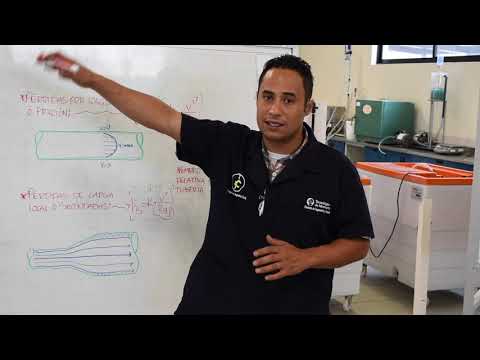
- Las pérdidas se dividen en dos grupos: por longitud (pérdidas primarias o por fricción), que son más significativas.
- Ejemplo práctico: En una línea desde una refinería hasta un punto de abastecimiento, se generan grandes pérdidas por cada unidad de longitud.
Efecto de la Fricción
- La fricción con las paredes detiene el flujo; esto se observa claramente mediante experimentos prácticos relacionados con el teorema o principio de Reynolds.
- Se debe sumar todas las pérdidas por fricción para obtener un valor total significativo para los cálculos hidráulicos.
Factor de Fricción
- El factor de fricción es crucial para calcular estas pérdidas; puede ser encontrado en bibliografía proporcionada por fabricantes.
Understanding Friction Losses in Fluid Systems
Types of Friction Losses
- The discussion begins with the concept of dimensional friction factors, including length, diameter, and flow velocity as project data to estimate friction losses in a system.
- Friction losses are categorized into two groups: long-term friction losses and local or secondary pressure losses caused by specific components like valves and bends.
Local Pressure Losses
- A sudden change in direction can disturb flow, creating turbulence that leads to additional pressure losses around the bend.
- To calculate local pressure losses, a different formula is used that incorporates dimensional factors; manufacturers test components like valves to determine their specific friction factors.
Energy Considerations
- Higher kinetic energy results in increased friction losses; thus, understanding both types of losses helps estimate total system supply or conduction losses effectively.
Temperature Effects on Viscosity
- Other loss types include temperature exchange between the environment and fluid. For instance, transporting oil in cold climates increases viscosity and consequently raises loss numbers.
- It’s crucial to account for temperature-related viscosity changes when designing hydraulic systems to ensure optimal energy delivery without excess or insufficient energy at the destination.
Additional Loss Factors
- Other potential loss sources include pipe expansion due to high pressure or contraction from temperature changes affecting material elasticity.
- Various loss types must be estimated based on specific cases analyzed for optimal hydraulic design.
Friction Factor Dependencies
- The friction factor (f_e) depends on Reynolds number, which relates to dynamic or kinematic viscosity and is influenced by pipe diameter and flow velocity.
Practical Application: Measuring Pressure Losses
Overview of Measurement Setup
- The speaker introduces a measurement board designed for estimating pressure losses across various accessories within a fluid system setup.
Equipment Description
- A small water tank supplies fluid through a pump; an aforador measures flow rate output from the pump continuously expressed in cubic meters per hour but converted for practical use into cubic meters per second.
Monitoring System Safety
- Emphasis is placed on maintaining safe operational pressures below three bars using manometers; exceeding this threshold could lead to equipment failure or hazards.
Flow Management
Understanding Valve Operation and Pressure Measurement
Overview of Valves and Flow Control
- The speaker explains the position of a ball valve, indicating that when the handle is perpendicular to the flow, it is closed; when parallel, it is open. All valves are currently closed.
- Water does not flow through the accessories due to all valves being shut; it only reaches a certain point before returning to the tank, creating a closed loop.
Measuring Pressure with Differential Manometer
- A mercury differential manometer connected via blue and red hoses measures input and output pressure. The height difference in these hoses indicates pressure variations.
- Regardless of how the manometer hoses are connected (input or output), observing pressure differences due to accessory-induced losses is crucial.
Procedure for Taking Measurements
- To measure accurately, it's essential to pressurize at both entry points simultaneously until a click sound indicates readiness. No pressure registers while the machine is off.
- Upon starting the machine, changes in measurement can be observed as indicated by movements in the manometer's counterweight.
Calibration and Measurement Process
- Before taking measurements, ensure that both needles on the differential manometer are levelled using manual adjustments for accuracy.
- After achieving balance, apply pressure until a click confirms readiness for measurement. Record water column heights from both sides of the manometer.
Accessories for Measurement Practice
- The speaker introduces various accessories for practice measurements:
- A long-radius cone with a one-inch diameter will be measured first.
- Next will be a short-radius elbow with different charge loss characteristics due to its design.
Analyzing Flow System Components
- Each accessory has unique charge loss properties; understanding these differences is vital for accurate measurements during practice sessions.
- Prior to each measurement, calibrate levels in the mercury manometer by adjusting needle positions until they appear balanced.
Practical Application of Measurements
- The next pieces include various elbows and valves which will also be measured under controlled conditions where some valves remain closed while others are opened sequentially.
Measuring Flow and Pressure in Valves
Introduction to Valve Measurement
- The process begins with an open valve allowing flow back to the tank, emphasizing the importance of opening one valve before closing another to maintain flow and prevent dangerous pressure buildup.
Measuring a Ball Valve
- The next measurement involves a 3/8 inch ball valve. The procedure includes monitoring pressure as valves are opened and closed, ensuring proper flow through the small pipe.
Measuring a Lens Valve
- A half-inch lens valve is introduced. Similar steps are followed: opening the new valve while closing the previous one, measuring both inlet and outlet pressures as flow is directed through available paths.
Membrane Valve Measurement
- Transitioning to a membrane valve of half an inch, the same protocol applies. This section also introduces a needle valve, highlighting safety practices when handling non-secure pipes or valves.
Right-Hand Rule for Valve Operation
- A practical tip is shared regarding the right-hand rule for operating valves: using thumb direction for opening/closing guidance while fingers indicate flow direction. This principle extends to secure systems using the left hand.
Gate Valve Measurement
- The gate valve is measured next, following similar procedures for pressure checks at entry and exit points.
PVC Pipe Measurements
- Discussion shifts to measuring PVC pipes (16mm diameter), noting that smaller diameters lead to greater losses due to friction.
Impact of Pipe Bends on Flow
- Attention turns to measuring pipes with multiple tight bends (90 degrees). Differences in friction loss between short-radius and long-radius fittings are highlighted.
Venturi Tube Usage
- Mention of venturi tubes indicates their role in estimating flow velocity; however, they also contribute to losses that need consideration during calculations.
Additional Equipment for Flow Measurement
- Other tools like flanges and pitot tubes are discussed for their utility in estimating flow speed but also their associated losses.
Conclusion on Testing Setup