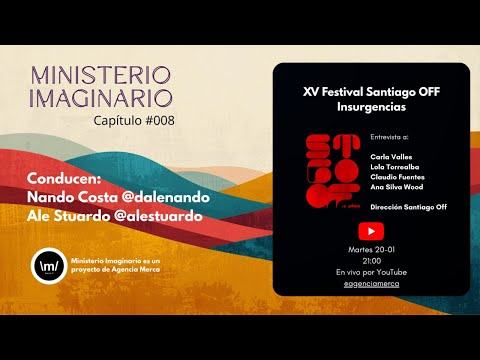
Ministerio Imaginario - Live #008 - Santiago Off 2026, INSURGENCIA
Welcome to Chapter Eight
Introduction of Guests and Festival Discussion
- The host welcomes listeners to the eighth episode of "Ministerio Imaginario," expressing surprise at reaching this milestone. They introduce guests from the festival team, celebrating its fifteenth edition.
Importance of Communication in Cultural Management
- The host shares a reflection on the strategic role of communication in cultural management, emphasizing that without effective communication, management fails. This sets the stage for deeper discussion.
Communication as a Last Consideration
- Over 20 years in cultural management have shown that communication is often one of the last aspects considered, overshadowed by budgets and logistics. This neglect leads to ineffective project promotion.
Budget Allocation for Promotion
- Current funding guidelines require allocating 20% of production budgets towards promotional activities, highlighting a systemic issue across various artistic disciplines where communication is undervalued.
Strategic Communication as Essential
- A cultural manager lacking strategic communication skills operates blindly in today's hyper-connected world filled with content saturation; effective communication connects art with its community context.
Perspectives on Communication Needs
- Guests reflect on their experiences regarding the necessity for strategic communication within cultural management, particularly referencing Santiago Off's mission to create space outside mainstream recognition.
Professionalization and Awareness Growth
- There’s an increasing awareness among cultural workers about the importance of strategic communication as they navigate professionalization over the past 15 years amidst structural challenges in funding and resources.
Structural Challenges Impacting Communication Roles
- The lack of dedicated communicators stems from broader structural issues within cultural projects that prioritize basic operational needs over marketing or communications roles due to financial constraints.
Marketing Actions and Community Engagement
- Recent work has revealed that marketing actions aimed at specific niches are similar to those employed by local cultural centers trying to engage their communities effectively despite limited reach compared to larger venues like theaters.
Tailoring Strategies for Unique Contexts
- Each artistic space requires tailored communication strategies; understanding unique contexts allows teams to creatively engage audiences rather than relying on generic protocols for outreach efforts.
Understanding Audience Engagement in Theater
The Complexity of Strategy in Theater
- The development of a theater strategy is not straightforward; it requires deep understanding and human interaction, focusing on audience research and engagement.
- Different theaters attract distinct audiences, with some patrons attending without prior knowledge of the performance, highlighting the importance of identity in audience demographics.
Evolving Artistic Contexts
- Creativity in theater is multifaceted and influenced by various factors such as context, annual themes, and evolving artistic languages.
- The relationship between community work and festival activities raises questions about how audiences connect with different productions.
Community Engagement Challenges
- The RedOff project emphasizes the significance of community involvement, particularly for marginalized groups lacking access to artistic content.
- Political influences can complicate community art initiatives, often overshadowing local cultural efforts when larger festivals are introduced.
Importance of Local Communication
- Effective communication with local cultural agents is crucial for fostering genuine connections within communities rather than imposing external narratives that may alienate audiences.
- Past projects aimed at community development have struggled due to shifting public policy priorities that neglect grassroots cultural organizations.
Future Directions for Cultural Policy
- Recent government initiatives like "Puntos de Cultura" aim to address local cultural needs but require time to evolve into sustainable public policies rather than temporary programs.
- Current political attitudes towards culture may threaten previous advancements; there’s a need for dialogue among policymakers and cultural organizations to ensure community needs are met effectively.
Political Landscape and Cultural Challenges in Chile
Concerns About Political Administration
- The speaker expresses uncertainty about the future of Chile, indicating a lack of optimism regarding political administration and potential setbacks in cultural programs due to unstable governance.
- There is concern over legislative support for cultural organizations, highlighting that changes in government could lead to the dismissal of existing organizations without legal protections.
Influence of Political Parties
- The speaker notes the difficulty of extreme right movements gaining traction in Chile due to strong political party influences and a history of political pluralism.
- Acknowledges the rise of hate speech and xenophobia globally, which poses a significant threat given Chile's violent past and ongoing struggles for justice.
Cultural Resistance and Collective Action
- Despite fears surrounding political shifts, there is confidence in collective cultural forces that may resist drastic changes imposed by new administrations.
- Critiques past governmental approaches to culture, emphasizing failures in engaging communities meaningfully rather than through superficial events or external producers.
Misalignment Between Culture and Community Needs
- Discusses errors made culturally, particularly regarding event-driven approaches that neglect genuine community engagement and fail to utilize resources effectively.
- Highlights issues with external production companies lacking depth in content delivery during cultural initiatives, stressing the need for contextual understanding.
Addressing Hate Speech Through Cultural Management
- Raises questions about the role of cultural management in countering rising hate speech linked to far-right ideologies across Latin America.
- Emphasizes concerns over symbolic degradation within culture as a result of these discourses, suggesting structural challenges are less daunting than perceived but still alarming.
The Value of Art and Culture in Society
The Importance of Cultural Investment
- The discussion emphasizes the need to prioritize cultural investment over basic needs, arguing that reducing culture to a mere competition with essential services undermines its intrinsic value.
- It highlights how art contributes to emotional education, mental health, and overall human development, asserting that these aspects are fundamental for civilization.
- There is a concern about the degradation of symbolic capital when art is viewed as secondary to infrastructure needs like street lighting.
Art as an Essential Human Expression
- The speaker argues that art and culture are not competing with basic survival needs; rather, they enhance life while addressing those needs.
- Emphasizes the idea that understanding the role of art should be integral to societal discussions about progress and dignity.
Challenges Facing Cultural Institutions
- Discusses the evolution of cultural movements such as "insurgencia," which began as antifascist before evolving into broader social resistance.
- Critiques public officials who lack knowledge in cultural matters, suggesting this ignorance reflects poorly on their roles in society.
Financial Struggles in Cultural Sectors
- Highlights issues surrounding funding for cultural initiatives and the complexities involved in financial transactions within arts organizations.
- Points out the limited opportunities for artists due to economic constraints despite a growing demand for theatrical productions.
The Role of Artists in Political Discourse
- Notes how political climates can stifle artistic expression, leading to silencing within cultural organizations during certain administrations.
- Reflects on how criticism towards government actions was often misinterpreted politically, creating divisions among artists and cultural groups.
Discussion on Political Disillusionment and Cultural Engagement
The Shift in Political Landscape
- The loss of significant municipalities during the Borich campaign reflects a shift towards the far-right, indicating a change in political engagement and representation.
- The expectation for constitutional reform and a new political system was not met, leading to disillusionment with political representatives and their credibility.
Cultural Development Under Current Governance
- Despite some positive developments (e.g., 40-hour work week), there is still a lack of solid cultural foundations for dialogue between private entities and the state.
- There is an observed dependency of culture on state support, which hinders genuine collaboration between cultural agents and governmental bodies.
Resistance and Insurgency in Cultural Context
- Maintaining resistance does not equate to violence; it involves re-evaluating concepts like memory and insurgency from their fundamental expressions.
- A widespread disillusionment exists within the artistic community regarding government actions, leading to calls for stronger collective dialogue among cultural organizations.
Hope Through Collective Action
- Artists are encouraged to engage politically beyond individual interests, fostering community through collaboration rather than competition.
- Emphasizing community over individualism is crucial in navigating today's information-saturated environment.
Upcoming Festival Insights
- Discussion about the festival's programming highlights efforts to blend new artistic languages with traditional forms, showcasing both established works and emerging talents.
- The festival aims to present diverse performances that reflect contemporary themes while honoring historical contributions to the arts.
Insights on Contemporary Theatre and Dance in Chile
The Impact of "Denominación de Origen" Film
- Discussion begins with the influence of the film "Denominación de Origen," highlighting its popularity and relevance to current cultural conversations.
- The film is noted for illustrating how good intentions can be undermined by community dynamics, showcasing a duality in artistic expression.
Notable Contemporary Works
- Mention of the play "Pasta Base," which critically examines a character's life intertwined with drug culture, emphasizing both epic and realistic elements.
- Introduction of Marina Otero, an acclaimed international artist leading a contemporary dance cycle at Estación Mapocho, marking her first appearance in Chile.
Programming Challenges and Community Engagement
- Acknowledgment of limited programming slots available for quality works due to time and financial constraints; many deserving pieces were left out.
- Highlighting the significance of community-focused projects that address migration issues, demonstrating active engagement with societal themes.
Festival Santiago Off: Structure and Sustainability
- Overview of the upcoming Festival Santiago Off, emphasizing its role in fostering artistic dialogue and community building over ten days.
- Discussion on how the festival maintains itself through passion rather than commercial success; it relies on faith in art's value amidst financial challenges.
Accessibility and Opportunities
- Information about ticket availability, including contests for free entries to various performances, encouraging wider audience participation.
- Announcement regarding open calls for workshops under "Escuela Off," promoting educational opportunities within the arts community.
This structured overview captures key discussions from the transcript while providing timestamps for easy reference.
Festival Resilience and Community Engagement
The Challenges of Optimism in Cultural Initiatives
- The speaker reflects on the fatigue that can accompany ongoing challenges, yet emphasizes the importance of optimism and teamwork in overcoming obstacles.
- They highlight the festival's significance as a cultural necessity, stressing the need for dialogue with authorities to secure resources and support amidst insufficient mechanisms.
Evaluating Progress Over 15 Years
- A call to assess changes over 15 years is made, focusing on aesthetic, political, and community engagement aspects within artistic circles.
- The speaker expresses a commitment to contributing positively to the community despite personal setbacks, emphasizing collective achievements as a source of pride.
Collective Responsibility Beyond Individual Interests
- There’s an acknowledgment that the festival transcends individual ownership; it represents a shared responsibility among team members for something greater than themselves.
- The discussion touches on how this sense of duty has naturally guided their management approach without needing explicit conversations about continuation or project viability.
Sustaining Community Through Shared Conviction
- The importance of viewing projects from a broader perspective is emphasized; success should not solely be measured by immediate outcomes but by long-term impact and community benefit.
- Team dynamics are crucial; if any member lacks conviction, it jeopardizes the project's sustainability due to its demanding nature.
Building Networks and Artistic Discourse
- The conversation highlights how collaboration fosters community building and networking among artists, creating spaces for discourse that enriches individual artistic expressions.
- Acknowledgment is given to the necessity of these spaces in countering larger homogenizing trends in art events while fostering new voices within political art contexts.
Importance of Disseminating Conversations
- Gratitude is expressed for engaging discussions that will be edited and published to raise awareness about initiatives like the Festival Santiago within policy contexts.