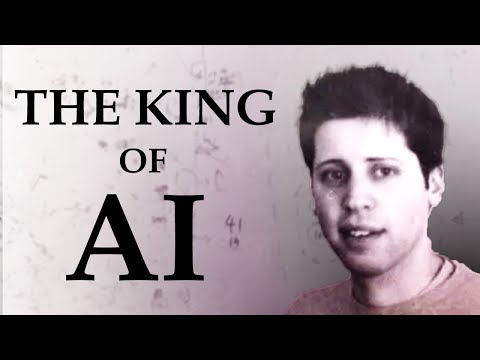
Sam Altman - The Man Who Owns Silicon Valley
The Story of Sam Altman
This transcript tells the story of Sam Altman, from his early days as a talented debater to his rise as a successful entrepreneur and venture capitalist.
Early Life and Education
- Sam Altman was born in 1985 and grew up as the youngest of three siblings.
- He received his first computer at age eight and already knew how to program it.
- He attended Stanford University alongside future billionaires Evan Spiegel (Snapchat) and Kevin Systrom (Instagram).
- Despite being a great student, he dropped out at age 19 after realizing he was wasting his time.
Loopd: His First Startup
- After dropping out, he founded Loopd, a mobile app that connected users based on their location.
- Loopd reached a peak valuation of $175 million but struggled to grow further.
- In 2012, Sam sold the company for $43 million.
Becoming a Venture Capitalist
- With millions in the bank, Sam traveled the world before returning to Silicon Valley.
- He became a venture capitalist but found it unfulfilling compared to running his own company.
Y Combinator Partnership
- Paul Graham offered him a partnership at Y Combinator where he could build new startups while learning from Graham himself.
- After just three years as partner, Paul Graham made him president of Y Combinator due to his work ethic and ability to recognize promising startups.
- Under Sam's leadership, Y Combinator invested in startups working on promising and world-changing ideas.
Conclusion
- Sam Altman's story is one of hard work, intelligence, and risk-taking that led him to become a successful entrepreneur and venture capitalist.
Sam Altman's Investing Principles
In this section, we learn about Sam Altman's top three investing principles and how he became interested in artificial intelligence.
Sam Altman's Top Three Investing Principles
- Principle 1: Focus on the founders.
- This means that when investing in a startup, it is important to consider the qualities of the founders and their ability to execute their vision.
- Principle 2: Solve real problems.
- When considering an investment opportunity, it is important to evaluate whether the product or service solves a real problem for customers.
- Principle 3: Think long term.
- It is important to invest in companies with a long-term vision and potential for growth.
Sam Altman's Interest in Artificial Intelligence
- In February of 2014, Sam Altman became interested in artificial intelligence (AI).
- Despite AI being considered a failed science at the time, Sam believed that it would be the biggest development in technology ever.
- He teamed up with Elon Musk to start OpenAI, a company focused on ensuring that artificial intelligence benefits all of humanity.
OpenAI's Hiring Strategy
In this section, we learn about OpenAI's hiring strategy and how they overcame challenges related to talent acquisition.
OpenAI's Hiring Strategy
- To build a team of top AI researchers, OpenAI made a list of the 10 best researchers and were able to hire nine of them.
- OpenAI offered competitive salaries to attract the best talent, recognizing that the best people are much better than the pretty good people.
Challenges Overcome by OpenAI
- When OpenAI was created, 75% of all AI talent was at Google, making it difficult for other companies to hire top researchers.
- Despite attracting top talent, OpenAI faced challenges related to funding as a non-profit organization. Elon Musk promised to contribute one billion dollars but later left the company due to disagreements over its future.
- To overcome these challenges, Sam Altman met with Satya Nadella, CEO of Microsoft and formed a strategic partnership with them.
OpenAI's Achievements
In this section, we learn about some of OpenAI's achievements and how they have evolved over time.
GPT-1 Release
- In 2018, OpenAI released GPT-1 which was considered okay but not mind-blowing.
Sam Altman's Focus on OpenAI
- In 2019, Sam Altman stepped down from his position as chairman at Y Combinator to fully focus on OpenAI.
Partnership with Microsoft
- The partnership with Microsoft allowed OpenAI access to more resources and support from a trillion-dollar company.
- Some criticized the decision to partner with Microsoft as it went against their original mission as a non-profit organization.
The Evolution of AI Language Models
This section discusses the evolution of AI language models, starting with GPT-1 and ending with GPT-4. It also highlights the breakthroughs achieved by OpenAI in this field.
The Emergence of GPT-2
- GPT-2 was significantly better than its predecessor, GPT-1.
- Jeffrey Hinton, the Godfather of artificial intelligence, was impressed by GPT-2's performance.
- OpenAI released its best product yet in 2020 - GPT-3. It could generate new text, summarize existing text and even translate to all kinds of languages.
Dali and Chatbot Breakthroughs
- Dali was released in 2021 and demonstrated impressive creativity by generating images in all kinds of styles including cartoons, photos, and abstract art.
- Sam Altman had the idea to take GPT-3 and put it into a simple chatbot called ChairGPT. Despite initial resistance from some OpenAI engineers who thought developing a chatbot for the masses wasn't worth the time and energy, ChairGPT became the fastest-growing product in history reaching over 100 million users in less than two months.
Sam Altman's Personal Life
- Sam Altman is a Doomsday prepper who owns a nuclear bunker with a stash of gold guns and gas masks.
- In 2017 he wrote a blog post pointing out how political correctness and censorship were crushing the intellectual spirit of San Francisco.
- Sam Altman has an impressive personal portfolio which consists of over 400 companies. Some of his best investments include Airbnb, Stripe, Reddit, Asana, and Pinterest.
GPT-4 and the Risks Involved with AI
- In 2023, Microsoft gave OpenAI another $10 billion to play with making OpenAI worth over $30 billion dollars at this rate.
- GPT-4 was released and can only be described as scary good. It's already better than most humans at most things.
- The biggest issue with AI is the problem of alignment. We have to make sure that AI has the same goals as we do because if we don't it's very likely that the human race will not survive.