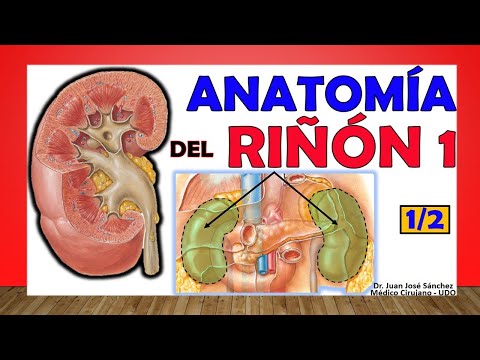
🥇 Anatomía del RIÑÓN (1/2). ¡Fácil Explicación!
Introduction and Generalities
In this section, the speaker introduces the topic of the anatomy of the kidney and provides an overview of what will be covered in the video.
- The kidneys are paired organs that play a crucial role in ultra plasma filtration and urine formation.
- They belong to the excretory and genitourinary systems, but they also have endocrine functions.
- The kidneys are retroperitoneal organs located between the L1 and L3 vertebrae.
- There may be variations in size and position between the left and right kidneys.
Function of Kidneys
This section focuses on the primary function of the kidneys.
- The main function of the kidneys is ultra plasma filtration, which leads to urine formation.
- Kidneys are essential for life, as their absence is incompatible with survival.
- The kidneys also have other functions, including hormone production.
Differences Between Left and Right Kidney
This section highlights some differences between the left and right kidneys.
- In most cases, the left kidney is larger than the right kidney due to differences in venous drainage.
- The position of both kidneys is generally between L1 and L3 vertebrae when a person is standing. However, there can be variations depending on factors like diaphragm relaxation.
Variations in Position
This section discusses variations in position between individuals' kidneys.
- The right kidney is generally lower than the left kidney due to pressure from a voluminous liver in the upper right quadrant of the abdomen.
- While classically positioned between L1 and L3 vertebrae when standing, anatomical variations can occur, especially in cadavers where the diaphragm relaxes.
Size and Shape of Kidneys
This section provides information about the size and shape of kidneys.
- The length of a kidney is approximately 13 to 14 centimeters, while the width at its widest part is between 7 and 8 centimeters.
- The anteroposterior dimension ranges from 3 to 4 centimeters.
- The weight of a kidney typically falls between 125 to 155 grams.
- Kidneys are often described as having a bean-like shape.
Renal Capsule and Attachment
This section discusses the renal capsule and how kidneys are attached within the abdomen.
- The renal capsule is the outermost layer of the kidney that can be easily separated when the kidney is healthy.
- Kidneys are attached to the posterior wall of the abdomen and follow the axis of the psoas major muscle.
The transcript continues with further details about kidney anatomy, but this summary covers only up to this point.
New Section
This section provides an overview of the arrangement and structure of the kidney.
Kidney Arrangement
- The upper poles of the kidney are closer to each other than the lower poles.
- The distance between the upper pole and the upper pole of the kidney is 6 to 7 centimeters, while the distance between the lower pole and the lower pole is up to 13 centimeters.
- The kidney is arranged obliquely in the retroperitoneal region.
New Section
This section discusses the faces and edges of the kidney.
Faces and Edges
- The kidney has two faces: anterior face (convex) and posterior face (similar to anterior face).
- It has two edges: medial/internal edge (facing the spine with a notch shape) and external/lateral edge (convex and longer than internal edge).
New Section
This section explains the extremities or poles of the kidney.
Extremities or Poles
- The kidney has two extremities: upper extremity (in contact with adrenal gland) and lower extremity (mostly in contact with psoas major muscle).
- Some authors refer to the lower pole as the lower extremity.
- Structures enter and exit towards the kidney through its internal/medial edge, known as renal hilum.
New Section
This section discusses structures entering and exiting through renal hilum.
Renal Hilum
- Renal hilum is located on the medial/internal edge of the kidney.
- It serves as an entrance for structures entering and exiting towards/from the kidney.
- Renal hilum leads to a fossa within depths of the kidney called renal sinus.
New Section
This section explains the renal sinus and renal fascia.
Renal Sinus and Renal Fascia
- The renal hilum leads to a hole or fossa called the renal sinus within the kidney.
- The renal sinus will be further explained in another video.
- The kidney is covered by its capsule, followed by the renal fascia externally.
- The renal fascia consists of two leaves: anterior leaf (continuous with contralateral side) and posterior leaf (not continuous with contralateral side).
- A space between the kidney's capsule and renal fascia is known as perirenal space.
- Perinephric fat is located within the perirenal space, while pararenal fat remains outside the renal fascia.
New Section
This section discusses communication between spaces within the kidneys.
Communication Between Spaces
- Most authors state that there is no real communication between one space of a kidney and another.
- However, both kidneys reach below to the pelvis, allowing infections to spread downwards quickly.
- Sagittal cut at the level of right hypochondrium shows how a kidney infection can spread downwards.
New Section
This section provides an overview of a sagittal cut at the level of right hypochondrium.
Sagittal Cut
- A sagittal cut at this level shows various organs including transverse colon, liver, posterior wall of abdomen, and kidney surrounded by renal fascia.
New Section
This section provides an introduction to the video and encourages viewers to subscribe to the channel for access to anatomical content.
Introduction and Channel Subscription
- The video invites viewers to subscribe to the channel by clicking on the subscription button in the lower right corner.
- Viewers are reminded to like the videos and subscribe, as there are already over 57 thousand subscribers.
- The channel offers more than 160 anatomical videos, with a focus on anatomy. Other topics may be covered in the future after completing the anatomical content.
Renal Relations
This section discusses the peritoneal and visceral relations of the kidneys.
Peritoneal Relations
- The kidneys are retroperitoneal organs, meaning they lack visceral peritoneum. They are in contact with the parietal peritoneum on their anterior face.
- The right kidney is separated from certain organs by parietal peritoneum, such as the liver and small intestine. Naked areas devoid of peritoneum exist on its anterior face.
- The left kidney has three islands or islets of parietal peritoneum that separate it from specific organs, including the stomach, vessel, and loops of small intestine. It also has a renal splenous ligament connecting it to other structures.
Visceral Relations
- The upper pole of both kidneys is surrounded by adrenal glands and wrapped inside renal fascia.
- The lower pole of the kidneys is in contact with the psoas major muscle and quadratus lumborum muscle.
- There is a mention of the upper poles of the right kidney being related to the inferior vena cava, but it may not be accurately depicted in atlases or confirmed in live cadavers.
Visceral Relations and Conclusion
This section continues discussing visceral relations of the kidneys and concludes the video.
Visceral Relations (Continued)
- The right kidney is related to organs such as the liver, second portion of the duodenum, ascending colon, and loops of small intestine. It also has a hepatorenal sac or subhepatic spaces formed by a division of the large peritoneal cavity.
- The left kidney is related to organs including the stomach, tail of pancreas, vessel, splenic artery and vein descending, splenic flexure of colon, and descending colon. It also has a renal facet on its anterior face that relates to the vessel.
Conclusion
- The video concludes by emphasizing that understanding visceral anatomy is crucial for studying the kidneys and encourages viewers to explore other videos on abdominal anatomy.
New Section
This section provides an overview of the posterior relationships of the twelfth rib and the kidney with various muscles.
Posterior Relationships
- The twelfth rib has a posterior relationship with the thoracoabdominal diaphragm muscle.
- The transversus abdominis muscle is related to the kidney in red.
- The quadratus lumborum muscle is related to the kidney in yellow.
- The psoas major muscle is related to the kidney in lilac.
New Section
This section explains the lateral to medial relationships of different muscles with the kidney.
Lateral to Medial Relationships
- The most lateral relationship is with the transverse abdominis muscle.
- The quadratus lumborum muscle is related to the kidney in yellow.
- The most medial relationship is with the psoas major muscle.
New Section
This section discusses how the superior part of the kidney is related to ribs and muscles.
Superior Relationship
- In the superior part, the kidney is related to the 12th and 11th ribs as well as the thoracoabdominal diaphragm muscle.