Business Process Analysis
Business Process Analysis and Its Benefits
In this section, we will define business process analysis (BPA), discuss its benefits, and differentiate it from other related disciplines.
Definition of BPA
- BPA stands for business process analysis.
- It is not to be confused with BPM (business process management) or BA (business analysis).
- BPA focuses on specific analysis of processes to increase efficiency and create better governance.
Benefits of BPA
- BPA can increase efficiency in existing processes, such as employee onboarding.
- It can also create better governance by revealing where compliance measures have faulted and setting an improvement plan in place.
- Additionally, it can strengthen a company's culture by breathing new life into employee experience.
Differentiating BPA from Other Disciplines
- BA relates to high-level operational analysis like financial forecasting and budgeting, while BPA focuses on specific process analysis.
- BPM is a discipline that includes BPA as one of its components.
Two Philosophies Guiding BPA Methodology
In this section, we will discuss the two predominant philosophies guiding business process analysis methodology: Six Sigma and Lean Six Sigma.
Six Sigma
- Six Sigma is a 5 to 7 step methodology used by most businesses today to analyze efficiencies and restraints.
Lean Six Sigma
- Lean Six Sigma combines the Six Sigma approach with the Lean philosophy.
- It focuses on eliminating tasks and resources that don't provide defined value.
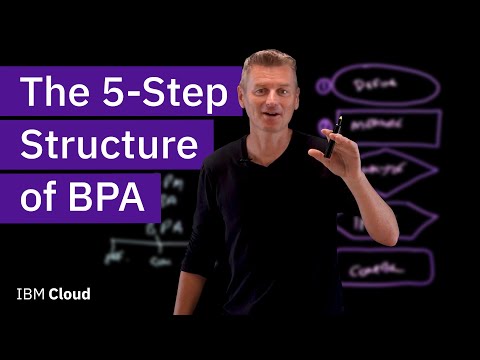
Five Step Structure for Implementing BPA
In this section, we will discuss the five-step structure for implementing BPA.
Step 1: Define
- Defining the process you want to analyze is the first step in implementing BPA.
- Analysts begin with as-is processes, which is how things work today.
Step 2: Measure
- Measuring how the process functions against defined metrics such as key performance indicators (KPIs) is the second step in implementing BPA.
- KPIs provide indications of effectiveness, quality, productivity, and value.
Step 3: Analyze
- Analyzing the process using value analysis, gap analysis or root cause analysis is the third step in implementing BPA.
- A gap analysis reveals what's missing in the process.
- A value analysis conveys what is a value within the process and therefore also what's considered waste.
- A root cause analysis applies certain "why" questions and methods that help you to work backwards to the root cause of the problem.
Bonus Tip: How to Write Backwards?
In this section, we will learn about a bonus tip on writing backwards.
Writing Backwards
- The most commonly asked question by viewers is how to write backwards.
- The presenter does not write backwards but writes facing themself and then flips it during post-production.
Business Process Automation
In this video, we learn about business process automation (BPA), which is the use of technology to automate repetitive tasks and improve efficiency in business processes. The video explains the steps involved in BPA and how it can help organizations move towards hyperautomation.
Steps Involved in BPA
- After defining, measuring, and analyzing a process, the next step is to make it better.
- Business process managers and analysts create and execute plans to improve errors in a process.
- Control is the final step where decision-makers use analysis to manage resources, responsibilities, processes, and monitor changes for future analysis.
Hyperautomation
- Hyperautomation is the use of advanced technologies like AI and robotic process automation to automate tasks currently performed by humans.
- BPA can help organizations create a documented path towards integrating automated processes and moving towards hyperautomation.
- A good example of this is how customer service centers can lower costs by moving to fully automated chatbot support.
Benefits of BPA
- BPA helps identify what's working well in current processes, what needs improvement, and how improvements can be made.
- Improvements lead to increased efficiency.