#1 CONTABILIDAD AGRÍCOLA, LIBRO DIARIO
Introduction to Agricultural Accounting Case Study
Overview of the Case Study
- The case study will cover practical examples in agricultural accounting, spanning the entire accounting cycle from journal entries to financial statements.
- The presentation is structured into multiple videos, gradually increasing in complexity. It aims to cater to both beginners and those familiar with basic concepts.
Initial Balance Sheet
Understanding the Balance Sheet Components
- The initial balance sheet for 2018 is presented, including essential components such as the company name, document title, date, and currency used.
- The balance sheet begins with assets categorized into current and non-current assets. This structure is crucial for understanding financial health.
Current Assets Breakdown
Details on Current Assets
- Current assets include cash equivalents amounting to $25,000 and inventory valued at $15,000, which consists of $10,000 in fertilizers and $5,000 in insecticides.
- Future coffee harvest costs are recorded as a current asset totaling $10,000; this includes various subcategories like fertilizers and supervision costs associated with coffee production.
Non-Current Assets Overview
Analysis of Non-Current Assets
- Non-current assets consist of property plant equipment valued at $55,000 (land: $40,000; building: $15,000), along with accumulated depreciation of $6,750 that will be discussed later.
- Biological assets related to coffee plantations are valued at $100,000; these represent investments in living plants that generate future economic benefits through production.
Total Asset Calculation
Summarizing Total Assets
- The total current assets amount to $50,000 while total non-current assets reach $112,250; thus the overall asset total stands at $162,250 without any liabilities recorded for educational purposes.
- This balance confirms that total assets equal equity when liabilities are zero—an important principle in accounting practices.
Transitioning into New Year Transactions
January 2019 Transactions
- As we transition into January 2019 operations begin with recording collection costs of $6,000 paid in cash alongside an exhaustion charge of $4,000 related to capital expenses incurred during coffee harvesting activities.
Journal Entry Preparation
Creating Journal Entries
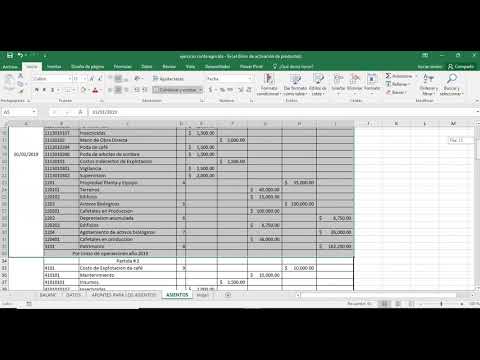
- To initiate journal entries for transactions provided by the company starting from January 1st involves registering last year's closing balances as opening balances for this year’s operations using appropriate account codes based on a chart of accounts structure outlined earlier.
Structure of Journal Entries
Detailed Structure Explanation
- Each journal entry must include specific columns such as date and account details while adhering strictly to local regulations regarding format standards which may vary across countries or companies involved in agricultural accounting practices .
Recording Initial Balances
First Journal Entry
- The first entry records cash equivalents ($25k), following standard rules where increases in asset accounts are debited while corresponding credits reflect other accounts impacted by this transaction .
Inventory Account Registration
Registering Inventory
- Next step involves registering inventory worth ($15k); it requires identifying relevant subaccounts within established charts ensuring accurate representation according to data provided by management about its composition (fertilizers & insecticides).
Future Coffee Harvest Costs
Cost Allocation for Future Harvest
- Costs associated with future coffee harvest ($10k) need careful allocation among respective categories reflecting expenditures incurred prior but not yet liquidated due sale completion processes .
Finalizing Asset Registrations
Completing Asset Registrations
- After completing registrations for all current asset categories attention shifts towards non-current ones including property plant equipment totaling ($55k), biological investments ($100k), followed by necessary adjustments concerning depreciation calculations applied accordingly .
Understanding Depreciation and Biological Asset Depletion
Depreciation Calculation
- The depreciation is calculated as the acquisition value minus the residual or realization value divided by the useful life of the assets.
- A specific example includes a building valued at $15,000 that has an annual depreciation of $6,750. This amount corresponds to the recorded depreciation for accounting purposes.
Biological Asset Depletion
- The discussion introduces biological asset depletion, specifically related to agricultural assets like coffee plants, which is referred to as "agotamiento" (depletion).
- An initial charge of $100,000 is noted for biological assets, with a calculated depletion value of $36,000 for coffee plantations. This reflects their loss in value over time.
Accounting Entries and Balance Verification
- After recording both depreciation and biological asset depletion, there’s a need to adjust equity accounts accordingly. The total equity stands at $162,250 before adjustments are made.
- The process involves verifying previous year balances to ensure accuracy in financial reporting; this includes summing debits and credits to confirm they match correctly.
Conclusion and Next Steps
- The session concludes with plans for further explanations on additional accounting entries in future discussions while ensuring clarity on current topics covered.