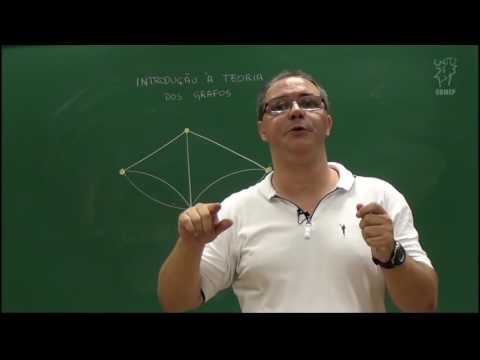
Introdução à Teoria dos Grafos – Aula 5 – Grau de um vértice e o problema das Pontes de Königsberg
Introduction to Graph Theory
Overview of Graphs
- The lesson introduces a new way to interpret real or hypothetical situations using graphs, moving away from traditional geometric representations.
- Graphs consist of a set of vertices and edges; the instructor provides two examples to illustrate this concept.
Describing Graphs
- Instead of drawing, graphs can be described by listing their vertices (e.g., A, B, C, D, E) and edges (e.g., A connected to E).
- The importance of isomorphic graphs is highlighted; different drawings can represent the same relationships among vertices.
Summarizing Graph Characteristics
- While summarizing graph information may lead to loss of detail, it helps focus on essential aspects for problem-solving.
- The degree of a vertex (number of edges connected to it) is introduced as a key characteristic; for example, vertex A has one edge.
Analyzing Vertex Degrees
- Each vertex's degree is calculated: B has 2 edges, C has 3 edges, D has 2 edges, and E has 4 edges.
- This summary allows clearer thinking about the graph without being overwhelmed by excessive details.
Application in Problem Solving
Example Problem: Bridges of Königsberg
- The instructor revisits the "Bridges of Königsberg" problem where one must traverse all bridges exactly once and return to the starting point.
Graph Theory: Analyzing Paths and Degrees
Understanding the Problem of Path Traversal
- The speaker introduces a problem where they aim to traverse each bridge exactly once, returning to the starting vertex without retracing any steps.
- They illustrate potential paths, emphasizing that while returning to a vertex is allowed, it cannot be done via the same bridge used for departure.
- The degrees of vertices are analyzed: Vertex A has a degree of 3, B has 5, and both C and D have degrees of 3. This information is crucial for understanding path possibilities.
Exploring Graph Theory Concepts
- As the discussion progresses into graph theory, the speaker notes that determining when such traversal problems have solutions will be explored later in their study.
- Testing all possible paths is deemed impractical due to the exponential growth in complexity with even a few edges present in the graph.
Conditions for Starting Points
- The speaker decides to start from region A, noting that at least one edge must lead out from A; otherwise, it would be isolated and untraversable.
- To return to vertex A after traversing other edges, there must also be an edge leading back into A. Thus, at least two edges must connect to A.
Degree Requirements for Vertices
- The necessity for pairs of edges (one outgoing and one incoming) implies that vertex A must have an even degree. This requirement extends to all vertices involved in this traversal problem.
- Each vertex's degree is examined further; if any were chosen as starting points, they would need even degrees—this applies equally across vertices B, C, and D.
Conclusion on Path Possibilities
- None of the vertices can serve as valid starting points since they all possess odd degrees (A: 3, B: 5).
Turn any video into a summary like this
YouTube links, meetings, lectures. With transcripts, search, and chat.