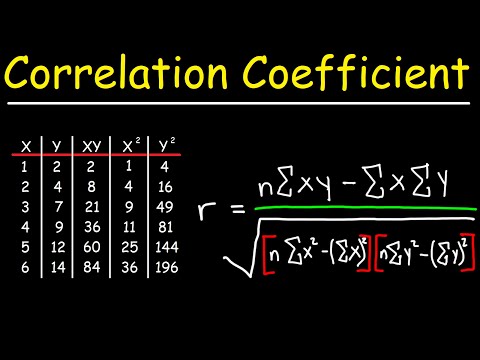
Correlation Coefficient
Introduction and Overview
In this video, the speaker discusses how to calculate the correlation coefficient between two variables. The correlation coefficient measures the strength of the linear relationship between variables.
Understanding Correlation Coefficient
- A positive correlation coefficient (r = +1) indicates that as one variable increases, the other variable also increases.
- A negative correlation coefficient (r = -1) indicates that as one variable increases, the other variable decreases.
- When points are close to a line but not exactly on it, the correlation coefficient will be somewhere between 0 and 1.
- The closer the points are to the line, the closer r is to 1. If points are scattered away from the line, r is closer to 0.
No Apparent Correlation
- When there is no apparent correlation between variables, r can be close to zero.
- Randomly scattered points indicate a weak or no linear relationship.
Calculation of Correlation Coefficient
The speaker demonstrates how to calculate the correlation coefficient using a table of values for x and y.
Steps for Calculation
- Create a table with columns for x, y, product of x and y, x squared, and y squared.
- Fill in values for x and y based on given data.
- Calculate products of x and y by multiplying corresponding values.
- Calculate squares of x and y values separately.
- Sum up each column in the table.
- Plug in these sums into the formula for calculating r.
Formula for Correlation Coefficient Calculation
- The formula for calculating r is:
Calculation Example
- Given values:
- x: 1, 2, 3, 4, 5, 6
- y: 2, 4, 7, 9, 12, 14
- Calculate the sums:
- Sum of x values = 21
- Sum of y values = 48
- Sum of xy products = 211
- Sum of x squared values = 91
- Sum of y squared values = 490
- Plug in the sums into the formula to calculate r.
Conclusion
The correlation coefficient measures the strength and direction of the linear relationship between two variables. It can be calculated using a formula that involves summing up various components derived from a table of data. The resulting value of r indicates whether there is a positive or negative correlation and how strong it is.
Getting Rid of Numbers
The speaker discusses the process of eliminating numbers in a calculation.
Eliminating Numbers
- The speaker suggests getting rid of the numbers in the calculation.
Calculation Steps
The speaker explains the steps involved in a calculation.
Calculation Steps
- Multiplying 6 by 211 gives us 1266, and multiplying 21 by 48 gives us 1008.
- Multiplying 6 by 91 gives us 546, and squaring 21 gives us 441.
- Multiplying 6 by 490 gives us 2940, and squaring 48 gives us 2304.
Subtraction
The speaker introduces subtraction as the next step in the calculation.
Subtraction
- Now it's time to subtract.
- Subtracting 1266 from 1008 gives us a result of -258.
- Subtracting 546 from 441 gives us a result of -105, and subtracting 2940 from
2304 gives us a result of -636.
Calculating R Value
The speaker calculates the R value based on previous calculations.
Calculating R Value
- So far, we have an R value of 258 divided by the square root.
- Multiplying 105 by 636 gives us a result of 66780.
- Dividing 258 by the square root of 66780 gives us an R value of approximately 0.998.
Conclusion
The speaker concludes that the high R value indicates a strong positive linear relationship between the x and y variables in the problem, suggesting that as x increases, y also increases.