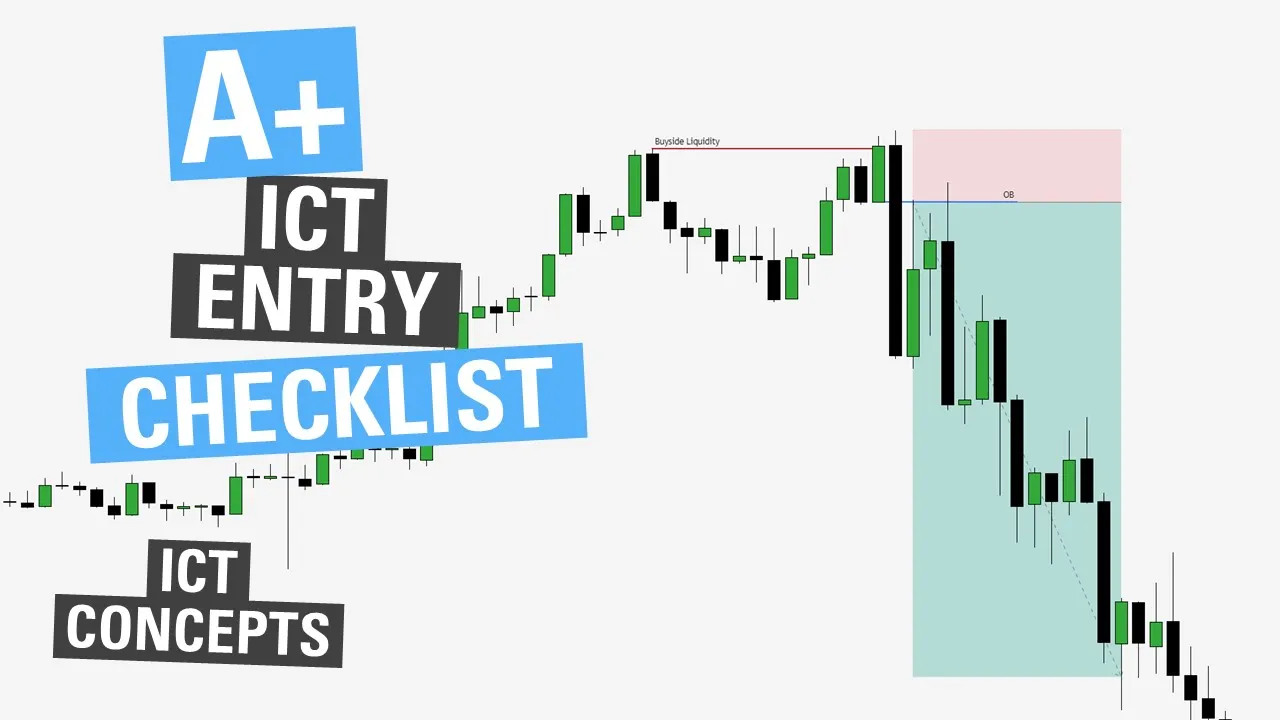
A+ ICT Entry Checklist - ICT Concepts
Introduction
The speaker introduces the video and explains that it will cover their A+ ICT entry checklist.
A+ ICT Entry Checklist
- The speaker has a daily bias or direction before using the checklist to ensure all requirements are met before taking an entry.
- The first thing the speaker focuses on is a stop raid, which means that a low was put in before it was rated or broken.
- The next thing the speaker looks for is a market structure shift or displacement, which means that a previous high was broken and aggressively moved over.
- The speaker also looks for price to move back into a discount of this price range, some sort of PD array, fair value gap, order block, OTE in this area as well as breaker block.
Blending Concepts
The speaker discusses how they blend different concepts together for their personal strategy.
Examples of Blended Concepts
- For example, the speaker will look for a fair value Gap in an optimal trade entry or use the box set up in an optimal trade entry. There are many different ways to blend these concepts; they do what catches their eye the most.
Example 1: NASDAQ on 15 Minute Chart
In this section, the speaker provides an example of how they use their A+ ICT entry checklist on NASDAQ's 15-minute chart.
Key Points
- Sell-side liquidity resting right here as price moves into that level you can see we get a nice reaction out of it however have we shifted structure yet no with this next candle we have shifted structure so we have that sell side liquidity or stop rate our shift in structure.
- The speaker narrows down their discount range to their OTE right in here.
- The speaker looks for a fair value gap, which they have a very small one right here as well as an order block and then breaker block.
- For the entry, the speaker would personally be looking to enter the trade right here with their stop on this low first partial here and then looking for buy-side liquidity up here.
Example 2: ES on 1 Minute Chart
In this section, the speaker provides another example of how they use their A+ ICT entry checklist on ES's 1-minute chart.
Key Points
- The speaker notices that we have our buy-side liquidity resting here that we were taking we have a move up there in an aggressive move off of that so if we're looking at this structure we have a high low higher high so what I notice here is this breaker block.
- The next thing the speaker notices is what is within that breaker block and they see a fair value Gap resting right there so what they'd like to see is price return to this breaker block and at most into this fair value Gap.
- If the speaker was just going to take the breaker block entry it would look something like this; however, if they were going to narrow that down to the fair value Gap, it would look something like this.
- For the entry, if they were too partial and reach for those lows talked about earlier, it would look something like this.
Identifying Trade Setups
In this section, the speaker discusses how to identify trade setups by looking for a PD array in an OTE or premium. They also discuss marking out FIB and identifying breaker blocks and fair value gaps.
Identifying Trade Setups
- Look for a PD array in an OTE or premium.
- Mark out the FIB.
- Identify breaker blocks and fair value gaps.
Example of a Trade Setup on 5-Minute Chart
In this section, the speaker provides an example of a trade setup on a 5-minute chart. They discuss how to identify an order block and enter on it while targeting a new low.
Example of a Trade Setup on 5-Minute Chart
- Identify an order block.
- Enter on the order block while targeting a new low.
Displacement Move Up Criteria
In this section, the speaker discusses their criteria for displacement move up. They explain that they prefer to have a stop rate prior to displacement move up.
Displacement Move Up Criteria
- Prefer to have a stop rate prior to displacement move up.
Retest of Manipulation for Distribution
In this section, the speaker discusses retesting manipulation for distribution. They explain that they are looking for accumulation manipulation and want to see distribution before reaching for the other side.
Retest of Manipulation for Distribution
- Look for accumulation manipulation.
- Want to see distribution before reaching for the other side.
Example of a Trade Setup on Daily and 5-Minute Chart
In this section, the speaker provides an example of a trade setup on daily and 5-minute charts. They discuss identifying sell-side liquidity and entering on order block while targeting initial highs from the morning.
Example of a Trade Setup on Daily and 5-Minute Chart
- Identify sell-side liquidity.
- Enter on order block while targeting initial highs from the morning.