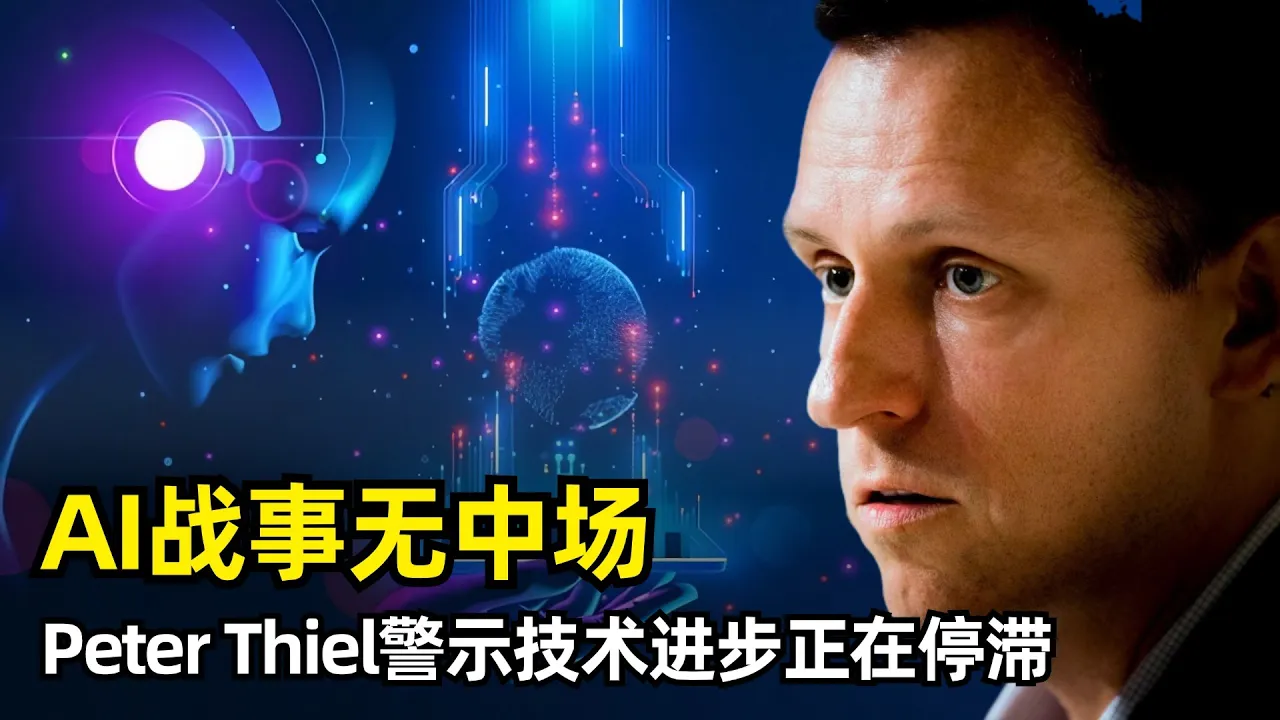
【人工智能】AI战事无中场 | 彼得·蒂尔最新访谈 | 创新停滞 | AI无法真正改变生产力 | 人类的自我约束 | 反乌托邦 | 建造的能力 | 10年窗口期
AI and the Future: Are We Stagnating?
Overview of AI Capital Expenditure
- In 2025, major tech companies like Alphabet, Amazon, Meta, and Microsoft plan to spend approximately $32 billion on AI capital expenditures, a significant increase from $22.3 billion in 2024, marking a growth of about 46% .
- Despite this investment surge, market statistics indicate that the new revenue generated by these companies is less than one-tenth of their investments, raising concerns among investors about a potential AI bubble .
Peter Thiel's Perspective on Innovation
- On June 26th, billionaire Peter Thiel expressed an alternative viewpoint during an interview on "Interesting Times," arguing that the stagnation of technology poses greater risks than advancements in AI .
- Thiel warns that if humanity cannot find a way to "return to the future," society will slowly deconstruct; thus, the real crisis lies not in destruction but in stagnation .
The Cost of Innovation Stagnation
- Thiel emphasizes that we should focus not on the probability of world-ending scenarios but rather on the costs associated with halted innovation .
- He questions whether humanity has truly stopped progressing since around 1970 and notes a shift from rapid technological acceleration to gradual slowdown—termed “The End of Accelerating Change” .
Comparison Between Past and Present Innovations
- If someone from 1985 were transported to 2025, they would likely notice minimal changes aside from electric vehicle brands; many aspects remain similar despite advancements like smartphones being absent at that time .
- While there have been significant developments in digital technologies over recent decades (e.g., computers and internet), progress in physical sciences remains stagnant—illustrated by ongoing challenges such as Alzheimer's treatment and nuclear power plant construction halting .
The Dangers of Complacency
- Thiel argues that societal goals have shifted from actionable plans to mere dreams; he recalls how optimism surrounding radical ideas like cryonics has faded over time .
- He suggests that while AI presents opportunities for advancement, it also signals a lack of progress across other technological fronts. If AI is our last hope for innovation, its effectiveness remains uncertain .
Limitations Imposed by Society
- Many believe intelligent AI can solve complex issues (like cancer); however, Thiel posits that societal limitations stem more from willingness than intelligence. Progress requires investment and cultural courage to take risks .
- He expresses concern over society's reliance on AI as an escape route from responsibility instead of pursuing genuine efforts toward improvement. This reflects a sense of resignation rather than optimism regarding future innovations .
The Illusion of Safety Amidst Decline
- Thiel fears not an apocalyptic scenario due to uncontrolled AI but rather a slow collapse where society loses its ability or desire to enact change—a phenomenon he describes as “a seemingly safe yet crumbling state” ( t =378 s ).
Regulatory Challenges Hindering Progress
- He critiques regulatory bodies like the FDA for impeding drug approvals which stifles biotechnological advancements globally. This regulatory environment fosters collective avoidance of failure rather than ensuring safety ( t =446 s ).
The Need for Action Over Discussion
- Emphasizing action over debate, Thiel laments how today's systems often hinder innovative projects due to excessive bureaucracy. Even brilliant minds may be lost within convoluted processes ( t =489 s ).
Conclusion: A Call for Constructive Change