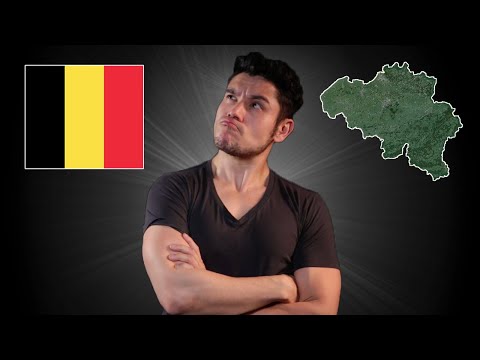
Geography Now! Belgium
The Story of Belgium
In this section, the speaker tells a story about how Belgium came to be.
How Belgium Came to Be
- France had a son named Wallonia and the Netherlands had a son named Flanders.
- Flanders asked Wallonia to be his roommate, and they became roommates.
- This is how Belgium became a country.
Introduction to Belgium
In this section, the speaker introduces Belgium and its flag.
The Flag of Belgium
- The flag looks like the German flag knocked over to the left side but with black-yellow-red colors.
- The black represents determination, yellow represents generosity, and red represents bravery and strength.
Location and Regions of Belgium
- Belgium is located in Europe under the Netherlands and northeast of France.
- It is divided into three regions - Dutch-speaking north region called Flanders, French-speaking south region called Wallonia, and bilingual capital Brussels.
- Each region is then divided into five provinces each making it ten provinces in total.
Complicated Divisions of Regions in Belgium
In this section, the speaker explains how complicated it can get when dividing regions in Belgium.
Divisions within Regions
- Brussels doesn't count as either Flanders or Wallonia but functions as a third region that's bilingual.
- There are French administrative centers in southeast/southwest regions of Flanders and a Walloonian municipal exclave in the west Flanders province.
- The Flemish have one municipal exclave in the Liège Province in Wallonia called "Voeren".
- There are technically five German exclaves hidden along the border of the Liège province in east Belgium.
Baarle Nassau / Hertog
- In this town, there are 22 Belgian enclaves in the Netherlands and eight Dutch enclaves in Belgium. Seven of which are counter-enclaves or part of the Netherlands in Belgium.
Conclusion
In this section, the speaker concludes by summarizing what was covered about Belgium.
Summary
- Belgium is divided into three regions - Flanders, Wallonia, and Brussels.
- The flag has black-yellow-red colors representing determination, generosity, bravery, and strength.
- Divisions within regions can get complicated with French administrative centers and German exclaves.
- Baarle Nassau/Hertog has Belgian enclaves in the Netherlands and Dutch enclaves in Belgium.
The History of Belgium
This section covers the history of Belgium and how it was divided between two regions.
The Division of Land
- Henry I Duke of Brabant gave land to Godfried II of Schoten to build an alliance.
- Henry's land became Belgium and Godfried's became the Netherlands.
- To this day, the two countries have stayed true to their agreements.
The Lys Rivièr River
- The "Lys Rivièr" River is in the border between the Walloon province of "Hainaut" and France.
- It zigzags for about 26 km with multiple river islands and land pieces that act like pene-enclaves.
- Each side has seven enclaves each along the river.
Landscape and Economy
This section covers the landscape, environment, and economy of Belgium.
Landscape
- Mostly flat with farms and forests outside cities.
Environment
- World Wide Fund for Nature ranks Belgium low in terms of environmental performance.
- Water quality was lowest in EU due to high population density.
Economy
- Revenue comes from machinery, pharmaceuticals, diamonds, service, and industry jobs.
Belgian Identity
This section covers the identity of Belgium and its people.
Ethnicity
- Slight majority of people are Flemish from Flanders.
- Terms "Flemish" and "Walloon" are more in reference to linguistic communities than ethnicities.
- About 77% of the people identify as ethnically Belgian.
Origin
- Largest groups include Moroccans, Italians, Turks, and Congolese from the Democratic Republic of Congo.
The Complexity of Belgium
This section covers the complexity of Belgium's government structure.
Regions and Communities
- Belgium has three distinct regions - Flanders, Wallonia, and Brussels.
- Due to German-speaking minority, a semi-mediary third community was created with its own government.
Government Structure
- Each language group has its own government with just as much power as the central government.
- French and Dutch communities provide cultural and social services to citizens in Brussels but not in other regions.
Monarchy
- Belgium became a constitutional monarchy that started in 1830
Belgium: A Quick Overview
This section provides a brief overview of Belgium, including its famous surrealist artists, national dish, and international affiliations.
Famous Belgian Contributions
- Rene Magritte, the Smurfs, and Tintin are some of the world's most renowned surrealist artists from Belgium.
- Mussels with French fries and mayonnaise is the national dish.
- Belgians claim that fries originated from their country.
- Waffles are another popular Belgian food item.
- Belgium produces some of the best chocolate in the world that rivals Switzerland.
International Affiliations
- After gaining independence from the Netherlands, Belgium quickly rose to become one of the leading powers of industrialized Europe and was a founding member of both the EU and NATO.
- The UK played a pivotal role in Belgian independence and remains a good friend to this day. The US also commemorates their role in liberating Belgium during WWII through events like "The Battle of Bulge."
- France is not only culturally resonant with southern Walloon region but also played a role in Belgian independence. The Netherlands jives well with Flanders region despite having somewhat friendly rivalry over time.
- Luxembourg is seen as like the little brother of Belgium and has been there since very beginning even for short while part of it after their independence; their monarchies are cousins too (Philippe I & Grandduke Henry).
Conclusion
This section concludes by summarizing how confusingly politically engineered Belgium is as a country yet has managed to stay together for almost 200 years.
- Belgium is disputedly the most confusing politically engineered country in all of Europe.
- Despite the sense of nationalism being weak, they still can't seem to let go of each other for some weird reason.
- In conclusion, it makes no sense how they have kept together for almost 200 years but they actually did somehow.
Next Destination: Belize
This section briefly mentions that Belize is the next destination and plays music.
- Belize is coming up next!
- Music